
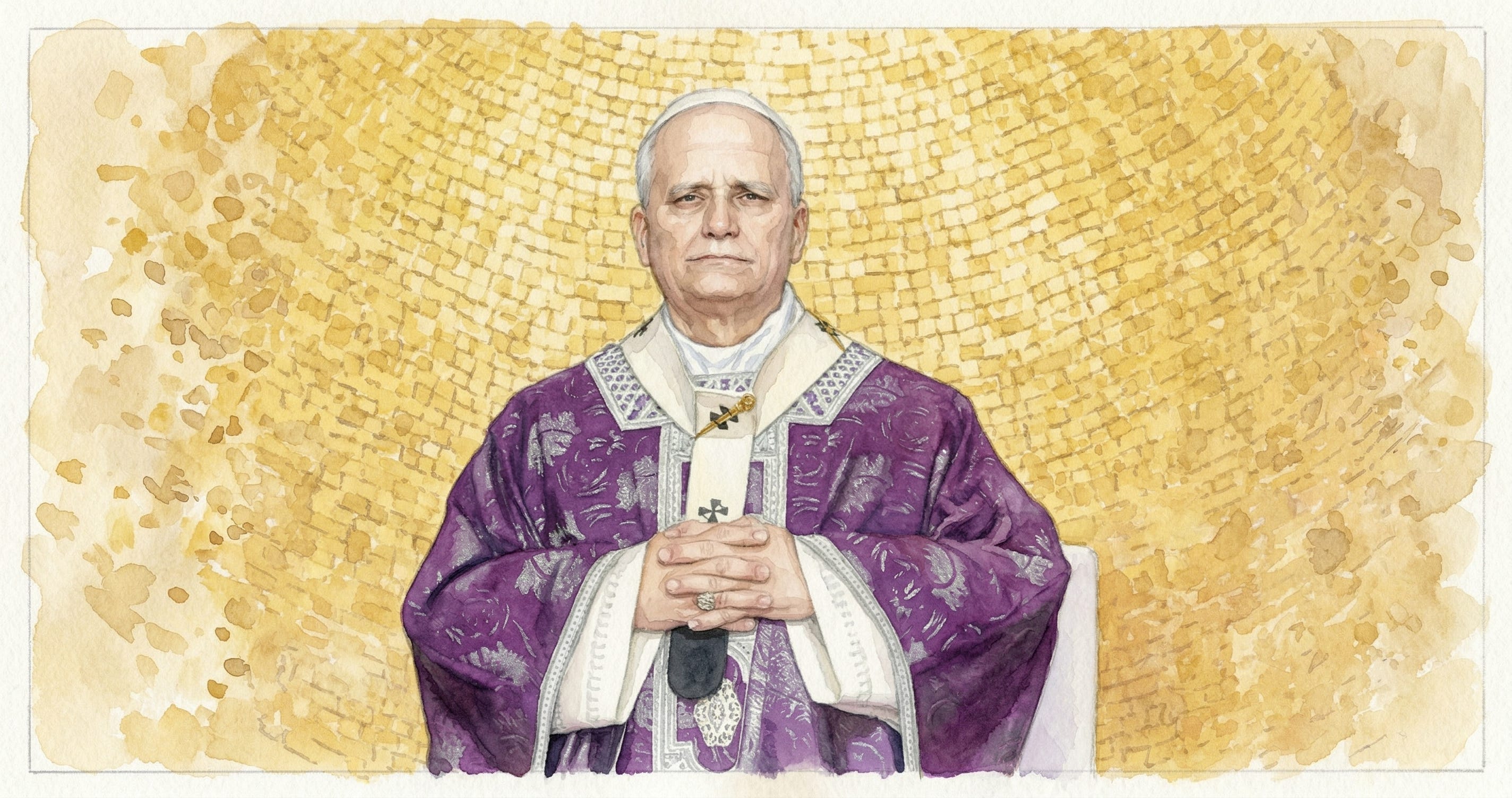
“The Small Make History” — Pope Leo XIV Tells Monaco’s Billionaires to Reject War and Greed
The first papal visit to Monaco in nearly five centuries delivered a pointed rebuke of greed, war, and the logic of profit. The pope told the world's wealthiest principality that self-giving — not accumulation — is the meaning of life.
Dear friends,
Pope Leo traveled to the richest square mile on earth today and said what the wealthy rarely hear from anyone, let alone a pope: your prosperity belongs to the poor. Your smallness is a gift only if you spend it on justice. The logic of profit as an end in itself is a spiritual dead end.
At Letters from Leo, we stand with Pope Leo XIV and the millions of Catholics around the world who believe that the Gospel makes demands on the powerful — that wealth hoarded while children starve is a sin, that bombing civilians offends the God who made them, and that the structures sustaining both deserve to be named and dismantled.
This is why Letters from Leo exists. In a moment when greed is celebrated, war is monetized, and the gap between the privileged and the rejected grows wider by the day, this community refuses to look away.
We are Catholics and people of goodwill who believe that the Church’s social justice teaching is not an abstraction — and that a pope who speaks it plainly to billionaires deserves a movement at his back.
If you believe that matters, I am asking you to join us.
If you’d like to invest in our mission, here are three ways you can help this Lenten season:
Subscribe as a paid member to receive exclusive posts about the life and formation of Pope Leo and help sustain this community.
Donate with a one-time gift to fuel this project’s mission.
Share this post (and Letters from Leo) with a friend who might enjoy it.
Paid subscribers get access to our ongoing biographical series, Pope Leo’s Life & Formation, exclusive in-depth writing, including The Epstein-Bannon Investigation, and curated collections in our full archive.
Whether you give $0, 5, $50, $500 or more, your presence here matters — no matter your faith or your politics.
Thank you for reading. I’ll see you on the road.
On Saturday morning, Pope Leo XIV’s helicopter lifted off from the Vatican heliport and landed forty minutes later in the Principality of Monaco — a two-square-kilometer city-state on the French Riviera where one in three residents is a millionaire, personal income tax does not exist, and the average apartment sells for more than $5 million.
He became the first pope to set foot in Monaco since Paul III visited in 1538, nearly five centuries ago.
He did not come to admire the yachts.
Pope Leo stood on the balcony of the Prince’s Palace alongside Prince Albert II and denounced what he called “unjust configurations of power, structures of sin that dig chasms between poor and rich, between the privileged and the rejected, between friends and enemy.”
He told the residents of one of the world’s most exclusive addresses that their prosperity carries an obligation:
“The gift of smallness and a living spiritual heritage invite you to put your prosperity at the service of law and justice, especially at a historical moment when displays of force and the logic of omnipotence wound the world and jeopardise peace.”
Pope Leo presented Prince Albert with a mosaic of St. Francis of Assisi — the patron saint who famously renounced his inheritance to live among the poor — a gift whose symbolism needed no translator in a principality built on sheltering fortunes.
Leo’s phrase — “structures of sin” — is borrowed from Pope John Paul II’s 1987 encyclical Sollicitudo Rei Socialis, where it described the institutional systems that perpetuate poverty and exploitation.
He was speaking to a nation whose entire economic model is built on attracting the ultra-wealthy through tax exemptions, and he was telling them that the accumulation of wealth without redistribution is a religious problem, not merely a political one.
The day unfolded across four events, each sharpening the same moral blade. At the Cathedral of the Immaculate Conception, the pope delivered a homily questioning whether our current economic and social models genuinely promote human dignity, or whether they remain trapped within “the logic of the exchange of equivalent things and profit as an end in itself.”
He called the Church to communion — not the comfortable kind that asks nothing, but the radical kind rooted in the Gospel that demands we see Christ in the face of the dispossessed.
At the Church of Saint Devota, he met thousands of young people and spoke about what actually gives a human life its weight. “What gives solidity to life is love,” the pope said — “first and foremost, the fundamental experience of God’s love, and then — as a reflection of that — the illuminating and sacred experience of mutual love.”
He told the young Monegasques that this love “demands fidelity, constancy, and a readiness to make sacrifices in the daily rhythm of life.” The meaning of life, in other words, is not what Monaco’s economy is designed to produce. Self-giving, not self-enrichment, makes a person whole.
“Good is stronger than evil,” he told them, “even when, at times, it may seem — in the immediate moment — to be getting the worst of it.”
The afternoon turned to war.
At the stadium Mass in Louis II, where 18,000 people gathered on the pitch where AS Monaco normally plays its home matches, Pope Leo turned his homily into an extended meditation on war and the sacredness of human life.
He urged the faithful to “proclaim the gospel of life, hope and love” and to “bring the light of the gospel to everyone, so that the life of every man and woman may be defended and promoted.”
Then he spoke directly about the wars consuming the world outside Monaco’s borders: “Let us not grow accustomed to the clamor of weapons and images of war.”
That line — “let us not grow accustomed” — carried the weight of a pope who has watched the global conscience go numb. He pressed further: “Every life cut short wounds the body of Christ.”
And he defined peace in terms that rejected the geopolitical calculus of deterrence and power projection: “Peace is not merely a balance of power; it is the work of purified hearts, of those who see others as brothers and sisters to be protected, not enemies to be defeated.”
The stadium seemed to fall quiet during those passages.
Pope Leo has spent the early months of 2026 waging a sustained moral campaign against the Trump administration’s war in Iran, calling for an immediate ceasefire, with the Vatican’s top officials declaring the conflict a violation of Catholic just-war teaching, and calling for the permanent abolition of aerial bombing.
The Monaco homily did not name the United States or any specific conflict. The pope did not need to. When you tell 18,000 people that every life cut short wounds the body of Christ, the congregation fills in the names of the dead on its own.
What makes this visit remarkable is the setting.
Monaco is not a war zone or a refugee camp. It is the place where the world’s wealthiest people go to avoid taxes. Pope Leo chose it for his first European trip of the pontificate because the Gospel has something to say to the comfortable, too — and what it says is uncomfortable.
“In the Bible, as you know, it is the small who make history,” the pope told the crowd at the Palace. The humble, not the powerful — the people who give themselves away rather than hoard what they have.
This is a pope shaped by decades of ministry among the poor in Peru, a man who chose his papal name to invoke Leo XIII’s foundational encyclical on economic justice and the rights of workers.
When he stands on a balcony in Monaco and names “structures of sin,” he is drawing on a lifetime of watching those structures crush real people in real places. The words land differently when the speaker has spent his entire pastoral ministry among families with nothing.
The world’s most powerful governments are spending trillions on weapons while millions of Americans lose health coverage. The logic of omnipotence is ascendant.
Pope Leo XIV flew to the playground of the rich and told them the truth most will never tell them: your wealth is not yours alone, your comfort is not innocent, and the only thing that gives life meaning is the willingness to give it away.
Thank you for reading. I’ll see you on the road.


Brilliant, I am so encouraged and inspired by this man and your account of his papacy thus far. Keep shining your light. Lots of love.
To Reflect his words Not reject them Sorry