
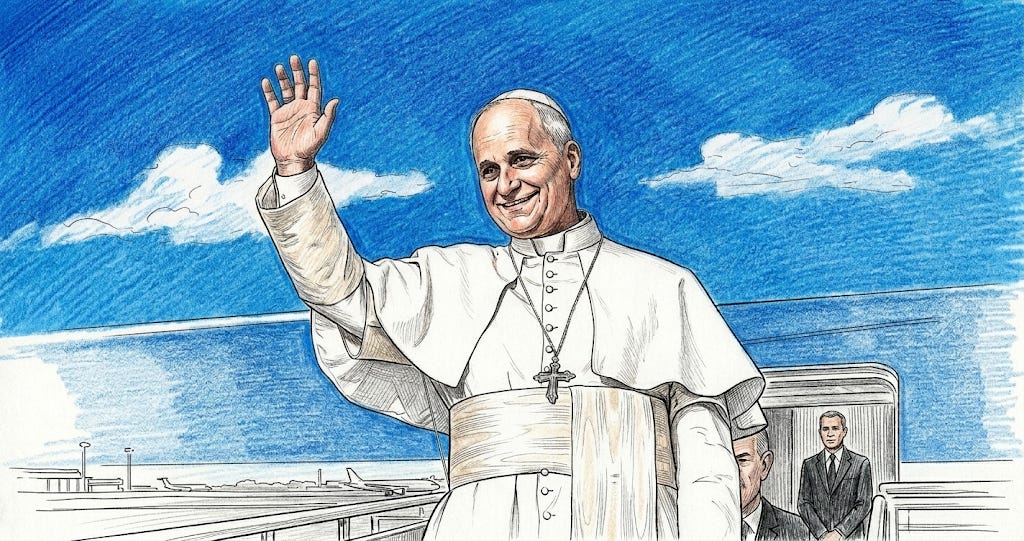
“The World Is in Profound Crisis” — Pope Leo XIV’s Historic Address to Spain’s Parliament Lands on Trump’s 100-Day Iran War
The first pope ever to address Spain’s Congress drew a seven-minute ovation for a speech on dignity, migration, and peace — delivered the same day Israel and Iran traded fire again. The message was aimed well beyond Madrid.
Thank you for reading! Letters from Leo is a reader-supported publication documenting the pontificate of Pope Leo XIV and the fight for human dignity. To receive new posts and support this work, consider becoming a free or paid subscriber.
Pope Leo XIV addressed the Spanish parliament on Monday afternoon, the first pope ever to speak from the floor of the Congress of Deputies in Madrid.
When he finished, the chamber rose. The ovation ran nearly seven minutes, and cries of “Long live the pope!” rang off the walls of a legislature in one of Europe’s most secular countries.
Seven hundred guests had gathered under tight security to hear the first American pope speak to Spain’s political class. He gave them a lesson in moral philosophy, albeit in a secular political setting.
The setting carried its own weight. This was the first papal visit to Spain in fifteen years, in a country that has drifted far from the Church and split hard along political lines.
Prime Minister Pedro Sánchez, who leads a secular left coalition, sat in the chamber. His government has moved to compensate the victims of clergy abuse, even as it clashes with the bishops over abortion and euthanasia. A pope entering that room could have been received as an intruder, yet Sanchez’s deputies gave him seven minutes on their feet.
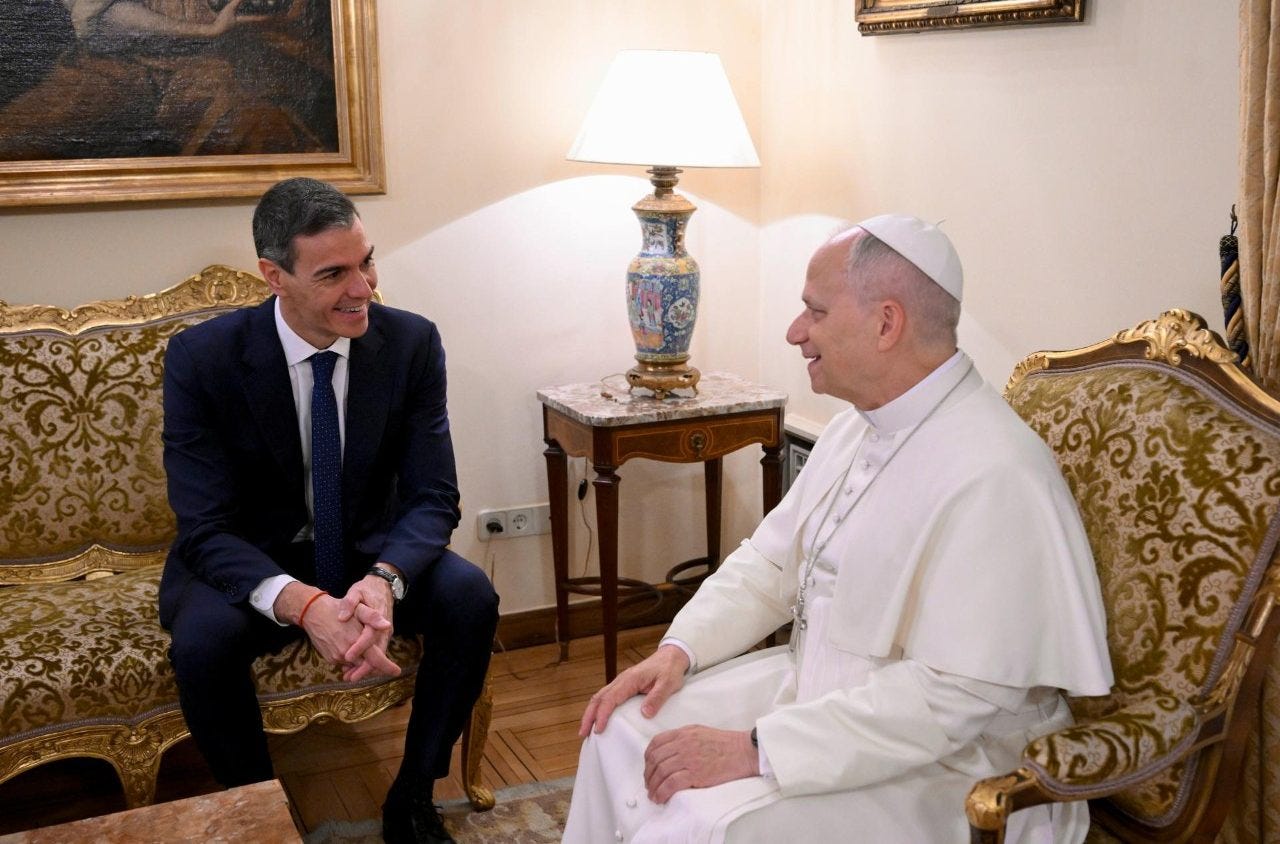
Leo built the speech around a single question he traced back five centuries to the University of Salamanca: what conception of the human person inspires a society’s laws, and what kind of society do those laws then build?
From there he moved through the fault lines that run across Spain and much of the West — the dignity of the unborn and the dying, the rights of migrants, the limits of state power over conscience.
That breadth was not improvised. The thread running from the unborn child to the dying patient to the migrant on the road is the “consistent ethic of life” — the “seamless garment” that his fellow Chicagoan, the late Cardinal Joseph Bernardin, laid out at Fordham four decades ago, insisting that abortion, war, poverty, capital punishment, and euthanasia are cut from a single cloth.
As Mike Lewis documented at Where Peter Is, then-Cardinal Robert Prevost built an entire 2023 address in Peru around Bernardin’s framework and Cardinal Blase Cupich’s expansion of it into an “ethic of solidarity.” He had carried that argument for years as a cardinal.
On Monday, the national parliament heard it from a pope.
The intellectual backbone of the address came from Salamanca’s great jurists. Leo invoked Francisco de Vitoria and the Dominicans who, as new worlds opened five hundred years ago, insisted that reason “could not be invoked to legitimize whatever force or self-interest seemed convenient.”
Their idea of a totus orbis — a human community wider than any single power — gave Europe the conviction that moral and legal bonds hold between peoples. Leo was reaching back to the founders of international law, and he was doing it for a reason.
On migration, he was just as plain. The drama of people forced to flee, he said, “goes beyond any purely demographic or economic analysis: it constitutes an eminently moral and legal issue,” and he pressed for safe, legal pathways alongside the right of people to remain in their own land.
In a Europe — and an America — busy hardening its borders, the words read as a rebuke.
Then he turned to peace. “The world is undergoing a profound spiritual and cultural crisis,” he told the deputies, “which manifests in multiple forms of violence, polarization, and mutual distrust.” Peace, he said, has stopped being a mere political aspiration and become a moral imperative.
He drove the point into territory no one in the room could mistake. States carry an obligation to settle their disputes “through the peaceful means offered by international law.” Rearmament, now spreading across a nervous Europe, he named a false answer to a fragile hour.
Weapons may impose a temporary silence; but they can never build a genuine and lasting peace.
He spoke those words on June 8 — the hundredth day of a war he has denounced since its first hours.
On February 28, the United States and Israel opened their campaign against Iran by killing Supreme Leader Ali Khamenei and much of his senior command. President Trump assured the country it would be finished in four to six weeks. A hundred days later, the shooting has not stopped, and the war has dragged into its fourth month with no end in view.
That same Monday, while Leo stood in the Congress of Deputies, Israel and Iran exchanged missiles for the first time since their April truce. Talks in which Washington has dangled the release of twenty-four billion dollars in frozen Iranian assets have stalled at a deadlock. Trump keeps announcing that a deal is close. On the ground, the missiles have not stopped.
The address stopped being about Spain alone
This is the moment the speech slipped its Spanish frame.
The pope who seemingly retired the doctrine of “just war” on his flight to Madrid now stood inside a national parliament, telling lawmakers that real security “stems from justice, patient dialogue, respect for international law, and a policy capable of placing the lives of peoples above the interests that profit from war.”
He named the machinery of modern conflict without flinching. Drawing on Magnifica Humanitas, the first encyclical of his pontificate, Leo warned that the spread of artificial intelligence into the military sphere “demands rigorous ethical oversight, so that decisions regarding life and death are never left to automated systems nor removed from the moral responsibility of the human person.”
For a pope who has spent the last few months confronting Silicon Valley and the Pentagon over autonomous weapons, the line was aimed far past the skylight above his head. He has already demanded that Trump end the Iran war, and he used the machinery of Vatican diplomacy to make the point unmistakable.
The Salamanca jurists built a moral architecture for relations among nations; Leo was charging the most powerful country on earth with tearing it down.
The same logic, in two rooms
Monday was a relentless day for Leo in Madrid — the bishops in the morning, the historic turn before parliament in the afternoon, and a private meeting with abuse survivors before the day was out. The schedule would have taxed a man half his age.
Hours before he reached the Congress, Leo sat with Spain’s bishops and refused to let them turn from their own failures. The sexual abuse of children by clergy he called a “scourge,” a wound the Church has not finished closing. He told the bishops to answer it with “listening, truth, justice, reparation and an ever more determined commitment to prevention and a culture of care.”
His insistence carried weight because of how long it had gone unspoken. For years, the Spanish hierarchy minimized the abuse in its own ranks, until an investigation by the newspaper El País and a damning report by Spain’s national ombudsman forced a public reckoning over decades of assault and concealment.
Leo told the bishops that every wounded person “must be able to find sincere listening, welcome, protection and real paths to healing,” and he framed the work ahead as a pilgrimage — an inner Camino, in his image, whose only true destination is God.
The lunch that followed showed a lighter side. Leo broke the ice by telling the bishops that he had asked an artificial-intelligence chatbot what the pope should say to them, and it had answered as though Pope Francis were still in the chair, until he reminded it there was a new pope.
Then he turned the joke into his charge to them: the Church runs on “another algorithm,” he said, one that “leads us to love people, to accompany them, and to become servants of the word.”
The words came with an act. Later that Monday, Leo spent about an hour at the apostolic nunciature with six survivors of clergy abuse drawn from Spain’s reparation plan.

It did not satisfy everyone. Several survivor associations said they had been left in the dark and gathered for a small protest outside the embassy, warning that one hand-picked group could not stand in for every victim.
And then there was Bad Bunny. The Puerto Rican superstar had opened his European tour in Madrid just as Leo arrived, and the speculation that the two might meet has only grown louder.

Cardinal José Cobo, the archbishop of Madrid, has called an encounter “possible” and spoken of building “bridges”; city officials have floated a live video link between Leo’s Mass and the singer’s stadium. The pope has cheerfully conceded the “stiff competition” — generous, given that Bad Bunny’s ten-night run is drawing crowds that dwarf his own.
One moral logic ran through both rooms that day. Power answers to the people it can wound. The abused child, the migrant on a dangerous route, the unborn, the civilian beneath the bombs — each belongs at the center of the moral account rather than at its edges, and a society reveals its greatness in how it treats the lives least able to defend themselves.
None of this stayed in Madrid. Leo is the first pope from the United States, and his words carry home in a way no foreign pontiff’s ever could. A warning about the throwaway culture that discards the unborn and the elderly lands squarely inside America’s own arguments.
His indictment of a war that enriches the powerful while burying the poor reads, from this side of the Atlantic, as a verdict on the Trump administration.
Leo closed by asking the deputies to lift their gaze — to remember that “every decision by public authorities affects real people, especially those who have less power to make their voices heard.” Alongside technical fixes and legal reforms, he said, a society needs moral renewal.
The seven-minute ovation says the lawmakers in Madrid heard him. Whether the men prosecuting a war in his name, four months in and still unfinished, are listening at all is the harder question — and the one that will decide how this papacy is remembered.
At Letters from Leo, we stand with Pope Leo XIV and the millions of Catholics — along with countless others of goodwill — who refuse to accept a world where the powerful write the rules and the vulnerable pay the price. The pope carried that conviction into the Spanish parliament this week. It animates everything we publish.
This is the fastest-growing Catholic community in the country because people are starving for something deeper than rage and spin.
They want courage, they want clarity, and they want a faith that acts. At a moment when a war grinds into its fourth month while the language of dignity is drowned out by the noise of power, that hunger has rarely been sharper.
If you believe this movement matters — Catholics and people of goodwill standing for human dignity against the cult of force — I am asking you to join us.
If you’d like to invest in our mission, here are three ways you can help during this critical time:
Subscribe as a paid member to receive exclusive posts on the life and formation of Pope Leo and help sustain this work.
Donate with a one-time gift to fuel this project’s mission.
Share this post (and Letters from Leo) with a friend who might need it.
Paid subscribers make this work possible, and they get the full archive: the biographical series on Pope Leo’s life and formation, the investigations, and the ongoing coverage of his confrontation with the warhawks and the AI giants in Pope Leo Takes On AI.
Whether you give $0, $5, $50, $500, $1,000, or more, your presence here matters — no matter your faith or your politics.
Thank you for reading. I’ll see you on the road.


Always great coverage on our Beloved Pope Leo!
I love this Man