
Trump-Vance White House Escalates Holy Week Assault Against Catholic Church
A judge forced ICE to open the doors. On Holy Thursday, four priests washed the feet of fourteen detained migrants. The next morning, the Pentagon excluded Catholics from Good Friday services.
Thank you for reading! Letters from Leo is a reader-supported publication. If you find value in my work, please consider becoming a paid subscriber.
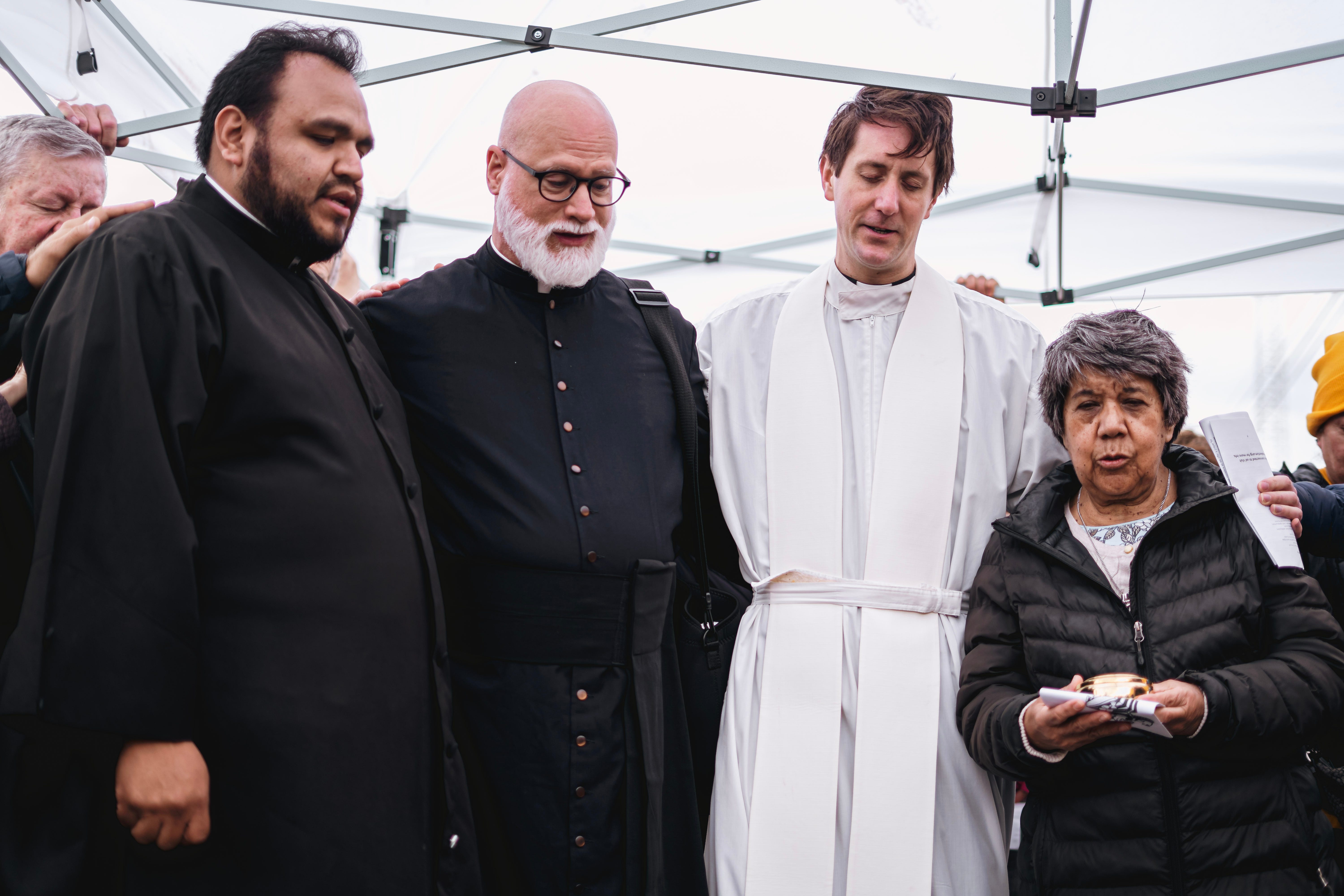
On Holy Thursday afternoon, Father Juan Vargas knelt on the floor of the Broadview Immigration and Customs Enforcement processing facility west of Chicago and washed the feet of a man in shackles.
Sister Alicia Gutierrez, SH, distributed Communion. Father David Inczauskis, SJ, and Father Paul Joseph Keller, CMF, offered pastoral care to thirteen other detained migrants wearing handcuffs and ankle chains. Outside, fifty Catholic faithful stood in rain and heavy wind, praying the Rosary and singing, waiting for the pastoral delegation to emerge.
None of this was supposed to happen. The Trump-Vance administration spent five months trying to prevent it.
The next morning — Good Friday — the Pentagon sent an email to more than 3,500 employees: “Just a friendly reminder: There will be a Protestant Service (No Catholic Mass) for Good Friday today at the Pentagon Chapel.” A Pentagon spokesperson confirmed it.
When HuffPost’s Jennifer Bendery followed up, a Pentagon spokesperson confirmed: “The Protestant service is the only service scheduled in the Pentagon chapel today.”
No Catholic service of any kind. Catholics do not celebrate Mass on Good Friday — the liturgy for the day is the Celebration of the Lord’s Passion, a solemn rite in which the faithful venerate the crucifix and receive Communion.
Hegseth’s Pentagon offered nothing for them. The Department of Defense hosted a Protestant Good Friday service at the nation’s military headquarters and confirmed that Catholic worship was excluded entirely.
In the span of twenty-four hours, two arms of the Trump administration told the Catholic Church that its worship is either a security threat or simply unwelcome.
The Broadview story is the one with a victory in it, so let me start there.
The chain of events began on October 11, 2025, when ICE denied clergy entry to the Broadview facility.
Three weeks later, on November 1, agents turned away Auxiliary Bishop José María García-Maldonado and eight spiritual leaders — including Sister JoAnn Persch — who had come to bring Communion to detained migrants.
The Trump-Vance White House then banned prayer vigils on the facility grounds entirely.
Pope Leo XIV responded three days after the November 1 denial.
Speaking to reporters as he left Castel Gandolfo on November 4, the pope called on American authorities to allow pastoral workers to attend to the spiritual needs of detained migrants.
He grounded his appeal in Matthew 25, the passage where Christ asks how we received the foreigner — and where the judgment of nations hinges on the answer. The White House ignored him.
The Coalition for Spiritual and Public Leadership, a Chicago-based Catholic coalition of over sixty parishes, universities, religious orders, and community organizations, filed suit in federal court.
Judge Robert Gettleman of the Northern District of Illinois took the case. On February 18, he issued a preliminary injunction permitting clergy to enter Broadview on Ash Wednesday.
Four detainees received Communion and ashes without a single security incident, and the facility’s own staff reported zero problems with the visit.
That uneventful Ash Wednesday demolished the administration’s core argument — that clergy access posed an unacceptable security risk — with the simplest possible evidence: it had already been tried, and nothing went wrong.
On March 20, a federal judge in Minneapolis granted clergy access to ICE detainees at the Whipple Building, establishing a second jurisdiction where courts refused to let the executive branch wall off pastoral care.
Eleven days later, on March 31, Judge Gettleman issued the order that opened Holy Week at Broadview. He found that the government had “substantially burdened” the plaintiffs’ religious exercise under the Religious Freedom Restoration Act and the First Amendment, citing the 1976 Supreme Court decision in Elrod v. Burns: the loss of First Amendment freedoms, even for minimal periods of time, constitutes irreparable injury.
The Department of Homeland Security argued that Broadview is a processing office, not a detention facility, and that religious services were available at permanent facilities elsewhere.
Judge Gettleman was unpersuaded. “With reasonable notice and communication, addressing legitimate security and safety concerns, allowing plaintiffs to provide pastoral care to migrants and detainees does not pose any undue hardship,” he wrote.
He ordered clergy access from April 2 through April 5 and directed ICE and the Department of Justice to negotiate an ongoing schedule for pastoral care. The order laid the groundwork for permanent access.
Father Vargas described what happened inside the facility on Holy Thursday: “This is what it means to move mountains. That’s how our prayer can make miracles happen. That’s what the Eucharistic table shows us.” Father Inczauskis offered a fuller account.
“It was heartbreaking to see them wearing handcuffs and to see them also wearing shackles on their feet,” he said, “but then to see as Sister Alicia was offering Communion and as Father Juan on his knees to wash their feet, to see how much it meant to those people — to see the consolation, the meaning, and the care that they were receiving in a moment of humanization and a recognition of their fundamental human dignity given by God in a situation of such torment and oppression.”
Father Keller reported that the facility staff were cooperative throughout. “I asked them specifically as we finished our time, did this flow well? Was there any inconvenience?” he said. “And they said there was none at all. The hope is that this continues on a regular basis because there’s no reason for it not to continue.”
Now consider the Pentagon’s Good Friday email alongside the Broadview fight, and the pattern sharpens into focus. Defense Secretary Pete Hegseth has been hosting evangelical worship services at the Pentagon for months.
He brought Pastor Doug Wilson to the Pentagon auditorium in February — a pastor whose vision of a Christian America would outlaw public Masses, Marian processions, and Corpus Christi devotions. Roughly a quarter of the U.S. military identifies as Catholic. Hegseth’s Pentagon runs their worship services and then excludes them from Good Friday observance.
This exclusion arrives at a moment when the Church’s senior military leader, Archbishop Timothy Broglio of the Archdiocese for the Military Services, has declared the Iran war unjust under Catholic just war doctrine.
Broglio told CBS that Hegseth’s invocation of Jesus Christ to justify the war is “problematic” and counseled Catholic service members to “do as little harm as you can, and to try and preserve innocent lives.” The administration’s response to Catholic moral authority — whether it comes from Archbishop Broglio on war, from Pope Leo on migrants, or from clergy at the doors of a detention center — has been consistent: shut it out.
The moral stakes of this Holy Week demand clarity. According to research from the United States Conference of Catholic Bishops and World Relief, eighty percent of those affected by immigration enforcement in this country are Christian, and sixty-one percent are Catholic.
Donald Trump and JD Vance have blocked clergy from entering ICE facilities and banned prayer on federal property outside detention centers.
The defense secretary hosts evangelical worship at the Pentagon while excluding Catholic Mass on Good Friday, and the pastor he invited to preach there wants to ban Catholic processions in America.
Pope Leo XIV invoked Matthew 25 in November and asked how this nation receives the foreigner. The question carries juridical weight, and at Broadview, a federal court has now answered it in the Church’s favor.
The victory at Broadview belongs to the clergy who refused to stop showing up — to the Coalition for Spiritual and Public Leadership, to the lawyers who built the RFRA case, to the fifty faithful who stood in the rain on Holy Thursday while the delegation ministered inside.
Pastoral delegations will enter the facility again for Good Friday, Holy Saturday, and Easter. The court has ordered ongoing negotiations for permanent access. Two federal jurisdictions — Chicago and Minneapolis — have now ruled that the government cannot substantially burden religious exercise by sealing off detention facilities from the Church.
But the Pentagon has no Judge Gettleman. Catholic service members received an email today telling them their faith does not merit a service on the day their Lord died.
The administration that claims to champion religious liberty has spent this Holy Week blocking the Eucharist from shackled migrants and barring the Mass from the Pentagon.
Father Vargas washed a detained man’s feet on the floor of a federal building yesterday. The Gospel of Matthew says Christ will remember. This administration should consider whether it wants to be remembered for what it did to his Church during the holiest week of the year.
At Letters from Leo, we stand with the clergy at Broadview, with the Catholic service members at the Pentagon, and with every person of faith who has watched this administration treat the Church’s pastoral mission as an obstacle to executive power. In this Holy Week — when Christ himself was detained, mocked, and abandoned by the state — the parallels are not abstract.
They are playing out in ICE facilities and military chapels across this country.
This is the fastest-growing Catholic community in the country because people are hungry for a faith that refuses to be silent when the powerful try to lock God out of the room.
That hunger has never been more urgent than it is right now, in a Holy Week where the government blocked the Eucharist from shackled migrants and told Catholic soldiers their Mass is unwelcome.
If you believe this movement matters — Catholics and people of goodwill standing for human dignity against an administration that treats the Church as an enemy — I am asking you to join us.
If you’d like to invest in our mission, here are three ways you can help this Holy Week:
Subscribe as a paid member to receive exclusive posts about the life and formation of Pope Leo and help sustain this work.
Donate with a one-time gift to fuel this project’s mission.
Share this post (and Letters from Leo) with a friend who might enjoy it.
Paid subscribers get access to the full Pope Leo’s Life & Formation biographical series, exclusive investigations including The Epstein-Bannon Investigation, the complete Lenten Reflection Series, and the full Best Of archive.
Whether you give $0, $1, or $1,000, your presence here matters — no matter your faith or your politics.
Thank you for reading. I’ll see you on the road.


Am I to understand that the detainees were shackled while having their feet washed?
Did any staff participate in the ceremony as they did on Ash Wednesday?
Unbelievable by the Pentagon!