


Thank you for reading! Letters from Leo is a reader-supported publication. If you find value in my work, please consider becoming a paid subscriber or making a one-time donation.
When Pope Leo XIV addressed the crisis in Venezuela at his Jan. 4 Angelus, he pointedly insisted that “the country’s sovereignty” be safeguarded along with the rule of law and rights of all citizens.
It was a clear caution amid the U.S.-led removal of Venezuelan President Nicolás Maduro.
That built on his December remarks urging the United States not to invade Venezuelan territory.
Yet the official statement issued by U.S. Ambassador to the Holy See Brian Burch conspicuously omitted any mention of that sovereignty warning.
Instead, Burch’s Jan. 5 release portrayed the pope only as “praying for peace in Venezuela” and urging a future built on “cooperation, stability, and harmony,” implicitly framing Leo’s words as backing Washington’s policy — particularly the unilateral invasion of Venezuela to ouster Maduro.
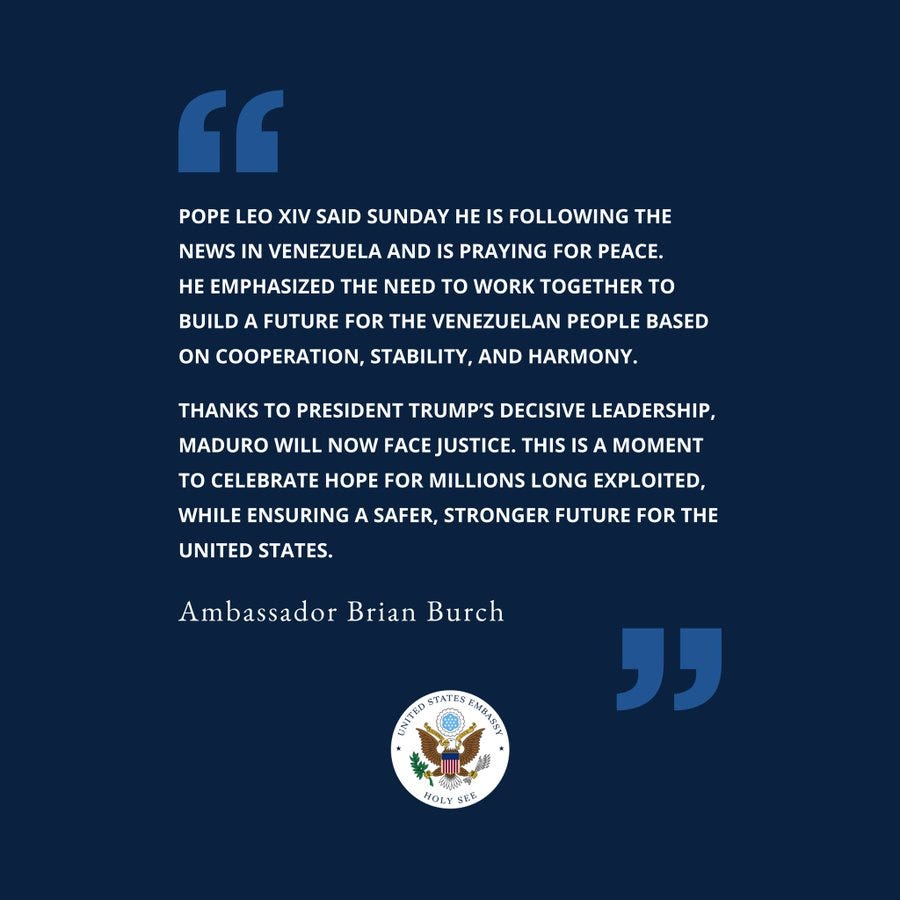
By highlighting only the pope’s calls for peace and unity, Burch cast Leo’s stance as broadly supportive of U.S. actions, while sidestepping the pontiff’s explicit and consistent critique against the foreign intervention.
The omission is striking given that Pope Leo’s Angelus appeal — “the good of the beloved Venezuelan people must prevail… overcoming violence and embarking on paths of justice and peace, safeguarding the country’s sovereignty” — directly tempered any endorsement of regime change. Burch’s selective framing thus purposely presented a partial narrative at odds with the pope’s full message.
An Unprecedented Break in 42 Years of American-Vatican Diplomacy
Burch’s handling of the Pope’s remarks is without precedent in the 42-year history of formal American-Holy See relations.
Since the U.S. and Vatican established ties in 1984, American ambassadors — regardless of administration — have publicly acknowledged when papal views diverged from U.S. policy. They might downplay disagreements, but they have not pretended consensus where it doesn’t exist.
For example, during the 2003 Iraq War, Pope John Paul II was an outspoken opponent of the U.S.-led invasion. Rather than gloss over this, U.S. Ambassador Jim Nicholson plainly admitted the split: “Well we clearly had a disagreement over Iraq. The pope said no to war.” Nicholson went on to respectfully explain the differing perspectives, but crucially, he did not erase the pope’s dissent.
Under President Obama, envoys likewise made a point to recognize areas of tension. Miguel Díaz, Obama’s first ambassador to the Holy See, affirmed that “it’s normal to have differences” on issues like abortion, even as he emphasized common ground; he “does not downplay the continued differences… on issues such as abortion [and] embryonic stem cell research.”
His successor Ken Hackett was similarly transparent. “There’s no doubt that Francis and Obama differ on issues such as abortion rights and gay marriage,” Hackett said ahead of a 2014 meeting between the pope and president, even as he noted both sides would focus on shared goals.
In each case, prior ambassadors navigated disagreements by acknowledging them openly — not by implying the pope was fully on board with U.S. policy.
Burch’s decision to elide Leo XIV’s reservation about Venezuelan sovereignty marks a distinct break from this diplomatic norm of candor.
A Partisan Activist Turned Ambassador
Part of what sets Brian Burch apart is his unusual background for a Vatican envoy. Burch is a co-founder of CatholicVote, a conservative political advocacy group that actively supported Donald Trump’s campaigns.
Unlike previous ambassadors, who were often seasoned public servants or non-partisan civic figures, Burch came into the role as an avowed right-wing activist whose organization endorsed Donald Trump two times.
He has even been a vocal critic of Pope Francis, Leo XIV’s predecessor.
In 2023, Burch accused Francis of a “pattern of vindictiveness” and publicly catalogued grievances against the pontiff — such as objecting to Francis’ off-the-cuff remark that Catholics need not breed “like rabbits.”
This history of partisan and papal criticism is unprecedented for a U.S. ambassador to the Holy See.
Burch’s activist instincts may help explain his approach in the Venezuela episode. By spinning Pope Leo’s words to align with U.S. objectives, Burch appeared to prioritize defending the administration’s narrative over faithfully representing the pope’s full position. Diplomatically, it is a risky approach.
The Holy See values frank dialogue, and past envoys earned trust by showing respect for the pope’s viewpoints — even when those diverged from Washington’s.
Burch is the first envoy with a resume of open political combat and papal critique, and his Venezuela statement underscores how that background is translating into a more combative posture in Vatican diplomacy.
Notably, Burch’s statement was released immediately after Pope Leo XIV held a private meeting in Rome with Cardinal Christophe Pierre, the Vatican’s apostolic nuncio (ambassador) to the U.S.
Here’s what happened and why it matters.
