
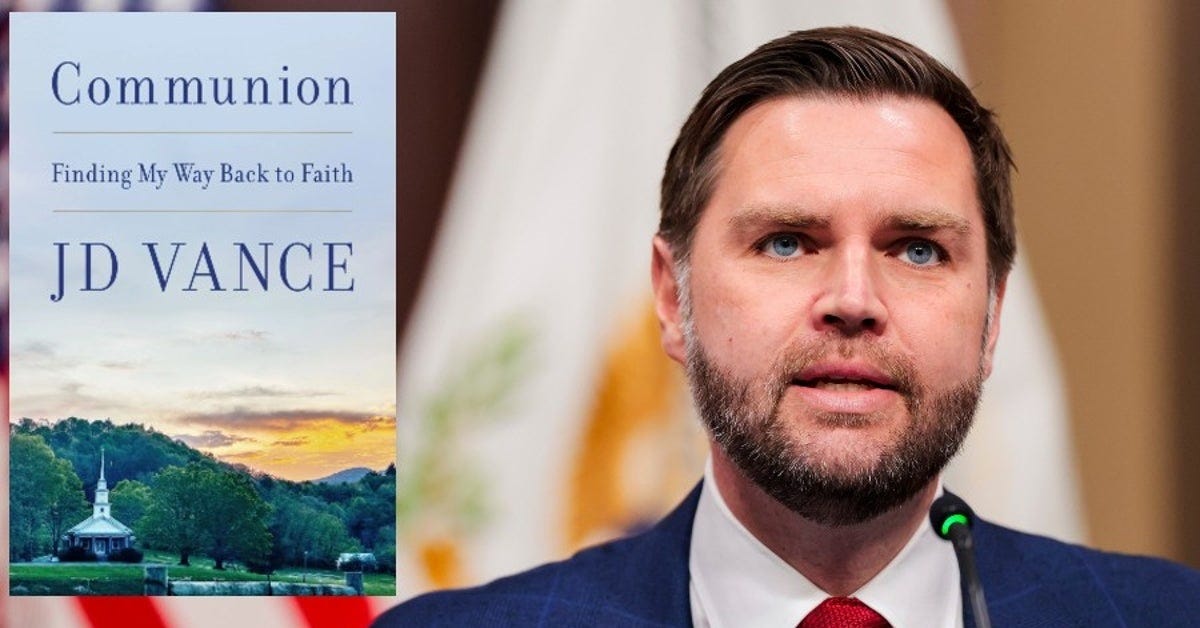
Two Popes Already Corrected JD Vance. Now He’s Written 304 Pages About Finding God.
“Communion” arrives from Harper this week — and the convert who lectured Francis and Leo XIV is underwater with the very Catholics the GOP sent him to win.
Thank you for reading! Letters from Leo is a reader-supported publication. If you find value in my work, please consider becoming a paid subscriber or making a one-time donation.
Anyone who has read me for a while knows that JD Vance and I are not friends — at least not right now.
We got into a public spat back in November that made national headlines, after I called out the White House for dismissing Pope Leo’s plea for migrants and the vice president came after me on X.
So I picked up his new book braced for the worst and read it with as much good faith as I could muster. I came away with a few things the book gets right and a long ledger of things it gets wrong.
Vice President JD Vance did not enter the Catholic Church the way most converts do. He bypassed the OCIA process most parishes run and was received in 2019 under the private direction of two conservative Dominican priests — a route as bespoke as the political identity he would later build on it.
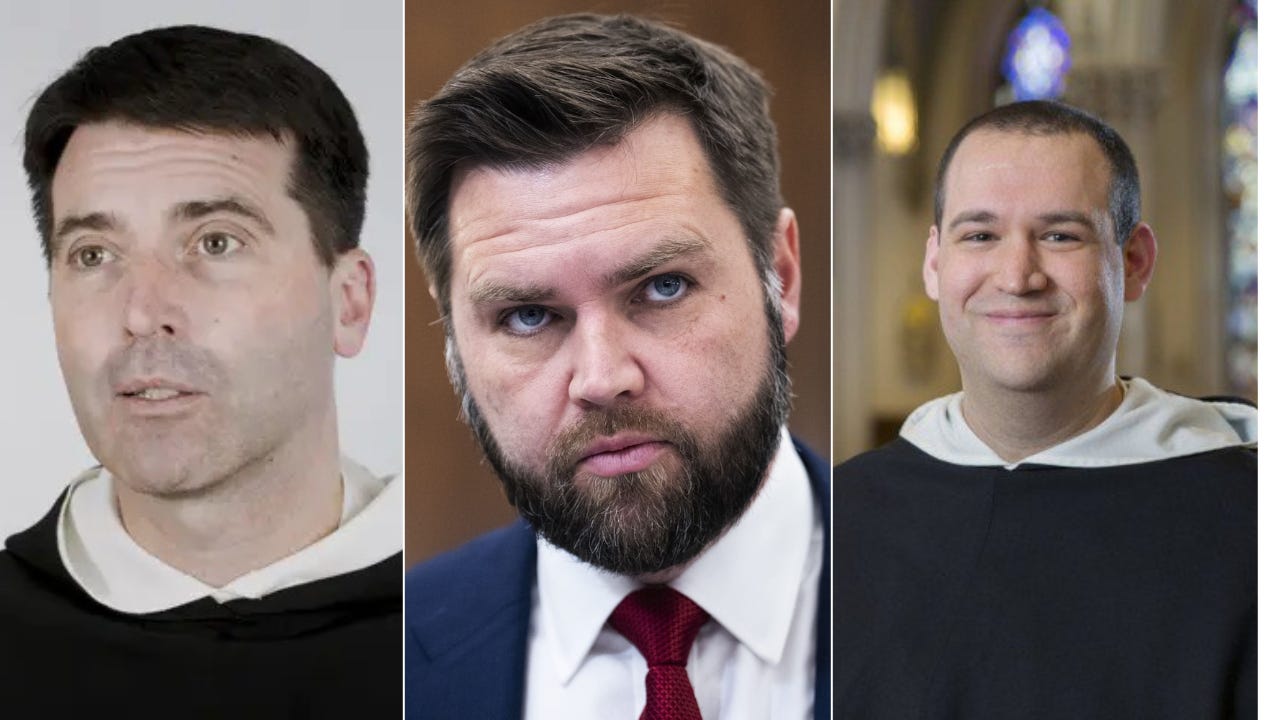
His new memoir, Communion: Finding My Way Back to Faith, is the account he wants the country to have of that journey. The men who guard the faith he joined keep telling him he has it wrong.
The book arrives from Harper this week, 304 pages tracing his path from the Protestantism of his Appalachian childhood, through an atheism he built on Ayn Rand, and into Rome. Candidates publish these before they run, and Vance — the presumptive front-runner for the Republican nomination in 2028 — has given his the shape of a manifesto for religion in public life.
Some of it lands. He writes with feeling about his mamaw, whose death drained the Christianity out of his youth, and about a rain-slicked road where his car stopped short of a guardrail in what he calls the closest he ever came to a supernatural experience.
After a fellow Marine handed him Ayn Rand, he became, in his telling, a “self-professed atheist and meritocrat.” He puts the creed plainly: “I didn’t care about God’s will. I cared about my own.”
The turn back came through people. He recalls deciding, after meeting Usha in law school, “I will marry this girl. Or I will be a lifelong bachelor.” A 2018 visit to a French cathedral with Usha and their son Ewan softened his ambivalence about religion into “a distinct sense of belonging and presence,” and he was baptized the next year.
He also credits Peter Thiel.
Vance describes leaving a Thiel lecture convinced he had met “possibly the smartest person I’d ever met” — a man who “identified very openly as a Christian” and so “defied the simple social template I had constructed, that dumb people were religious and smart people were atheists.” Thiel, who would become one of his earliest political patrons, helped break the spell Rand had cast. Thiel was one of the figures who drew him back toward the Church, though not the only one.
What the memoir omits is what Thiel has since become. In private lectures I reported on, Vance’s chief benefactor cast Pope Leo XIV as a tool of the Antichrist, mocked him as a woke American pope, and counseled Vance to disregard the pope on questions of morality altogether. The man Vance credits with his return to Christianity now treats the head of Vance’s Church as an enemy of human progress.
Then there is everything the book gets wrong. The cover of a memoir about becoming Catholic shows Mount Zion Church in Elk Creek, Virginia — a United Methodist congregation. The trouble does not stop at the art department.

Vance writes that Pope Francis was scheduled to celebrate the Easter Mass on the morning the two men met at the Vatican in 2025. The Vatican had said otherwise for days. Francis was too ill to preside; the Holy See had made clear that a cardinal would offer the Mass in his place, and Cardinal Angelo Comastri did, while Francis managed only a brief Urbi et Orbi blessing from the loggia. Francis died the next morning.
In his own account of that meeting, reported this week, Vance found the encounter with Francis and the Vatican’s diplomats “unsettling,” their words “trite platitudes” and “clichés.” The officials struck him as “too diplomatic” and “too abstract to be helpful,” unwilling to argue specifics about what divided Washington and Rome. He was careful to exempt the popes themselves — he gave Francis, and later Leo, more credit for being direct and blunt with him than he gave the Vatican writ large.

What divided them was immigration. Vance writes that he was “struck that one of the few institutions with the moral authority and global perspective to address the migration question seemed so afraid of saying something controversial that it chose, effectively, to say nothing at all.”
That sentence is the confession underneath the memoir. A convert of a few years sat across from the Holy See, heard its refusal to bless a deportation regime, and read that refusal as cowardice.
The Church had not gone quiet. It had already told him no — to his face, and from the chair of Peter.
Two months before that Easter meeting, Vance reached for ordo amoris, the ordering of love, to claim that Christians owe their countrymen before they owe the stranger, and that this medieval idea licensed mass deportation. Francis answered in a letter to America’s bishops: Christian love is not a concentric expansion of self-interest, and the true ordo amoris builds a fraternity open to all, without exception.
Here is what the book leaves out, and what I first reported and CNN’s Christopher Lamb later confirmed: the cardinal who helped Francis author that rebuke was Robert Prevost, the man who would become Pope Leo XIV. Vance was corrected by two popes in a single letter before he ever knew it.
The ordo amoris fight was not the only time Vance bent the Church to fit his politics.
A year ago, he went on national television and accused the bishops of backing immigrants for the money, charging that the U.S. Conference of Catholic Bishops cared more about the “over $100 million” it received to resettle refugees than about the refugees themselves — worried about “their bottom line” rather than “humanitarian concerns.”
It was false. Cardinal Timothy Dolan said so to his face and later recounted the exchange: the charge was “not only untrue, it was scurrilous,” and Vance apologized, telling the cardinal, “That was out of line and that’s not true.”
Vance has since tried to walk it back, telling the Washington Post he “didn’t recall exactly what he said” to Dolan and recasting the rebuke as a caution that the bishops’ “financial interests” should not “cloud” their judgment.
JD Vance lied about the Catholic Church, a conservative cardinal made him own it, and now he wants it both ways.
Then Francis died, and the cardinals elected an American. Pope Leo XIV took up his predecessor’s defense of the Church’s teaching on war, peace, and the dignity of migrants. Donald Trump answered with a running campaign against the new pope — falsely claiming Leo had blessed Iran’s pursuit of a nuclear weapon, attacking him over Venezuela, over immigration, over a war Leo called unjust.
“I have no fear of the Trump administration,” Leo said. Vance had a choice in that moment: defend the first American pope, or join the pile-on. He joined the pile-on.
At a Turning Point USA event in Georgia, he instructed the Successor of Peter to be “more careful when he talks about matters of theology,” lectured a pope who holds a doctorate from the Angelicum on “a thousand-year tradition of just war theory,” and told him to keep to morality and stay out of policy.
The bishops answered him. Through Bishop James Massa, the U.S. Conference of Catholic Bishops’ Committee on Doctrine wrote that when Pope Leo speaks as supreme pastor of the universal Church, he is not floating opinions — he is preaching the Gospel and exercising his ministry as the Vicar of Christ. A convert had presumed to school the Vicar of Christ on the boundaries of his office.
A man who lectures two popes inside a single year, and lies about an entire bishops’ conference, is telling you something true about himself. Francis rebuked him and Leo rebuked him, and he kept going.
Vance built a public identity on his Catholicism — the audiences with Francis, the Latin references, the rosary aesthetics that delight a certain precinct of the online right. Communion is the fullest expression of that project, and a running record of the distance between the faith he performs and the faith its shepherds teach.
The book is careful about other things it leaves out, too. Communion has nothing to say about the meetings Vance presided over in the White House Situation Room — a room built for national security — to manage the fallout from the Jeffrey Epstein files, first reported by the New York Times and now the subject of a House Oversight demand for his testimony. A memoir about the examined life skips the chapters its author would rather forget.
The Catholics he was sent to deliver have read the distance clearly. A Navigator survey taken this month put Pope Leo’s net favorability among Catholics at plus fifty-seven. Vance’s stood at negative twelve — a sixty-nine-point gap, with the very Catholics the Republican Party hoped he would bring home.
Here is the irony the book cannot escape. Vance wrote a memoir to prove his faith is real, central, and hard-won, and the men charged with guarding that faith keep telling him, first gently and then plainly, that he has missed its opening demand.
The Gospel does not rank the stranger last. The Church Vance joined exists, in no small part, to insist otherwise — at the border, in the holding cell, in the letter a dying pope wrote about how love is ordered.
He called the book Communion. Communion is also what a Catholic enters when he hands his private judgment over to the body of Christ instead of lecturing that body on where it has gone soft.
Vance gave 304 pages to finding his way back to faith. The harder road — the one his book keeps approaching and never walks — ends in obedience to a Church that has already told him, more than once, where love begins.
Letters from Leo stands with the Catholics and people of goodwill who believe the Gospel means what it says about the stranger, the migrant, and the poor — and who refuse to let any politician dress cruelty in the language of the faith.
This is the fastest-growing Catholic community in the country because people are hungry for something deeper than performance and grievance.
If you believe that hunger is worth feeding — that human dignity does not stop at a border or a poll number — I am asking you to join us.
If you’d like to invest in our mission, here are three ways you can help during this critical time:
Subscribe as a paid member to receive exclusive posts about the life and formation of Pope Leo and help sustain this movement.
Donate with a one-time gift to fuel this project’s mission.
Share this post (and Letters from Leo) with a friend who might enjoy it.
Paid members make this work possible — the biographical series on Pope Leo’s life and formation, the Epstein-Bannon Investigation, The Pope Takes on Silicon Valley, and the Sunday Scripture Reflection Series.
Whether you give $0, $5, $50, $500, $1,000, or more, your presence here matters — no matter your faith or your politics.
Thank you for reading. I’ll see you on the road.


JD Vance lost me when he said Pope Leo XIV should “be careful” when he talks about theology. I trust Pope Leo’s knowledge of theology a whole lot more than JD Vance’s knowledge of Catholicism.
Vance did not actually have the Appalachian childhood he claimed in his Hillbilly Elegy. He grew up in a suburban setting, two generations removed from Appalachia.