
“Welcoming, Protecting and Assisting Immigrants” — Pope Leo XIV’s Birthday Letter Says the Words Trump’s Speeches Would Not
Dated June 25, the pope’s letter for the semiquincentennial calls welcoming immigrants a recognition of God-given dignity. When Trump’s two speeches turned to today’s newcomers, he saw only a “communist menace.”

Letters from Leo is the fastest-growing Catholic community in the country — a movement for human dignity in the face of authoritarianism. On America’s 250th birthday weekend, I am asking you to join us.
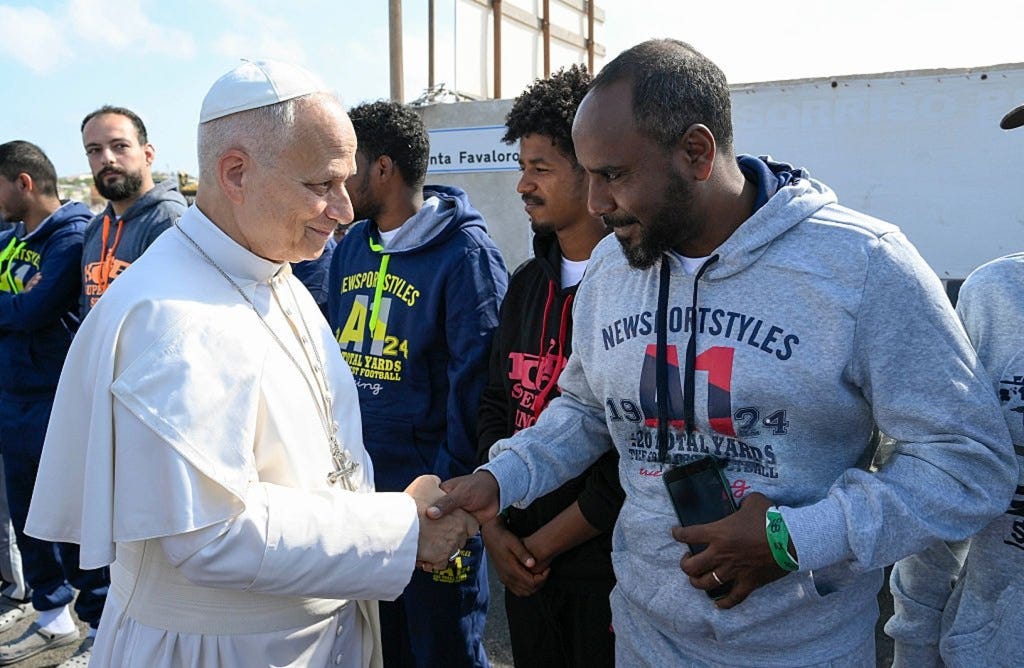
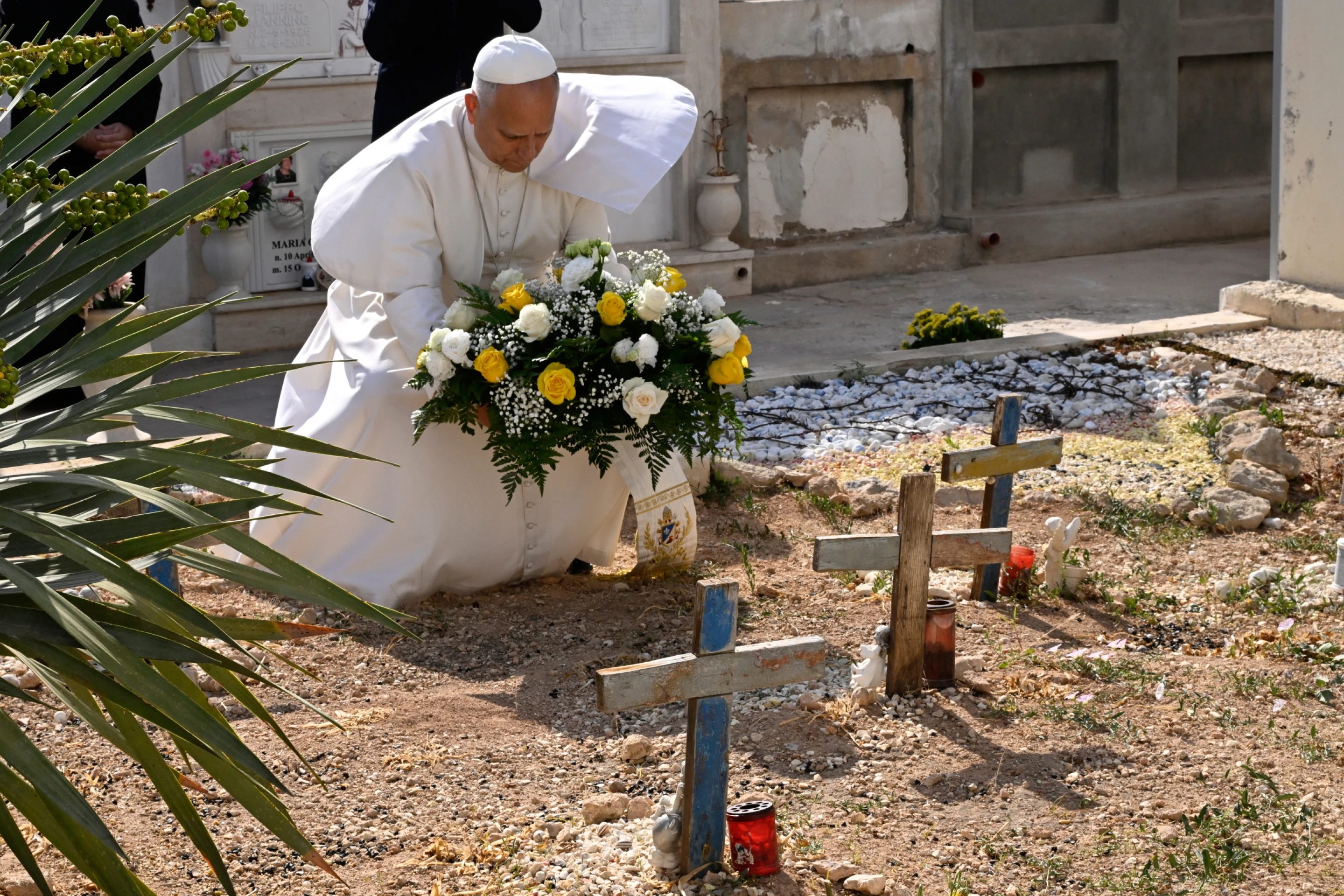
Pope Leo XIV spent the 250th birthday of the United States on Lampedusa, an eight-square-mile Italian island that sits closer to Africa than to the Italian mainland, laying a wreath over the graves of migrants who drowned trying to reach Europe.
Donald Trump chose different scenery. The president saluted “the most successful, most accomplished, most exceptional nation ever to exist in human history” beneath the floodlit faces of Mount Rushmore on Friday night, and on Saturday — after lightning forced a roughly two-hour evacuation of the National Mall — he took the stage in Washington late that night to declare the American republic “the crowning achievement of human history” and America itself “a nation of winners.”
Between the island and the stages sits a letter, and the letter is what this weekend will be remembered by.
Dated June 25 and released for the semiquincentennial, Pope Leo’s letter to the American people congratulates the nation on two and a half centuries of “liberty, equality, the pursuit of happiness, justice and democratic self-government.”
Religious freedom stands among “the most cherished” of the founding principles, he writes, and the Catholic Church’s long service to the nation’s schools, hospitals and poor flows from that same freedom.
Near the letter’s center, Leo turns to human life — every person “endowed with an inherent worth that calls for reverence, protection and care.”
“Defending human life also includes welcoming, protecting and assisting immigrants, whose hopes, sacrifices and contribution have formed part of the history of this country from its very beginning,” he writes. To receive them with compassion and generosity “is not only an act of charity, but also a recognition of the dignity that belongs to every human person.”
Leo closes with a line from his encyclical Magnifica Humanitas: “No one can single-handedly bear the weight of the challenges the world is facing.”
That letter arrived in a country where ICE agents detained a Texas nun walking to Mass — and over a holiday weekend when the president, speaking of the people still arriving on our shores, described a threat.
“There is now a resurgence of the communist menace in our land, including from newcomers to our country who embrace ideas totally opposed to our way of life and our great success,” Trump said at Mount Rushmore. Communism, he told the crowd, is a greater threat to the country than World War I, World War II, Pearl Harbor “or even 9-11.” Then he gave the menace a roster: “The Communist Party is made up of illegal immigrants, criminals, and everybody that doesn’t want to work.”
The Mount Rushmore speech does hold a place of honor for immigrants — in the past tense. Trump praised the “bravest, boldest, and most resilient” whom the old world once sent to these shores, a tribute reserved for arrivals long dead. The living received a condition instead: “You do not have to be born here, but you do have to love what we have built.”
Saturday’s address on the Mall dropped the subject entirely. The word “immigrant” appears nowhere in the transcript. In its place came a demand for proof of citizenship at the ballot box, another warning about communists — “It’s like a cancer. You got to cut it out. You got to cut it out fast” — and a promise: “We will always be on top. We will never let our country fall. We will always be the best.”

The president did brush against the pope’s theology once. “As our Declaration of Independence tells us, we are all made in the image of one Almighty God,” he said Saturday, inside a passage celebrating rights extended “to citizens of every race, religion, color and creed.”
Read that sentence carefully, and one word does all the work: citizens. Trump’s July 4 draws the boundary of the divine image at the border. Leo refuses the boundary altogether, insisting on a worth that belongs to every person before any state exists to certify it.
On the morning of the Fourth, the first American pope walked hand in hand with migrant children at Lampedusa’s Porta d’Europa, the stone monument that greets the boats.
He prayed in the island cemetery where crosses cut from shipwrecked hulls mark the graves of children who drowned within sight of the continent. At the port, the pier received a new name in honor of Pope Francis, who chose Lampedusa for his first trip outside Rome in 2013 and warned there of “the globalization of indifference.”
Before an open-air Mass of roughly 4,000 people, with an image of Our Lady of Safe Harbor beside the altar, Leo preached on the Good Samaritan and called the waters around the island “as dangerous as the one that led down from Jerusalem to Jericho.”

“Here you have seen not just one, but thousands of human beings fallen into the hands of robbers who have taken everything from them,” he said in his homily. “There is no love of God without love of neighbor, and there is no neighbor if I do not draw near.”
I watched him say it. For the first time in my life I marked the Fourth of July outside the United States, and I wrote yesterday about why I decided to spend America’s 250th on this island — and about the Mass Leo celebrated at the water’s edge.
The pope had already spent the eve of the holiday addressing Americans directly. Accepting the Liberty Medal of the National Constitution Center on Friday in a virtual address to Philadelphia — a speech I covered in full — Leo reminded the country that it became “a byword for freedom” because it “opened its doors to successive waves of immigrants, enabling them and their children to play their part in shaping the future of the nation.”
Human dignity, he told the Philadelphia audience, “precedes the establishment of any State,” and its custody “constitutes its very purpose.” He handed America back its own motto — e pluribus unum, out of many, one — and called for a nation “united not by goals bound to momentary endeavors, but by ideals that do not fade with the passing of time.”
And today Leo spoke to his native land a third time, in a video message closing this year’s National Eucharistic Pilgrimage — the procession that set out from St. Augustine, Florida, and crossed many of the original thirteen colonies under the motto “One Nation Under God” to mark the 250th. The pilgrims, he noted, walked a route named for St. Frances Xavier Cabrini, foundress of a religious congregation “whose mission was to care for the spiritual and material needs of poor immigrants.”
Even in a message about the Eucharist, the pope kept the Church’s work among the poor in view — “her charitable service to the wider society, especially in the areas of education, healthcare and basic social services.” Three messages to America across the anniversary weekend, and the stranger stands inside every one of them.
Two patriotisms were on display this weekend. The president’s version needs an enemy to define it — the crown in 1776, the “communist menace” in 2026 — and finds its liturgy in flyovers, floodlights and a 23-minute fireworks show in the Black Hills. Leo measures love of country at the door instead, by what a nation does when the world’s most desperate people come knocking.
Trump has tried before to turn the country against this pope — and lost the argument with the American people. The deeper argument belongs to the rest of us, because the Declaration’s central claim — that all are created equal, endowed by their Creator — either survives contact with a migrant child’s grave or it does not.
The fireworks over the Mall burned out right after midnight. On Lampedusa, the crosses cut from boats that never finished the crossing still stand in the island wind, and the American pope spent his country’s 250th birthday among them — insisting that the people they mourn belong to the very story the fireworks were lit to celebrate.
At Letters from Leo, we stand with the pope who spent America’s 250th birthday at the graves of drowned migrants, and with the millions of Americans — Catholics and countless others of goodwill — who believe the Declaration’s promise of God-given dignity does not stop at a border checkpoint.
In an age that stages its patriotism under floodlights, we remain rooted in a faith that finds a nation’s greatness in mercy — the stranger welcomed, the child mourned, the neighbor drawn near. This is the fastest-growing Catholic community in the country because people are hungry for a love of country deeper than spectacle, and for courage, truth and love made visible in action.
If you believe this movement matters — Catholics and people of goodwill standing for human dignity against the politics of the closed door — I am asking you to join us.
If you’d like to invest in our mission, here are three ways you can help:
Subscribe as a paid member to receive exclusive posts about the life and formation of Pope Leo and help sustain this newsletter.
Donate with a one-time gift to fuel this project’s mission.
Share this post (and Letters from Leo) with a friend who might need it today.
Paid members keep this work alive and unlock the full archive — the biographical series on Pope Leo’s life and formation, the Epstein-Bannon investigation, Pope Leo XIV’s showdown with Silicon Valley, and our Sunday scripture reflections — the work you won’t read anywhere else.
Whether you give $0, $5, $50, $500, $1,000, or more, your presence here matters — no matter your faith or your politics.
Thank you for reading. I’ll see you on the road.


I love the vestments with the blue edges of waves. It looks a little like Mother Theresa's blue-edged veil. And the reference to water is important. Recognizing what we need to keep working on, and that NO one person can solve alone, is the huge issue of migration and immigration, and Climate Change. I am glad he focused on this issue and on how we must be stewards of the Earth and neighbors to other humans.
The dichotomy is definitely distinct.