
Why Did Pope Leo XIV’s Hunger Speech Set Off a MAGA Meltdown?
Because he said access to food is a human right — and a movement that abolished USAID heard an accusation. Cindy McCain’s agency was the backdrop.
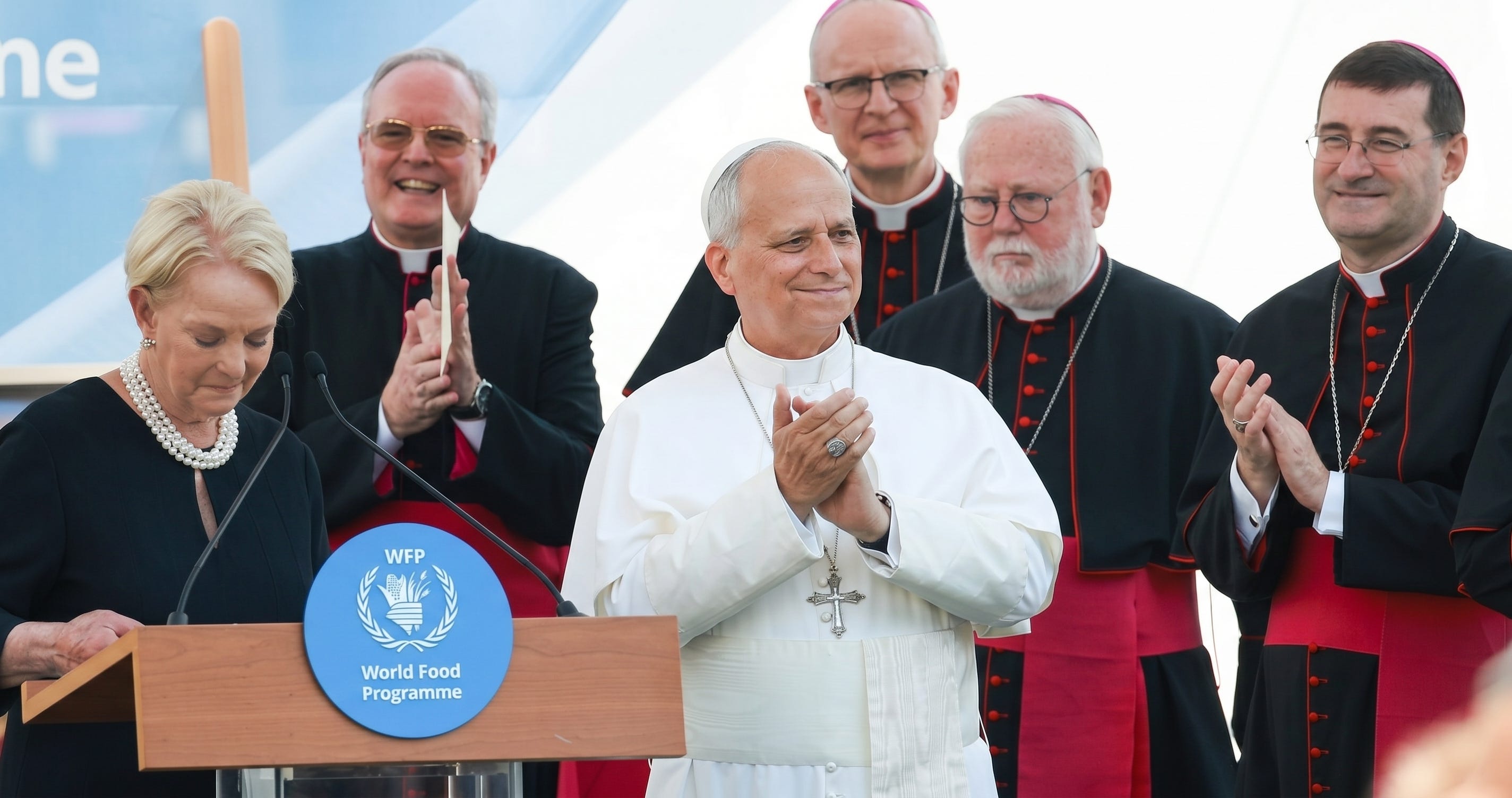
Pope Leo XIV walked into the Rome headquarters of the United Nations World Food Programme on Monday and told the people who run the world’s largest hunger-fighting operation that the global order has learned to feed wars faster than it feeds the starving.
He addressed the agency’s Executive Board at the invitation of its executive director, Cindy McCain. Before he proposed a single solution, he named the disease.
The world, the American pope said in his remarks, has drifted into “the progressive bureaucratization of solidarity alongside the quiet commodification of human life.” The result is a moral arithmetic in which, as he put it, “those who do not generate quantifiable value risk becoming invisible.”
On the remedy he was specific. “It is equally important to resist the commodification of basic human needs,” Leo told the board. “Food, water and healthcare cannot be subordinated to market considerations or geopolitical interests. Access to adequate food is a fundamental human right grounded in the dignity of every person.”
He drew the consequence out plainly.
In the gap between what governments profess and what they fund, he argued, “the human person is no longer consistently placed at the center of international action.”
Borrowing a line from Pope Francis, Leo observed that aid is throttled by “involved and incomprehensible political decisions, skewed ideological visions and impenetrable customs barriers,” while “weaponry is not.”
War, he said, is “fed” more readily than people are nourished.
The timing was not subtle.
Funding for global food assistance has collapsed by roughly 59 percent since 2022, even as need has surged. The largest single cause sits in Washington, where the Trump administration dismantled the U.S. Agency for International Development last year and erased some $60 billion in assistance.
I wrote about those cuts earlier this month in the context of JD Vance’s new book, where the vice president defended slashing foreign aid as an expression of his Catholic faith.
The agency has since restored a share of its WFP support and pledged $800 million last week, though the program’s $10 billion appeal for 2026 remains badly short.
His appeal was concrete.
He pressed governments to increase the resources devoted to fighting hunger and to tear down the obstacles that keep aid from reaching the people who need it. He asked the program to lean on the Catholic Church — its parishes, dioceses, and Caritas agencies — to reach populations that international institutions cannot, and he praised the school-meal initiatives that convert emergency relief into something durable.
Cut the bureaucracy, he urged, so that “transparency and accountability serve people rather than impede assistance.”
The bigger claim sat underneath the logistics: what is at stake, Leo said, is “not only the effectiveness of an agency, but also the credibility of international cooperation itself.” It was the case he carried to the same Rome food agencies last October, when he told the U.N. Food and Agriculture Organization that “the call to walk together, in fraternal harmony, must become the guiding principle.”
Leo never named Donald Trump, and he had no need to. Within hours of the Vatican posting his remarks, the movement that had built itself around the president supplied the rebuttal he had described.
The pope’s account on X drew more than one million views and a wave of contempt from the American right.
Tom Woods, the libertarian commentator, called the address “truly embarrassing” and said the pope has “no understanding of how anything works.”
One commentator dismissed it as “commie gobbledygook,” insisting that access to food cannot be a right because it “depends on the labor of others.”
Another demanded the Church liquidate its assets before lecturing anyone on hunger.
And, finally, MAGA Pizzagate provocateur Mike Cernovich supplied the cleanest distillation of the MAGA mood, connecting Stalin, Mao, and Pol Pot with Pope Leo XIV.
The reaction confirmed the argument.
A worldview that can hear “access to adequate food is a fundamental human right” and answer with the vocabulary of gulags has already decided that some lives generate quantifiable value and others do not.
This is the affront Leo delivered to the Trumpian project, plainly and without apology: a politics that measures the human person against the market will always find a reason to let the hungry stay invisible.
An irony was folded into the setting that the president’s admirers seem not to have noticed.
The agency Leo praised is led by Cindy McCain, the Biden appointee who has run the World Food Programme since 2023 and the widow of Senator John McCain.
Trump spent years degrading her late husband, beginning with the 2015 claim that McCain was “not a war hero” because he had been captured in Vietnam, and carrying the insults past McCain’s death in 2018. The pope chose her house to argue for the dignity of every person, including the ones a president decided were losers.
None of this arrived from nowhere.
Leo built the speech on the foundation of his first encyclical, Magnifica Humanitas, the document on artificial intelligence he released in May. That text was widely read as his reckoning with Silicon Valley — a warning against the commodification of persons and against private corporations amassing more power than the states meant to govern them.
The fight he opened against the tech oligarchy he has now carried into the food line, and the figure at the center is the same human person, refusing to be priced. I wrote earlier this month about his warning that a world cheering Elon Musk toward becoming its first trillionaire would be a world “in big trouble.” The same conviction animates the hunger address, pointed now at a different altar.
He closed where Catholic social teaching always lands.
“Every human person possesses an inherent and inalienable dignity that remains intact regardless of circumstance, condition or social status,” Leo said, a dignity he called infinite because it is rooted in the love of God, so that “nothing can diminish, erase or deny its value.”
The measure of any politics, he told the board, is its fidelity to that truth, and with it the future of the international community.
It is a standard the loudest voices in American politics cannot meet, and on Monday, a pope from Chicago said so to their faces.
At Letters from Leo, we stand with the hungry that the global order has trained itself to overlook, and with a pope who refuses to let the market decide whose life carries value.
Leo named the sickness in front of the very people paid to manage it, and he did it in the language of the Gospel rather than the language of a budget hearing.
This is the fastest-growing Catholic community in the country because people are worn out by a politics that meets the dignity of the human person with contempt. They are hungry for courage rooted in faith, for truth that does not flinch, for a movement that answers cruelty with conviction.
If you believe that food, water, and care for the vulnerable are matters of human dignity and not commodities to be priced — Catholics and people of goodwill standing together against the idols of the market — I am asking you to join us.
If you’d like to invest in our mission, here are three ways you can help during this critical time:
Subscribe as a paid member to receive exclusive posts about the life and formation of Pope Leo and help sustain this newsletter.
Donate with a one-time gift to fuel this project’s mission.
Share this post (and Letters from Leo) with a friend who might enjoy it.
Paid subscribers sustain this work and unlock the full biographical series on Pope Leo’s life and formation, our continuing coverage of the pope’s confrontation with the tech industry, the Epstein-Bannon investigation, and the Sunday Scripture Reflection Series that grounds all of it in prayer.
Whether you give $0, $5, 50, $100, $500, $1,000 or more, your presence here matters — no matter your faith or your politics.
Thank you for reading. I’ll see you on the road.


Cut the bureaucracy, he urged, so that “transparency and accountability serve people rather than impede assistance.” What a wonderful concept!
It sounds like MAGA people don’t understand treating people with dignity and providing aid as needed. MAGA people don’t understand the so called wealth of the Vatican.