
Why Is This Night Different From All Other Nights?
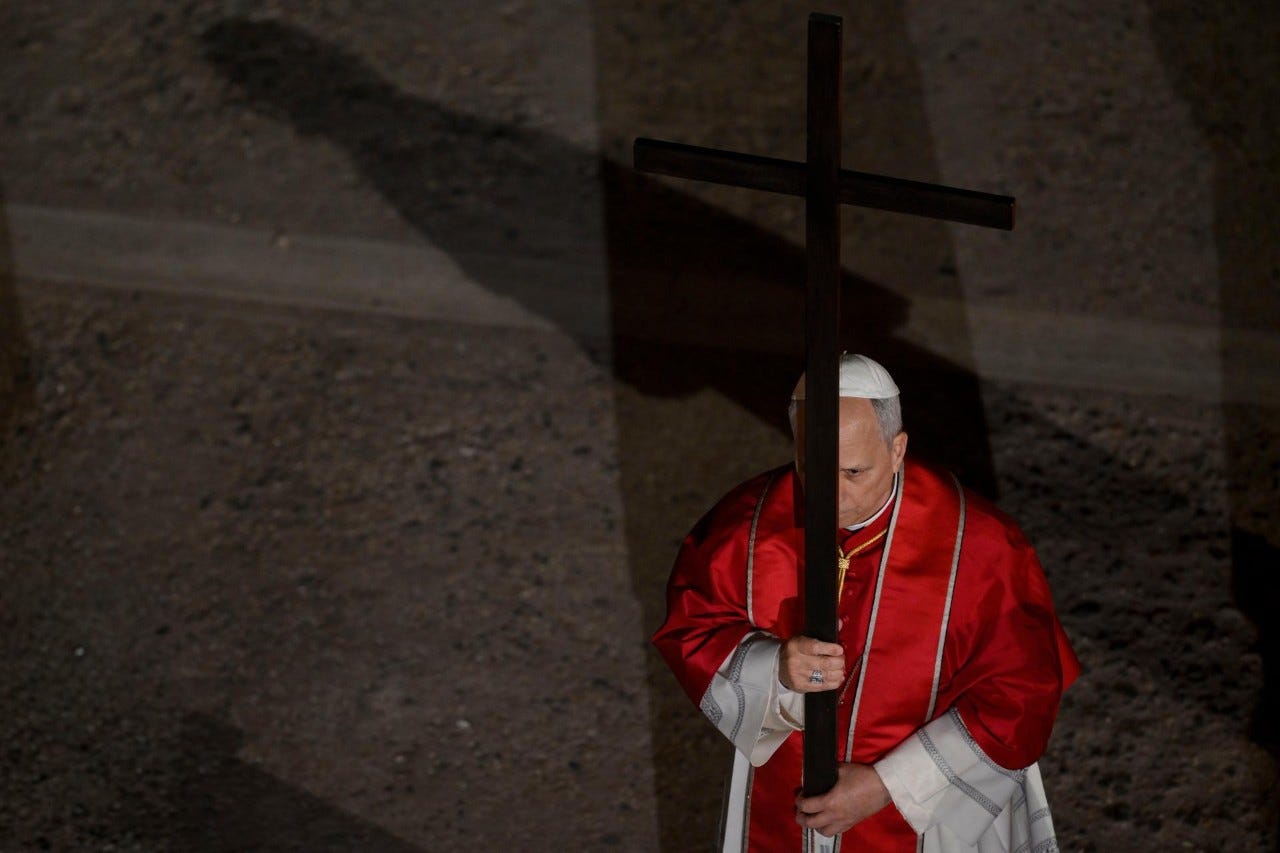
Pope Leo XIV carried the cross through all 14 stations at the Colosseum. Simon of Cyrene would have understood.
Dear friends,
Letters from Leo is publishing daily Lenten reflections through Easter. This series has been exclusively available to paid subscribers, but as a token of gratitude, the remainder of the series will be free this weekend.
Each meditation explores what it means to follow Jesus more faithfully — not as partisans first, but as Christians whose consciences are shaped by the Cross.
It’s Holy Week, which means these are the most important reflections of the year, and it’s not too late to join.
New yearly subscribers and one-time donors of $80 or more receive a free copy of Christopher Lamb’s revelatory new book on Pope Leo XIV — and the extended deadline to claim yours is Sunday at midnight PT.
These reflections are personal writing: vulnerable, searching, and grounded in the conviction that repentance, renewal, and resolve are not abstract concepts but daily choices.
If they’ve meant something to you this Lent, I hope you’ll consider making a one-time gift to support our work.
I invite you to walk with us in these final days of the most sacred week of the year.
“They compelled a passerby, Simon of Cyrene, the father of Alexander and Rufus, who was coming in from the country, to carry his cross.” — Mark 15:11
There is a man in the Passion narrative who did not volunteer.
Simon of Cyrene was not a disciple. He was not following Jesus. Mark’s Gospel says the soldiers “pressed” him into service as he was coming in from the country — a bystander conscripted into the central act of salvation history. He did not choose the cross. The cross chose him.
We know almost nothing else about Simon except one extraordinary detail: Mark names his sons.
“Simon of Cyrene, the father of Alexander and Rufus.” In the ancient world, a Gospel writer named someone because the audience knew them.
The biblical scholar Richard Bauckham has argued persuasively that Mark included Alexander and Rufus because they were known to the Christian community in Rome — living witnesses, members of the Church.
Paul, writing to the Romans years later, sends greetings to “Rufus, chosen in the Lord, and his mother, who has been a mother to me, too.” The consensus among scholars is that this is the same Rufus, the same family.
Simon carried the cross because he was forced to. His sons carried the faith because of what that forced encounter set in motion. We know Simon of Cyrene only because his children became followers of the man whose wood their father bore up the hill to Golgotha.
Tonight, during Passover seders around the world, the youngest child at the table will ask the ancient question from the Haggadah: Ma nishtana ha-laila ha-zeh mikol ha-leilot? Why is this night different from all other nights?
The question is a liturgical engine. It demands a story. The whole Passover narrative — slavery, the angel of death, the blood on the doorpost, the sea splitting open, the walk into freedom — unfolds as the answer to a child’s question.
I wonder whether Alexander and Rufus ever asked their father the same thing. Why is this night different? What happened to you on that road? Why did you carry a stranger’s cross?
And I wonder whether Simon, sobered by his experience with Jesus and his cross, had an answer, or whether the weight of the wood said more than any words could.
Good Friday sits inside that silence. The Church does not celebrate Mass today. The tabernacle stands open and empty, the altar stripped bare, and no bells ring anywhere in the Catholic world. We enter the space between death and resurrection with nothing to do but wait — and remember.
The readings hold us there. Isaiah’s Suffering Servant is “spurned and avoided by people, a man of suffering, accustomed to infirmity.” The verbs are passive: he was pierced, he was crushed, he was led like a lamb. The Servant does not fight back.
The Letter to the Hebrews insists that this is precisely the point — that we have “a high priest who has similarly been tested in every way, yet without sin,” one who “offered prayers and supplications with loud cries and tears to the one who was able to save him from death.”
God did not spare him the suffering. God heard him through it.
And John’s Passion account unfolds with the terrible specificity of eyewitness testimony: the lanterns in the garden, the charcoal fire, the seamless tunic, the sponge on the hyssop branch. Every detail anchored in a body that bled and a world that watched.
This evening, Pope Leo XIV walked barefoot onto the cobblestones outside Rome’s Colosseum and lifted a five-foot wooden cross onto his shoulders. He carried it through all 14 stations of the Via Crucis before 30,000 people gathered in the candlelit ruins — the first pope to carry the cross for the entire procession since John Paul II handed it off in 1994.
Leo, at 70 the youngest pope in more than three decades, had already stripped himself of every marker of papal authority earlier that afternoon inside St. Peter’s Basilica.
He removed his chasuble and his shoes. The fisherman’s ring came off, and the pastoral staff was set aside. When he prostrated himself before the bare altar, he lay on the floor of the basilica as a man emptied of power.
The meditations read at each station were composed by Franciscan Father Francesco Patton, the former custos of the Holy Land. Patton wrote that “every person in authority will have to answer to God for the way they exercise their power,” whether they start or end wars, sit in judgment, or promote or destroy human dignity.
The prayers named children who had been “taken away and imprisoned during protests, deported by policies devoid of compassion, shipwrecked on desperate journeys of hope, killed in war zones, and wiped out in death camps.”
At the seventh station, where Jesus falls the second time, Patton’s words turned to the structural violence of the global economy: Jesus falls “to raise up those who are crushed to the ground by injustice, by falsehood, by every form of exploitation and violence, and by the misery produced by an economy that seeks individual profit rather than the common good.”
Inside St. Peter’s, Capuchin Father Roberto Pasolini preached on the Servant Songs of Isaiah and the cycle of violence that the cross breaks open. “In a time like ours, still torn apart by hatred and violence, when even the name of God is invoked to justify wars and deadly decisions,” Pasolini told the congregation, “we Christians are called to approach the Lord’s Cross without fear — indeed, with full trust — knowing that it is a throne upon which one sits and learns to reign with him by placing one’s life at the service of others.”
Pasolini described the cross as a throne — one you reign from by serving rather than commanding.
The wood that Simon carried because soldiers forced it on him turns out to be the same wood that God chose freely, entering the lowest place on a night different from all other nights and refusing to leave.
Simon of Cyrene did not know what he was carrying. His sons spent their lives understanding it.
Tonight the question belongs to all of us — not just why this night is different, but what we will do with the cross that has landed, uninvited, on our shoulders.
Wars grind on across continents while economies crush the poor, and indifference lets both continue. The cross is already here. The only question is whether we will carry it or walk past.
I have been thinking about Simon all day — what it means to be enlisted rather than to volunteer, and how the act that defined his life was something he never planned. His sons built their faith on the story of a father who was simply in the wrong place at the right time.
May we be found in the same place tonight.
At Letters from Leo, we stand with every person who has felt the weight of an uninvited cross — and with every community of faith that refuses to walk past the suffering at the side of the road.
In a world where wars are waged in God’s name, and economies are built on the backs of the forgotten, we remain rooted in a Gospel that calls us to carry the wood, not to look away.
This is the fastest-growing Catholic community in the country because people are hungry for something real — a faith that does not flinch before injustice or retreat into comfortable silence while the crosses pile up.
If you believe this movement matters — Catholics and people of goodwill standing for human dignity against the violence and indifference that mark our age — I am asking you to join us.
If you’d like to invest in our mission, here are three ways you can help:
Subscribe as a paid member and get full access to our exclusive biographical series on Pope Leo’s Life & Formation, the Lenten Reflection Series, and deep-dive investigations.
Donate a one-time gift to support the work directly.
Share this reflection with someone who needs it today.
Whether you give $0, $1, or $1,000, your presence here matters — no matter your faith or your politics.
Thank you for reading. I’ll see you on the road.


All I can say is that I keep comparing how Pope Leo is strong enough to lift a cross all on his own while humble enough to walk this road with others while the stupid MAGAs wheel around pretending to carry a cross and start excluding Catholics from Holy Week events.
Beautiful writing, Christopher. I was blessed to spend the last 13 hours at church, starting with morning prayer, ending with Tenebrae. I have a lot of crosses on my back right now, but I am so fortunate to know the Lord is helping me carry them. I’m looking forward to a low key Vigil at a Franciscan convent tomorrow night, and will go to my beautiful Basilica for morning Mass Sunday. May your Easter be a blessed one.