
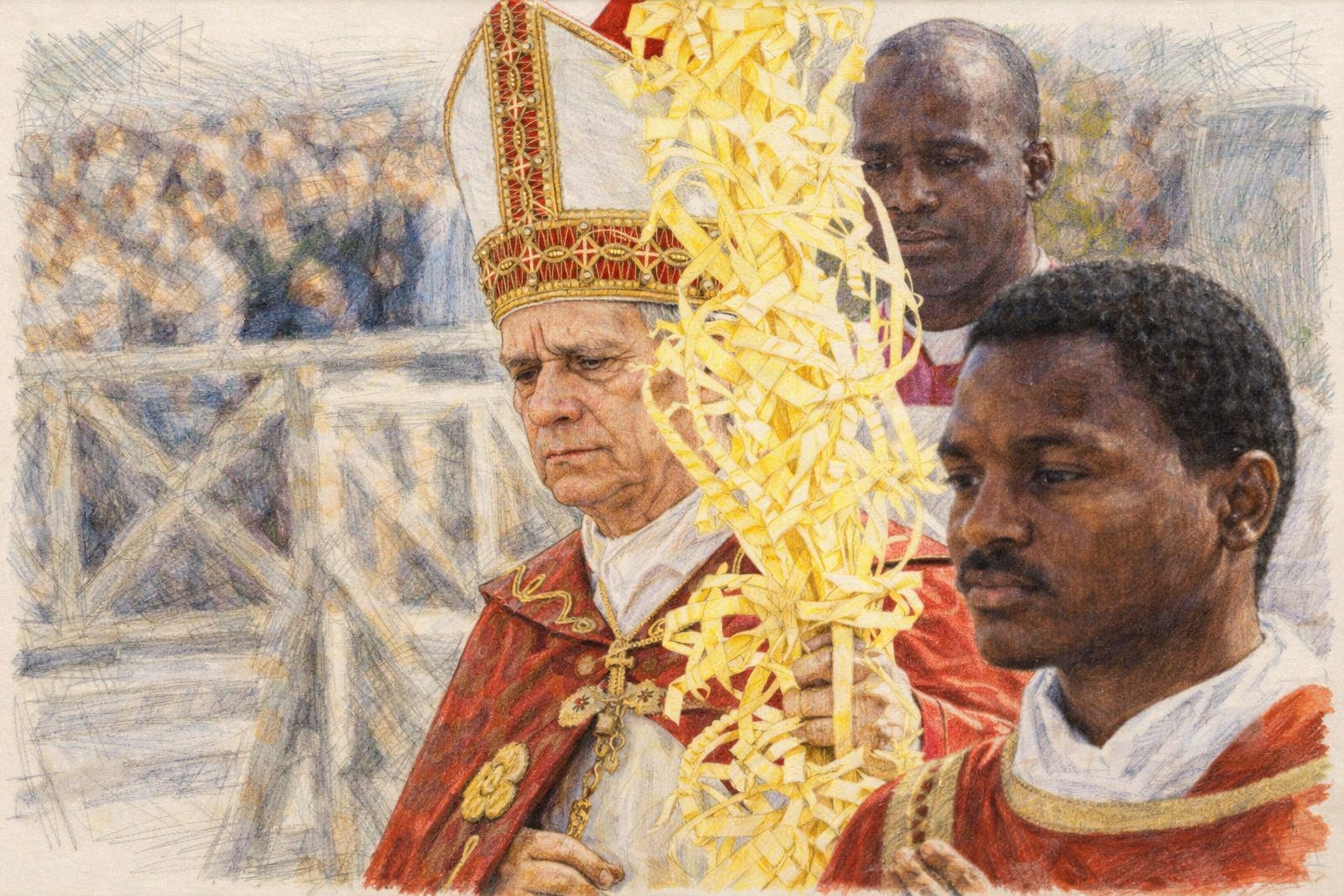
“Your Hands Are Full of Blood” — Pope Leo XIV’s Palm Sunday Message to Warmakers
On the first day of Holy Week, the pope invoked Isaiah to declare that God rejects the prayers of those who wage war — with the U.S.-Israeli bombing of Iran entering its second month.
Dear friends,
Holy Week begins today with a pope standing in St. Peter’s Square and telling the warmakers of the world that God will not hear them.
While American bombs fall on Iran and Russia’s grinding assault on Ukraine enters its fourth year, Pope Leo XIV opened the most sacred week of the Christian calendar by invoking the prophet Isaiah: “Even though you make many prayers, I will not listen: your hands are full of blood.”
At Letters from Leo, we stand with Pope Leo and the millions of Catholics — and countless others of goodwill — who believe that the Gospel cannot be conscripted into the service of violence. This community exists because people are hungry for a faith that tells the truth about what their government is doing and what their Church demands in response.
If you believe that hunger matters — especially now, as Holy Week calls us to walk with the crucified Christ and with every person crushed under the weight of war — I am asking you to join us.
If you’d like to invest in our mission, here are three ways you can help this Holy Week:
Subscribe as a paid member to receive exclusive posts about the life and formation of Pope Leo and help sustain this community.
Donate with a one-time gift to fuel this project’s mission.
Share this post (and Letters from Leo) with a friend who might enjoy it.
Paid subscribers get full access to our ongoing series on Pope Leo’s Life & Formation, the Epstein-Bannon Investigation, the Lenten Reflection Series, and every piece in the Best Of archive.
Whether you give $0, $100, $1,000, or more, your presence here matters — no matter your faith or your politics.
Thank you for reading. I’ll see you on the road.
Pope Leo XIV stood before tens of thousands gathered in St. Peter’s Square on Sunday morning and declared that God refuses to hear the prayers of those who wage war.
“Jesus is the King of Peace, who rejects war, whom no one can use to justify war,” Leo said during his Palm Sunday homily, the liturgy that opens Holy Week. “He does not listen to the prayers of those who wage war, but rejects them.”
The pope then quoted the prophet Isaiah: “Even though you make many prayers, I will not listen: your hands are full of blood.”
Those words landed on Day 30 of the U.S.-Israeli war on Iran. Since February 28, when the Trump-Vance administration and Israel launched coordinated strikes that killed Supreme Leader Ali Khamenei and scores of senior officials, American and Israeli forces have bombarded Iranian cities for a full month.
Iran’s health ministry reports nearly 2,000 dead, including 230 children. Yemen’s Houthis have opened a new front. Lebanon has absorbed Israeli strikes that have killed over a thousand people since early March.
Leo built his entire homily around a single theological claim: Jesus entered Jerusalem on a donkey, not a war horse, fulfilling the prophecy of Zechariah that the Messiah would “cut off the chariot from Ephraim and the war-horse from Jerusalem” and “command peace to the nations.”
When one of his own disciples drew a sword in Gethsemane, Jesus rebuked him: “Put your sword back into its place, for all who take the sword will perish by the sword.”
The application to Washington required no interpretation. Three days earlier, Defense Secretary Pete Hegseth stood at a Pentagon prayer service and asked God to sanction “overwhelming violence” against “those who deserve no mercy” — carrying a Bible stamped with “Deus Vult,” the Crusader battle cry. Leo’s invocation of Isaiah landed as a direct rebuke: the God of the Gospel does not bless your bombs, and he cannot be enlisted in darkness.
This is now the pope’s sustained, public, month-long confrontation with the Trump-Vance administration over the morality of this war. Letters from Leo has tracked every stage of it — from Leo’s first demand to “stop the spiral of violence,” to his declaration that the war is “a scandal for humanity,” to Trump’s blunt rejection of the ceasefire call: “We’re obliterating Iran.”
What Palm Sunday adds is the theological ground beneath all of it — moving Leo beyond diplomatic ceasefire calls into something more radical: the argument that waging this war severs the warmakers from God himself.
Isaiah 1:15 reads as prophetic judgment, not diplomatic plea — your prayers are an abomination because your hands are soaked in blood.
Leo closed the homily with a cry from the cross: “Lay down your weapons! Remember that you are brothers and sisters!” He then invoked the Servant of God Bishop Tonino Bello’s prayer to Mary, asking that “the flashes of war are fading into the twilight” and “the tears of all the victims of violence and pain will soon be dried up like frost beneath the spring sun.”
Russia’s war in Ukraine grinds into its fourth year while Iran burns under American and Israeli bombs. The pope stood in St. Peter’s Square on Palm Sunday and spoke with the voice of Isaiah, telling the warmakers of the world that God hears the cries of the dying but turns away when the warmakers kneel.
Holy Week begins with that verdict. The question is whether anyone in Washington is listening.
Thank you for reading. I’ll see you on the road.


Thank you, Pope Leo. You have returned the idea of the Roman Catholic Church to my heart.
Here is a portrait inspired by the early Church.
Jesus of Nazareth can be understood within the Hebrew Bible’s rich theme of the “ebed”—the servant—of **Yahweh**. The word “ebed” (עֶבֶד) denotes one who belongs to another and carries out that person’s will, and in Israel’s Scriptures it becomes a theological title: Yahweh has a servant through whom he makes himself known, advances his purposes, and sets the world right.
When early Christians identified Jesus as the Servant of Yahweh, they were not merely attaching a devotional label to him; they were reading his entire life, death, and vindication as the climactic embodiment of Israel’s calling and the decisive means by which Yahweh brings justice and salvation to the nations.
In Isaiah especially, the “servant” language operates on more than one level. At times the servant is clearly **Israel** itself—“Jacob” or “my servant”—chosen and upheld to bear witness to Yahweh in the world. Yet Isaiah is equally candid about Israel’s spiritual failure: the servant is described as blind and deaf, unable to live up to the vocation it has received. This tension creates a narrative problem inside the prophecy.
If Israel is Yahweh’s servant and yet cannot fulfill the servant’s task, how will Yahweh’s purposes be accomplished? Isaiah’s answer is a sharpening of focus: within the corporate identity of Israel emerges a servant who is both bound up with Israel and also distinct from it—called from the womb, empowered by the Spirit, commissioned to restore Israel, and sent as a light beyond Israel to the nations.
The servant is Israel’s vocation concentrated and made effective in a faithful representative.
The servant’s mission is not described in terms of political conquest or raw force.
Instead, Isaiah portrays a figure who establishes **justice** with a surprising gentleness and resolve: he does not crush the bruised reed, yet he does not falter until justice is set in the earth. This justice is restorative rather than merely punitive. It is the putting-right of what has been bent out of shape—healing, liberation, and the reordering of life under Yahweh’s good rule. In Christian reading, this helps illuminate the shape of Jesus’ public ministry. Jesus appears not as an ideological revolutionary seizing power, but as one commissioned by God and empowered by the Spirit, moving toward the vulnerable: the sick, the poor, the stigmatized, the outcast.
He enacts in concrete relationships what Isaiah’s servant promises in prophetic poetry—mercy that restores, truth that exposes, and authority that serves rather than exploits.
At the same time, the servant’s vocation has a horizon wider than Israel alone. Isaiah’s servant is given not only to gather the people back to Yahweh but also to become a “light to the nations”, extending salvation “to the ends of the earth.” Jesus’ mission begins squarely within Israel’s covenant story—addressing Israel’s need for renewal—yet it repeatedly pushes outward.
The servant framework makes sense of this movement: Israel’s restoration is never an end in itself; it is the means by which Yahweh’s blessing reaches the world. To claim Jesus as the Servant, then, is to claim that in him Israel’s calling becomes effective and expansive, opening into a universal mission without abandoning its scriptural roots.
The heart of the servant theme, however, is not only the servant’s compassion or global reach, but the startling claim that the servant’s obedience will entail suffering, and that this suffering will be more than a tragic consequence of faithfulness. Isaiah depicts the servant as one who is struck, humiliated, and rejected, yet who does not respond with retaliatory violence. In the Servant Songs the servant suffers unjustly, and his endurance is portrayed as purposeful: he bears the burdens of others and, in some profound way, makes reconciliation possible. Isaiah 52–53 presses this to its sharpest point, describing a servant who is wounded “for” others and who bears the sin of many, and then—just as surprisingly—is ultimately vindicated and exalted by God.
This is precisely where the New Testament most insistently draws the lines toward Jesus. The passion narratives portray him as innocent and condemned, mocked and struck, yet refusing the kind of self-defense that would save himself by abandoning his mission. His suffering is presented not merely as a moral example of courage, but as the decisive act by which sin is dealt with and covenant fellowship is renewed. In servant terms, Jesus does not simply endure evil; he absorbs it without perpetuating it, breaking the cycle of violence and guilt by faithful obedience to Yahweh’s will.
The cross, in this reading, is the servant’s work reaching its extreme form: justice comes not through domination, but through self-giving faithfulness that confronts sin, bears its weight, and opens a way to healing.
Yet Isaiah’s servant is not left in humiliation. The servant who suffers is also the servant whom Yahweh vindicates—“high and lifted up,” seeing the fruit of his labor. The resurrection, in Christian proclamation, functions as precisely this vindication. It is God’s reversal of the world’s verdict on Jesus, the declaration that the servant’s path is not defeat but the strange victory of divine justice.
In that sense, resurrection does not cancel servanthood; it confirms it. Jesus’ exaltation is presented as the outcome of servant obedience, redefining power itself: true authority belongs to the one who did not grasp at it, but fulfilled Yahweh’s purpose through faithful self-giving.
Seen as the Ebed Yahweh, Jesus also becomes intelligible as **Israel-in-person**—not a replacement for Israel, but Israel’s representative and fulfillment. Where Israel is called “servant” and yet falters, Jesus embodies what the servant was meant to be: the faithful one who trusts Yahweh, keeps the vocation intact, and carries it through to its goal. He gathers Israel by shouldering Israel’s burden; he restores Israel so that the nations may be blessed; he fulfills the servant’s calling so that the servant’s mission—justice, light, and salvation—can finally reach the world. The representative logic matters: the servant stands *with* and *for* others, not as an isolated moral hero but as the covenant agent through whom Yahweh acts on behalf of many.
To call Jesus of Nazareth the Servant of Yahweh, then, is to make a comprehensive claim about who he is and what his life means. It is to say that in him Yahweh’s purposes are carried out through chosen mediation; that justice is restorative and costly; that salvation comes not by coercive triumph but by obedient suffering that breaks sin’s power; that the mission of God moves outward to the nations; and that vindication belongs to the servant-shaped life. The servant theme allows Jesus’ story to cohere: Spirit-anointed compassion, steady proclamation, rejection and suffering, a cross interpreted as redemptive bearing of others’ burdens, and a resurrection understood as God’s vindication. In this light, Jesus is not merely a teacher who happened to suffer, but the faithful servant through whom Yahweh sets the world right—bringing healing, reconciliation, and light to the ends of the earth.
In memory of Blessed Father Stanley Rother