


Thank you for reading! Letters from Leo is a reader-supported publication and the fastest-growing Catholic community in the country. To receive new posts and support this movement, consider becoming a free or paid subscriber.
Earlier this week, a letter from the Washington law firm Cooper & Kirk arrived in my inbox. The firm represents Word on Fire, Bishop Robert Barron’s media company, and the subject line announced a “NOTICE OF LEGAL ACTION.” The letter itself is something slightly less than the subject line advertises: a threat of one.
The lawyers ask for a correction of a July 8 post of mine, which said that Barron’s YouTube views had “been on a nosedive during the past year of his MAGA conversion.”

In the letter, David H. Thompson of Cooper & Kirk writes that Word on Fire’s internal figures show the channel’s viewership more than doubling over the past year, with subscriber growth up 85 percent, and warns of “potential legal action” if I decline to correct the record.
For legal authority, the letter leans on the Covington Catholic teenager’s defamation suit against the New York Times — a suit the teenager lost. By his own team’s accounting, then, Bishop Barron’s audience is growing, a fact I am happy to place on the record here, in contradiction of my tweet.
Here is the letter — dated July 14, though it did not reach my inbox until July 21. Read it closely. Do you notice what’s missing?
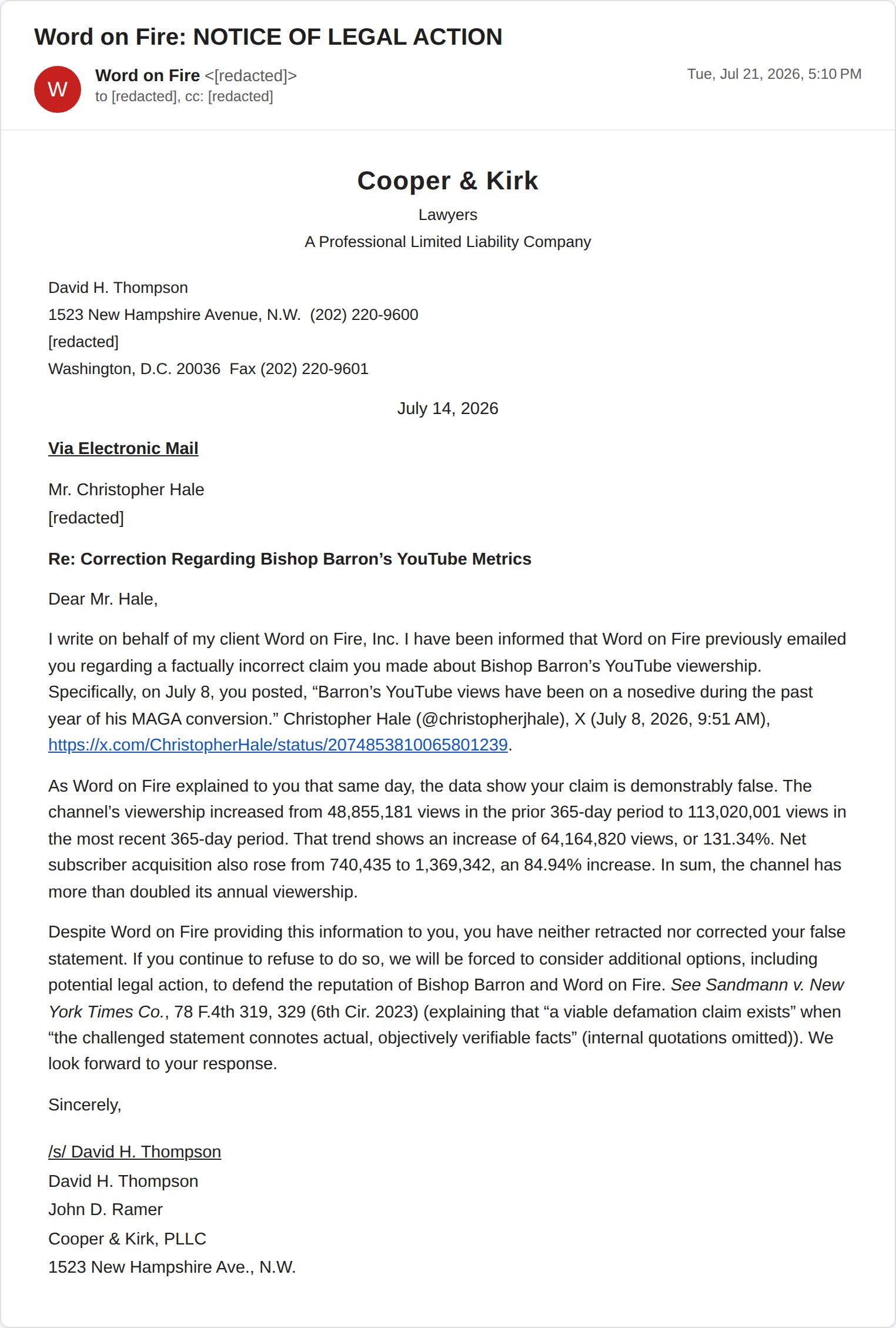
At no point does the letter ask me to retract the charge that gave my post its sting: that Bishop Barron has gone full MAGA.
His lawyers dispute my arithmetic. The thesis of more than a year of reporting in this community — that America’s most famous bishop has converted to Trumpism — apparently stands uncontested.
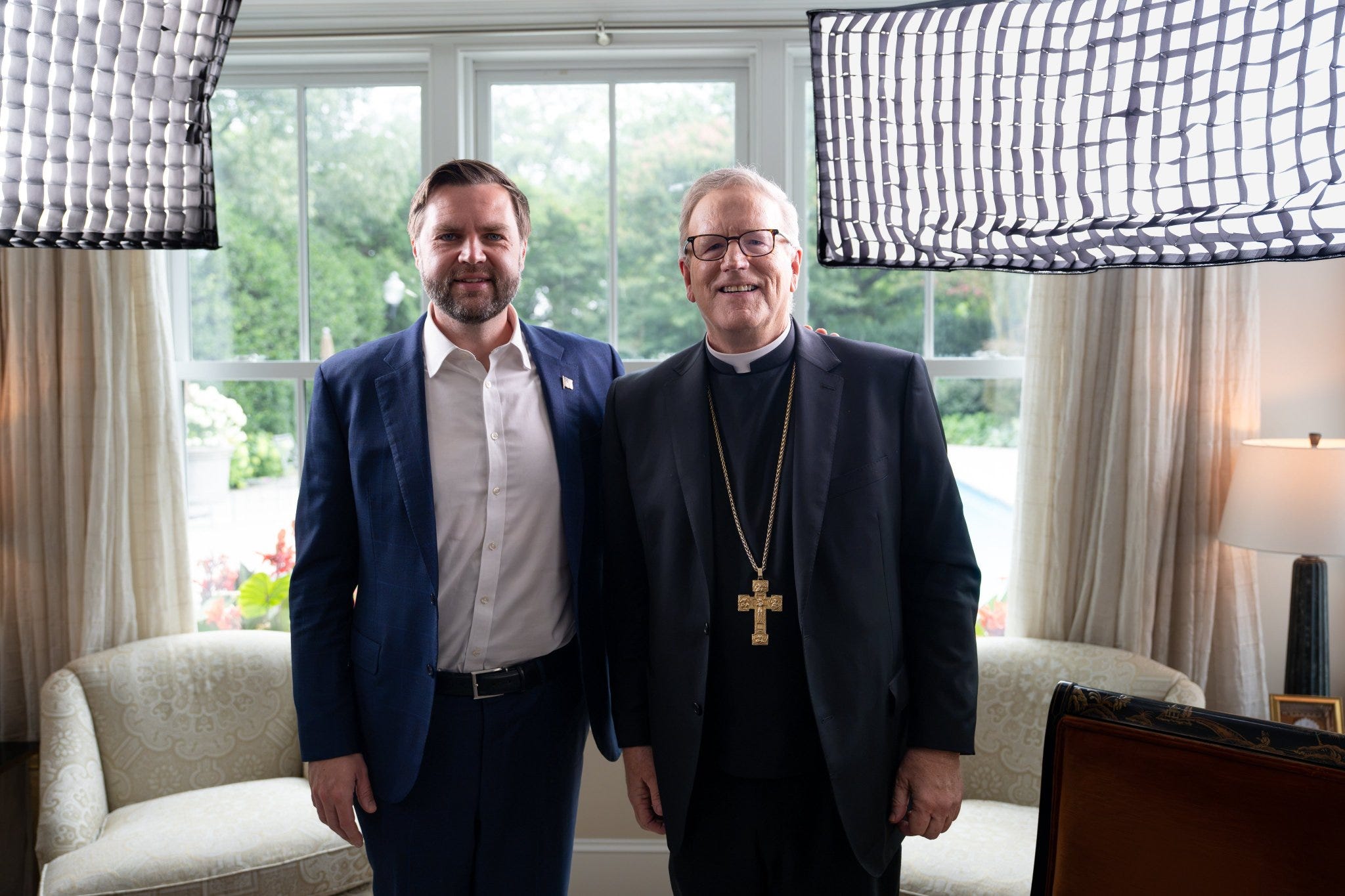
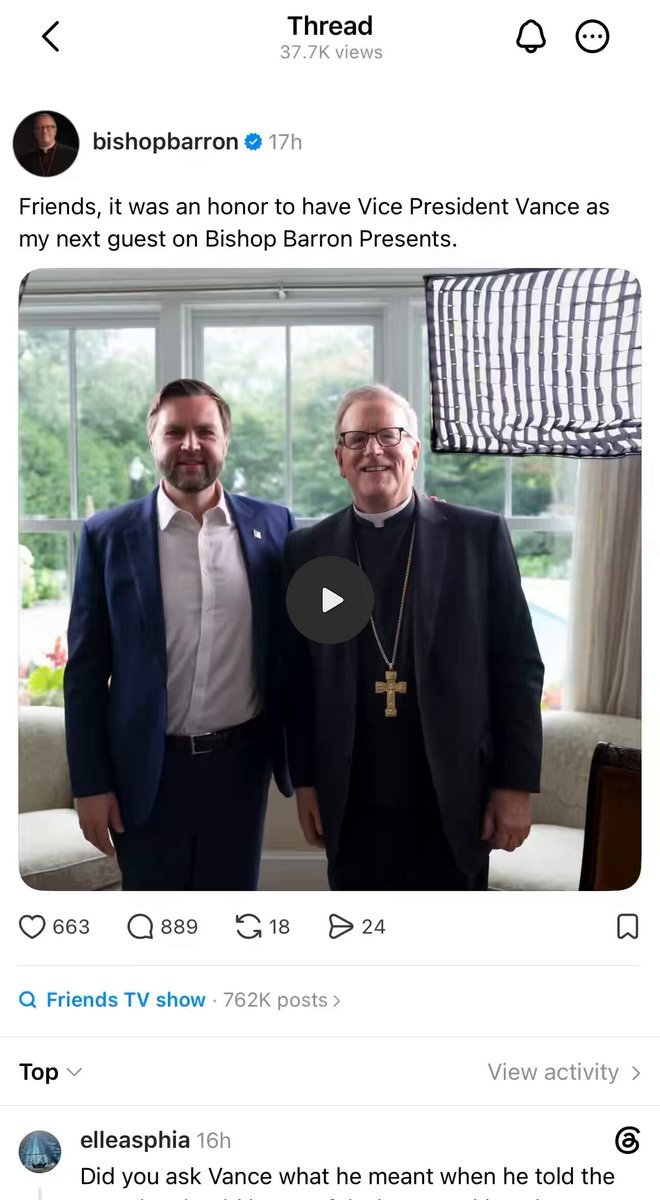
Bishop Barron recently gave a softball interview to Vice President JD Vance, and he has spent the summer falling deeper and deeper into the MAGA abyss.
Notice what stirs the empire to legal action. Trump’s April attack on Pope Leo earned from Barron a single statement of protest and then months of accommodation. An incorrect tweet about YouTube analytics, by contrast, summoned a Washington law firm.
Bishop Barron has become more interested in defending his stats than in defending the pope and the church against this administration.
Here is what makes the threat interesting: a lawsuit opens the door to discovery, and discovery runs in both directions. A defamation plaintiff puts his reputation at issue — and there is a lot to answer for.
Seven weeks of new material
They chose a busy stretch to write me. When I last covered Barron on June 2, he had just accused Catholics on the left of trying to “demonize” Donald Trump. The seven weeks since have given Rome, and the rest of us, plenty to study.
On June 29, Barron posted a long statement on X warning that politicians “who identify as extreme socialists or communists” were finding success in America, and reminding his followers that “Karl Marx said that the first critique is the critique of religion.”

Three days later, Fox News published the argument as an op-ed under the headline “The real reason communists fear religion and want believers silenced.”
The communism theme carried into this week. In a video he posted on Tuesday, Barron said the rise of “democratic socialism” should be recognized as communism. “Take them seriously; they mean what they say,” he warned, telling his “fellow believers” that “it’s time to speak up and to speak out.”
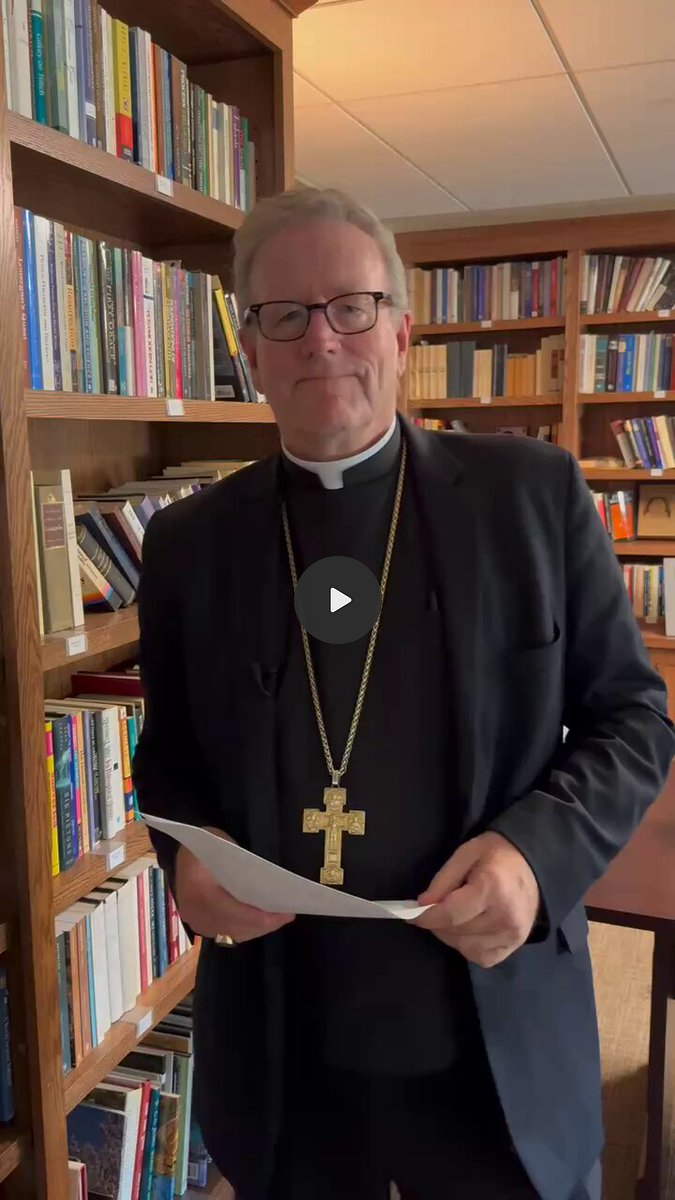
That clip was Barron’s second swing of the month at New York’s mayor. On July 3, he pronounced Mamdani’s address for the nation’s 250th anniversary “appalling,” the fruit of “the Marxism that, sadly, is all the rage today.”
Three days later, his podcast gave a full episode to America’s birthday, warm recollections of the Trump-backed Mall rally included.
Notice, too, the strange obsession. Zohran Mamdani is the mayor of New York City; Barron shepherds Winona-Rochester, 1,140 miles away. The pastor actually charged with Mamdani’s soul — Archbishop Hicks, the mayor’s own ordinary — has chosen engagement with his new mayor over long-distance denunciation.
There is a problem with the bishop’s new crusade against democratic socialism, and its name is Benedict XVI. Writing in First Things in January 2006, the late pope surveyed the political traditions of the West and rendered this judgment, which I quote in full:
But in Europe, in the nineteenth century, the two models were joined by a third, socialism, which quickly split into two different branches, one totalitarian and the other democratic.
Democratic socialism managed to fit within the two existing models as a welcome counterweight to the radical liberal positions, which it developed and corrected. It also managed to appeal to various denominations.
In England it became the political party of the Catholics, who had never felt at home among either the Protestant conservatives or the liberals.
In Wilhelmine Germany, too, Catholic groups felt closer to democratic socialism than to the rigidly Prussian and Protestant conservative forces.
In many respects, democratic socialism was and is close to Catholic social doctrine and has in any case made a remarkable contribution to the formation of a social consciousness.
Close to Catholic social doctrine — that is the verdict of the most theologically conservative pope of the modern era. Barron now sells the opposite claim as orthodoxy, and Fox News runs it as an op-ed.
On July 17, Word on Fire released Barron’s sit-down interview with Vice President JD Vance, taped in the pool house of the vice president’s residence in Washington. The Daily Wire carried the first clip as an exclusive.
And on Monday, Barron announced his new target: empathy.
“Suicidal empathy”
“I’ve just finished reading Gad Saad’s book Suicidal Empathy,” the bishop wrote on X. He ranked it, alongside Christopher Rufo’s America’s Cultural Revolution and Helen Pluckrose and anti-Catholic provocateur James Lindsay’s Cynical Theories, among “the best take-down of the lunacy at the heart of the wokeist philosophy.”
Saad, a marketing professor at Concordia University in Montreal, argues that Western compassion for migrants, trans people, and criminals amounts to civilizational self-harm. Elon Musk carried the idea to Joe Rogan’s audience last year, declaring that “the fundamental weakness of Western civilization is empathy.”
Barron softened the edges, as he always does. Empathy, he allowed, is “in itself a perfectly decent trait,” though it must yield to love, which “can very much involve hurting someone’s feelings.” His examples told the real story: biological men in women’s sports, “unqualified candidates” in universities and corporations, a meritocracy supposedly smeared as “white privilege.”
A Catholic bishop spent his Monday teaching one of the largest Catholic audiences online to ration its compassion. The church he serves teaches something else. Jesus told his followers that the nations would be judged on precisely the impulse Saad pathologizes: “I was a stranger, and you welcomed me.”
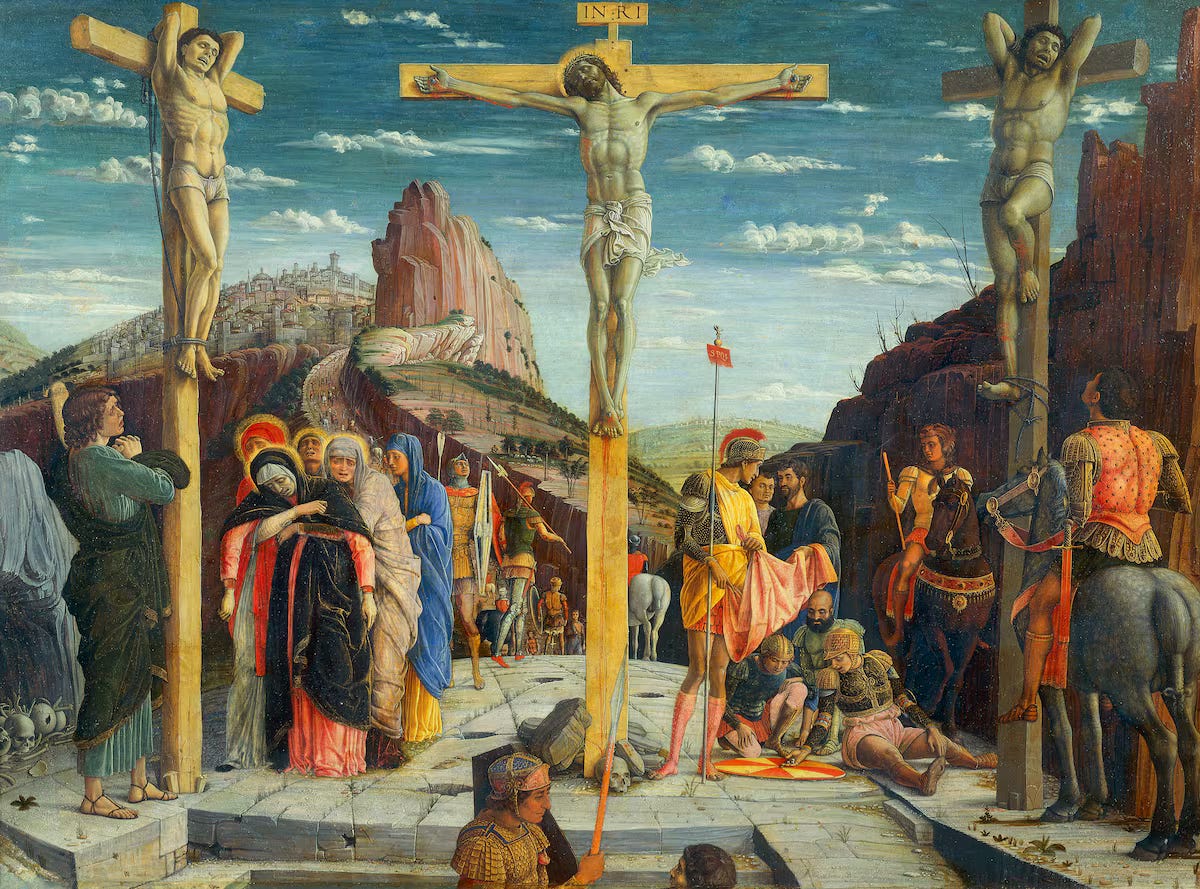
Follow Saad’s logic to its end, and it arrives at blasphemy: Jesus Christ on the cross — dying freely for people who could give him nothing in return — is the purest example of suicidal empathy in human history. A bishop, of all people, might have noticed.
Pope Francis addressed this exact argument in one of the final letters of his life, after Vance invoked ordo amoris to defend mass deportation. Christian love, Francis wrote to the American bishops in February 2025, is discovered by meditating on the Good Samaritan — a love that builds “a fraternity open to all, without exception.”
The response
The reaction from Catholic writers came fast. D.W. Lafferty, the Canadian independent scholar who has tracked Word on Fire’s drift for years, wrote that Saad’s concept amounts to “giving oneself permission to ridicule, demonize, and scapegoat,” and that Barron’s charitable gloss on the book betrays “ignorance of what it’s all really about.”


Daniel Rober, who chairs the Catholic studies department at Sacred Heart University, pointed to the evangelical cost: “Barron going full Fox News Uncle also makes it a lot easier to convince otherwise neutral people this isn’t a great evangelical approach.” In the anti-empathy movement’s rewrite of Christianity, Rober added, “the stuff about helping the poor and weak is jettisoned in favor of concepts like ‘suicidal empathy.’”


The magazines have started catching up with the tweets. In America, Emory theologian Susan Bigelow Reynolds wrote in June that “from the standpoint of integrity, Bishop Barron’s rapprochement with the manosphere has been disastrous.”
At National Catholic Reporter, Michael Sean Winters concluded that Barron “too often reverts to bumper sticker slogans that are false and, worse, unhelpful.” Deacon Steven Greydanus, who has chronicled what he calls the MAGAfication of a US bishop, judged it “scandalous” for Barron to repeat Vance’s complaints about Vatican “platitudes” without correction.
Commonweal knows this ecosystem well. Word on Fire twice sent the magazine cease-and-desist letters over a Massimo Faggioli essay on Catholicism and Trumpism, a campaign NCR documented in 2024. This week’s letter to me is part and parcel of how Barron and his team operate.
The record: two years of partisan acceleration
Do not take my word for the trend. Here is the public, too-often partisan record of America’s most famous bishop over the past two years — every entry documented, most in his own words: