Thank you for reading! Letters from Leo is a reader-supported publication and the fastest-growing Catholic community in the country. To receive new posts and support this movement, consider becoming a free or paid subscriber.
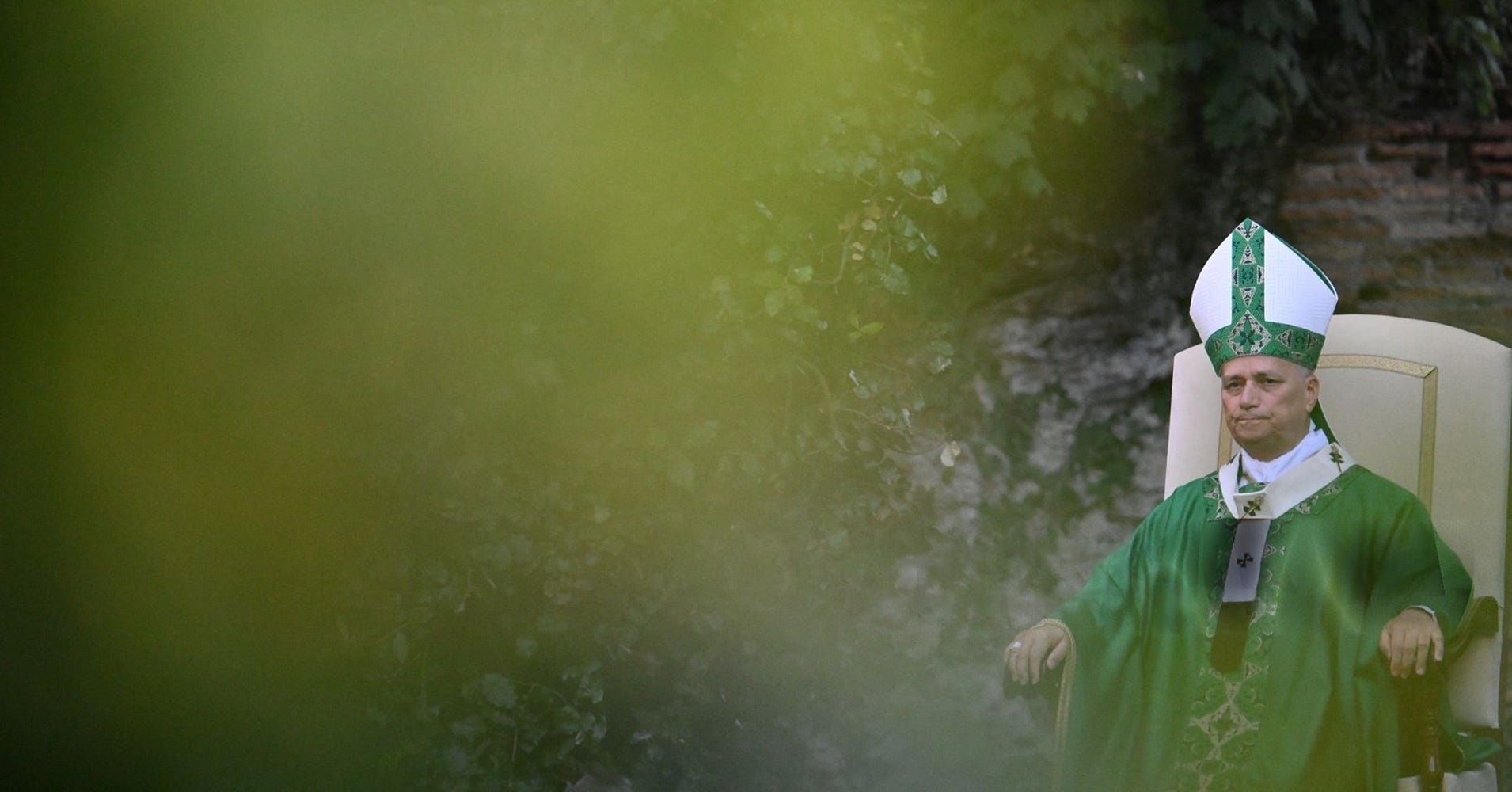
Pope Leo XIV celebrated Mass on Tuesday evening at a garden altar inside the papal grounds at Castel Gandolfo, opening the Season of Creation on the World Day of Prayer for the Care of Creation.
The altar stood in the Garden of the Madonnina at Borgo Laudato Si’, the ecological village Pope Francis founded on the old papal farm in the Alban Hills. I covered the pope’s lunch there with 200 of Rome’s poor in July, and the place is built for this kind of liturgy. Leo said as much in his homily, calling the contemplation of God’s works “a task that is certainly not difficult in the setting of these beautiful gardens.”
The homily was short, and its central request was silence. “Let us place in ‘silent mode’ the many noises generated by human activity,” Leo said, “so that we may hear the melodious voice of creation, through which God, the Author of all things, speaks to us.”
“It is not yet too late,” the pope went on, quoting his own message for the day: “What has been used for destruction can be redirected toward life, toward the care of the poor, the nourishment of the hungry, and the safeguarding of creation.”
That message, dated August 15 and released by the Vatican five days later, takes its title from Isaiah: “They shall beat their swords into plowshares and their spears into pruning hooks.” Leo argues in it that war and ecological ruin share a single source. He writes that the wounds of war and the degradation of the earth “are profoundly linked to the condition of the human heart,” and a world that renews that heart will move “from desert to garden, from division to communion, and from violence to peace.”

None of this is new for him. At his first Mass using the Church’s new formulary for the care of creation, celebrated at the Borgo on July 9, 2025, Leo described a “world that is in flames, as a result of both global warming and armed conflicts.”
Last October, at the tenth-anniversary conference for Laudato Si’, he told the Church to “shift from collecting data to caring” and laid his hand on a block of Greenland glacial ice, carried to Castel Gandolfo by the artist Olafur Eliasson, and blessed it. In November his message to COP30 in Belém insisted that “climate is a common good, belonging to all and meant for all.”
Francis founded the day Leo kept on Tuesday. On August 6, 2015, ten weeks after publishing Laudato Si’, he wrote to Cardinals Peter Turkson and Kurt Koch to say he had “decided to institute in the Catholic Church the ‘World Day of Prayer for the Care of Creation’” on September 1, “as has been the custom in the Orthodox Church for some time.” (The Orthodox custom dates to 1989, under Ecumenical Patriarch Demetrios I.)
Eight years later, in Laudate Deum, Francis called out the “dismissive and scarcely reasonable opinions that I encounter, even within the Catholic Church,” and he did the arithmetic on responsibility: “emissions per individual in the United States are about two times greater than those of individuals living in China, and about seven times greater than the average of the poorest countries.”
Here is where the MAGA Catholic reflex kicks in. Environmentalism, the argument goes, is a left-wing innovation that Francis smuggled into the Church, an Argentine’s politics dressed up as doctrine. The problem with that story is Joseph Ratzinger.
Newsweek profiled Benedict XVI under the headline “Benedict XVI, the Green Pope” on April 16, 2008, and the nickname had been earned. On September 2, 2007, preaching to roughly half a million young people at Loreto, Benedict said that “before it is too late, it is necessary to make courageous decisions that can recreate a strong alliance between humankind and the earth.” The following year the Vatican bolted 2,400 solar panels onto the roof of the Paul VI Audience Hall, a gift from the German firm SolarWorld, and that November Cardinal Giovanni Lajolo accepted the European Solar Prize on Benedict’s behalf.

The teaching ran deeper than the hardware. In Caritas in Veritate, his 2009 social encyclical, Benedict wrote that “the environment is God’s gift to everyone, and in our use of it we have a responsibility towards the poor, towards future generations and towards humanity as a whole.” He titled his message for the 2010 World Day of Peace “If You Want to Cultivate Peace, Protect Creation.” Standing in the German Bundestag in September 2011, he told the parliament that “the importance of ecology is no longer disputed.” No one accused Benedict of being a liberal.
Leo knows this lineage, which is why the hinge of his message this year is a quotation from Benedict. The line comes from the homily at Benedict’s inauguration Mass on April 24, 2005: “the external deserts in the world are growing, because the internal deserts have become so vast.” The sentence that follows in that homily, which Leo left for his readers to look up, reads: “Therefore the earth’s treasures no longer serve to build God’s garden for all to live in, but they have been made to serve the powers of exploitation and destruction.”
Which brings us to Washington, where the powers of exploitation and destruction have had a productive year.
On February 18, the Environmental Protection Agency published its rescission of the 2009 endangerment finding, the legal basis for federal limits on greenhouse gases from cars and trucks; the repeal took effect April 20. EPA Administrator Lee Zeldin marked the occasion at a Heartland Institute conference on April 8, telling a think tank that rejects mainstream climate science: “It is a day to celebrate vindication.”

The U.S. Conference of Catholic Bishops had filed a fifteen-page comment defending the finding, and after the repeal its spokeswoman, Chieko Noguchi, said the decision “flies in the face of efforts that have been put in place to protect and care for the earth now and for future generations.” Bishop Joseph Tyson of Yakima put it more plainly: “The science is pretty clear on this and it hasn’t changed.”
The American withdrawal from the Paris Agreement took legal effect on January 27, and in the same month the White House ordered the country out of the UN climate convention itself and out of the Intergovernmental Panel on Climate Change.
August alone tells the story. In the first week of the month the administration paid RWE $1.22 billion to abandon offshore wind leases off New York, California, and Louisiana, which brings the total spent on canceling wind farms to roughly $4 billion. The following week NOAA ended federal support for the Arctic Report Card it had published every year since 2006, and Senator Lisa Murkowski, a Republican, warned against the “undercutting of scientific research.”
On August 18, Agriculture Secretary Brooke Rollins proposed rescinding the Roadless Rule that has kept logging roads out of 44 million acres of national forest for a quarter century. That same week the Environmental Defense Fund sued to stop the dismantling of the National Center for Atmospheric Research, an institution Russell Vought, the president’s budget director, had called “one of the largest sources of climate alarmism in the country.”
Hold the two calendars next to each other. While a pope prayed in a garden and quoted a German theologian who preached the same warning twenty-one years ago, the men who claim the mantle of Christian civilization spent the month paying corporations to stop building windmills — and defunding the scientists who measure the ice Leo blessed.
Benedict saw it coming in 2005, when he warned of the earth’s treasures “made to serve the powers of exploitation and destruction.” Ten years after that Francis wrote the encyclical, and on the feast Francis founded, Leo stood at a garden altar to say it is not yet too late. Three popes across two decades have taught one thing in three voices, which leaves exactly one innovation on the table, and it is the one coming out of Washington.
At Letters from Leo, we stand with Pope Leo, with Benedict and Francis before him, and with the millions of American Catholics — and countless others of goodwill — who believe the earth is a gift held in trust for the poor and for the generations who will inherit it, and that no government has the right to auction that inheritance to the highest bidder.
In an era when a cabinet secretary can stand before a room of climate deniers and call the repeal of the nation’s clean-air protections a “vindication,” we remain rooted in a faith that hears the melting ice and the burning forest as a cry that has already reached the heart of God.
This is the fastest-growing Catholic community in the country because people are hungry for something deeper than rage and propaganda.
They are looking for a community that reads the wounding of the earth the way Benedict, Francis, and Leo read it, as a disorder of the human heart long before it becomes a policy dispute, and right now, as our government pays corporations to stop building windmills, that hunger has never been more urgent.
If you believe this movement matters — Catholics and people of goodwill standing for the care of creation against a government that treats God’s garden as inventory — I am asking you to join us.
If you’d like to invest in our mission, here are three ways you can help:
Subscribe as a paid member to receive exclusive posts about the life and formation of Pope Leo and help sustain this newsletter.
Donate with a one-time gift to fuel this project’s mission.
Share this post (and Letters from Leo) with a friend who might enjoy it.
Paid members receive the full biographical series on Pope Leo’s life and formation, from Villanova to the Peruvian missions, along with the weekly Sunday Scripture Reflection Series and our reporting on how Pope Leo is taking on artificial intelligence.
Whether you give $0, $5, $50, $500, $1,000, or more, your presence here matters — no matter your faith or your politics.
Thank you for reading. I’ll see you on the road.


I am SO happy to find this place where we can ALL get together to support and respect each other.
Pope Leo XIV ALWAYS gives me HOPE!
I am not Catholic, though I have grandparents who were, as well as many family members. I have always admired Pope Leo, and respect him as one of the greatest Popes ever. He sees the Earth, all its life, and its Climate as part of humanity. Saving our Planet from Global Warming and Extinction is not just what Jesus Christ would have encouraged, it is morally the right thing for everyone to fight for.