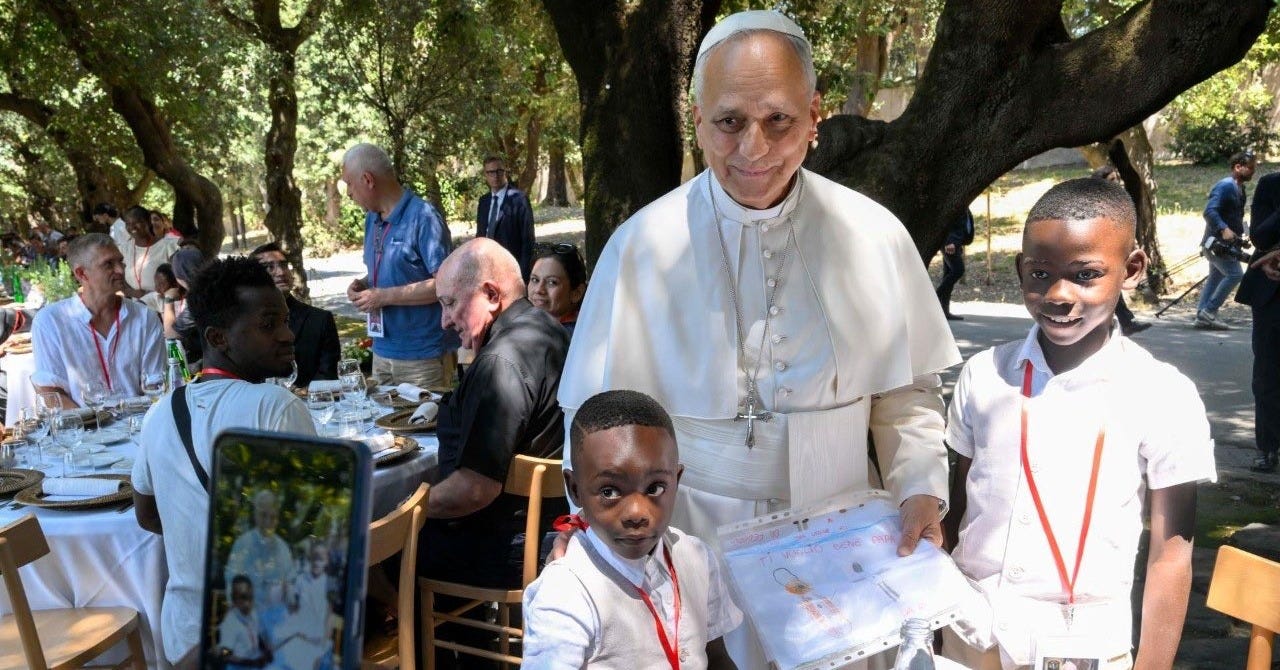
“I’m Hungry for Justice” — Pope Leo XIV Breaks Bread With 200 of Rome’s Poor at Castel Gandolfo
Speaking off the cuff at Borgo Laudato si’, the pope named his hungers: justice, authentic charity, and a Church where no one is an enemy. The meal he improvised in Albano last August now has a permanent place on the Vatican calendar.

Pope Leo XIV told 200 of Rome’s poor on Saturday that he had come to their table hungry — for justice, for genuine charity, and for a Church where no one is an enemy.
Today’s dispatch from Castel Gandolfo — and what two weeks of watching him up close has taught me — is free for everyone, because that is how Leo sets a table. If it feeds you, join the paid members who keep Letters from Leo on the road.
Pope Leo XIV sat down to lunch on Saturday with 200 poor and vulnerable residents of Rome in the pontifical gardens of Castel Gandolfo — and before the first plate reached the table, he told his guests that he was the hungry one at the feast.
“I came without a speech, because I’m hungry. I’m hungry for justice, hungry for authentic charity, hungry for a Church that truly knows how to open the doors, welcome, and receive everyone — where there is love for all and where no one is an enemy, where we all know how to live reconciliation, forgiveness, and peace.”
He spoke off the cuff, greeting the crowd gathered at Borgo Laudato si’, the ecological formation center Pope Francis planted in the papal gardens above Lake Albano, and Leo has carried forward.
Nearly 40 children sat among the guests, all of them accompanied by the Diocese of Rome and its affiliated charities. Cardinal Fabio Baggio, who directs the Laudato Si’ Center for Advanced Formation, opened the day with a Mass using the liturgy for the care of creation — the rite Leo first celebrated in these same gardens in July 2025. The guests walked the Borgo’s gardens and farmland before the meal.
I previewed this gathering on Tuesday: “Lunch with the Pope,” an event the Vatican now intends as an annual tradition, a different diocese arriving each summer with its poor, its refugees, and its migrants for a day of beauty and a place at the pope’s table.
The tradition began almost as an improvisation. Last August, Leo preached to the poor of the Diocese of Albano in their cathedral, told them there can be “no distinction between those who serve and those who are served,” and then welcomed them to lunch at the Borgo. Breaking bread together, he said that afternoon, is “the gesture with which Jesus Christ is recognized among his people.”

The Borgo gives those words a working address. Its farm-to-table project trains migrants, refugees, former prisoners, and women who survived abuse to tend the land and staff the kitchen, so the hands that raised Saturday’s food belong to the very people the world tells itself it can discard.
Pope Francis enlisted Father Manny Dorantes, a Chicago priest born in Mexico, to open the papal estate to the world, and Dorantes now directs the Vatican’s first job training center in the pontifical gardens, where migrants and vulnerable locals learn sustainable farming, gardening, and cooking.
When he laid the vision before the new pope, Dorantes recalled on 60 Minutes, Leo told him: “Full force ahead, Father Manny. This is the spiritual heart of Borgo Laudato si’ and this entire space.”
The Vatican’s first job training center now runs on that mandate, teaching sustainable farming, gardening, and cooking to migrants and locals in need, with the aim of forming a thousand people a year.
Its first graduating class of chefs came from around the world. One of them, 60 Minutes reported, was a young man from West Africa who survived the sea crossing to Lampedusa, the Italian island where tens of thousands of migrants have drowned — and where Leo prayed on the Fourth of July before returning to this garden.
The kitchen that fed Saturday’s guests was staffed, in part, by a man the Mediterranean nearly swallowed.
Leo reminded his guests what his oldest title requires of him.
“You know very well that the pope holds, among other things, the title of pontifex — a builder of bridges. And today we too would like to build a bridge with all of you, with your families, and with the society in which we want to live — a society of justice, where poverty can be eliminated, where the injustice that still exists in our world can be eliminated.”
“This,” he added, “is the Church we want to be.”
Bridge talk carries a particular charge when the builder is the first American pope. Leo’s letter for his country’s 250th birthday called the welcome of immigrants a recognition of God-given dignity, while the White House’s anniversary speeches found in today’s newcomers only a “communist menace.”
The unscripted register is itself news. Leo arrived at the papacy a careful, almost shy speaker who seldom strayed from his prepared texts. His first off-the-cuff address as pope came at the Tor Vergata vigil during last summer’s Jubilee of Youth, and the habit has grown on him since — most notably in June, when he spoke freely to some 600,000 young people on Madrid’s Castellana and days later went off-script among the migrants of Tenerife.
I have seen him in the flesh again and again these past two weeks, from the memorial stones of Lampedusa to Rome, and the change is visible up close.
He is growing more and more comfortable in his shoes as pope — less afraid of making a mistake, less reserved, more willing to speak from the heart. The man who told his guests he came hungry trusts the moment in a way the cautious newcomer of last spring did not.
At the table, Leo placed Christ himself among the diners.
“When we are together, when we live this spirit of encounter, all together at the one table where Jesus is also present with us, we are truly building a different world — a world of hope, a world that shines as a light amidst a reality so often broken by violence, hatred, and discrimination.”
He closed the thought with an exhortation: “Let us work together and try always to be this experience of Church — of justice, of peace, of love.”
The phrase worth underlining is the quiet one: “no one is an enemy.” American public life in 2026 runs on the opposite conviction, sorting the nation into enemies at the border, in the streets, and in the pews. A Church where the category itself dissolves would be unrecognizable to the politics of the moment — and that is precisely the Church this pope keeps describing.
Sit with the inversion at the center of the day. The leader of 1.4 billion Catholics walked into his own garden to feed 200 people who could offer him nothing in return, and he introduced himself as the man in need.
The move has a pedigree. In Matthew 25, Christ hides himself so completely inside the poor that feeding them becomes the only way anyone ever feeds him: “I was hungry and you gave me food.”
Leo has preached that identification his entire pontificate — most notably in November, when he shared a table at the Vatican’s World Day of the Poor with some 1,300 people, among them transgender women his own almoner had invited.
There is an Augustinian key here as well. Preaching on the Eucharist sixteen centuries ago, Augustine told the newly baptized: “Be what you see; receive what you are.” The friar formed in Augustine’s order has stretched that sacramental logic until it covers a lunch table — the Body of Christ recognized first in the bread, then again in the woman across the table eating it.
Before the food came out, Leo prayed over the tables. “Bless our families,” he asked. “Bless all those who find themselves in difficulty, in pain — that they too may find peace, forgiveness, reconciliation.” Then he sent the plates out the only way this pope could have: “Bon appétit — welcome, everyone.”
Eleven months ago in Albano, this was a single Sunday’s gesture. It now has a name, a liturgy, a rotating guest list of dioceses, and a permanent date on the Vatican’s summer calendar.
Every table reveals what its host loves. On Saturday, the pope’s table held nearly 40 children, men without homes, and women the world had already written off — and at its head sat a successor of Peter who says he will stay hungry until the doors of his Church open wide enough to take in everyone.
At Letters from Leo, we stand with the pope who arrived at his own table hungry — for justice, for charity that costs something, and for a Church whose doors swing open before anyone has to knock.
We built this community on the conviction that a shared meal can carry more truth than a decree, and that the Gospel belongs first to the people the world leaves standing outside. Tens of thousands of readers have made Letters from Leo the fastest-growing Catholic community in the country because they share the pope’s appetite — for courage, for truth, for love made visible in action.
In an age that treats mercy as weakness and manages the poor as a problem, we stay rooted in the conviction that every person carries the image of God, and that there is always another place to set at the table.
If you believe this movement matters — Catholics and people of goodwill who refuse to accept a world where “enemy” is a permanent category — I am asking you to join us.
If you’d like to invest in our mission, here are three ways you can help during this critical time:
Subscribe as a paid member to receive exclusive posts about the life and formation of Pope Leo and help sustain this newsletter.
Donate with a one-time gift to fuel this project’s mission.
Share this post (and Letters from Leo) with a friend who might enjoy it.
Paid members keep this work alive and unlock the full archive — including the biographical series on Pope Leo’s life and formation, the Epstein-Bannon investigation, and Pope Leo XIV takes on Silicon Valley — coverage that digs deeper than the news cycle allows.
Whether you give $0, $5, $50, $500, $1,000, or more, your presence here matters — no matter your faith or your politics.
Thank you for reading. I’ll see you on the road.


I love that Pope Francis changed Castel Gandolfo into something that the community can benefit from. Pope Leo now gets to show how Castel Gandolfo can belong to everyone, not just be his summer home. Food is very much one of Pope Leo's love languages.
I so enjoy listening to Pope Leo speak in Italian - and the translation into English that accompanies it. Grazie, Christopher.