


Thank you for reading! Letters from Leo is a reader-supported publication and the fastest-growing Catholic community in the country. To receive new posts and support this movement, consider becoming a free or paid subscriber.
Before you read on, take the pledge to be a Pope Leo voter on Nov. 3, and see where your candidates stand in our Catholic voter guides.
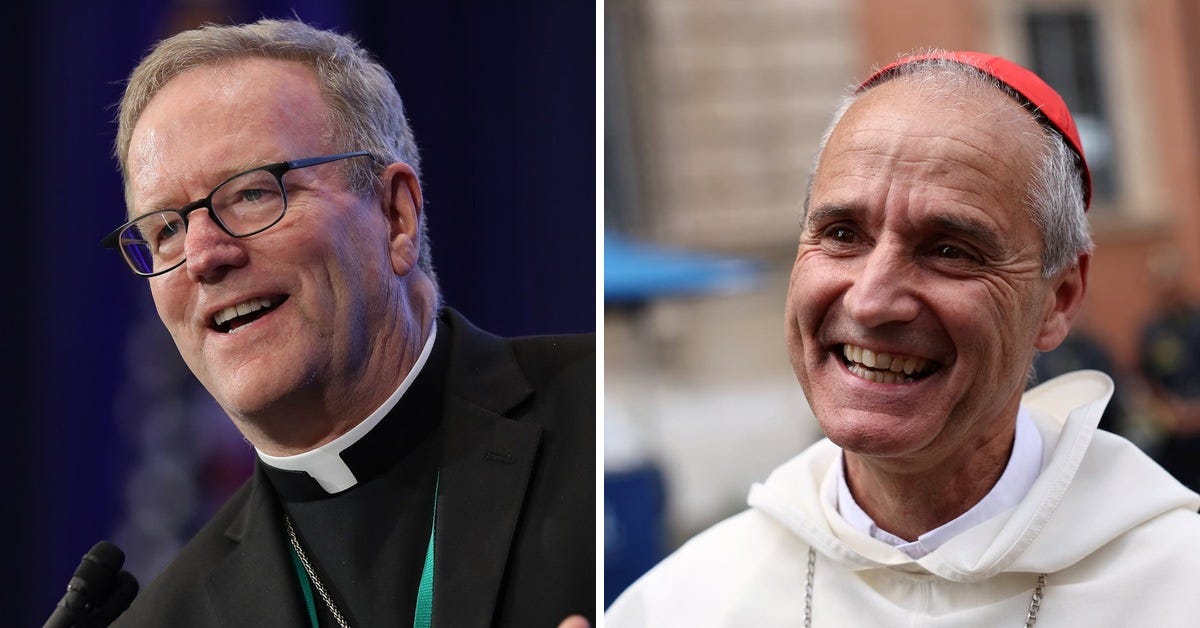
Bishop Robert Barron has found a new cardinal to scold. This time he picked one who lives under a law that can send Christians to prison for evangelizing.
The Winona-Rochester bishop accused Cardinal Jean-Paul Vesco of Algiers on X this week of offering “a, shall we say, puzzling take on evangelization.”
Barron told his followers that Vesco had declared “the Church is not there to convert” and that Christians “should approach other religions through fraternity rather than seeking conversions.”
“Excuse me, but…what?” Barron wrote. If he really thought the Church did not exist to bring people to Christ, he added, “then I would resign and get an honest job.”

The post has drawn more than a million views. It also got the cardinal wrong.
What Vesco actually said
Vesco’s remarks came from an Oct. 23 interview with CathoBel, the Belgian Catholic outlet.
He was describing his own flock, a small Church living as a minority inside a Muslim nation.
“We are the Church of this people,” he said. “Not a proselytizing Church, not a Church that is there to convert, but a Church that aspires to be one of the components of this people.”
Read whole, the sentence is about Algeria. On Thursday, CathoBel published a rebuttal saying Barron had stripped away an essential part of the quote’s context. The outlet was blunter about the second line: Vesco, it wrote, never spoke that sentence in the interview at all. Where Peter Is carried the correction in English.
Barron’s own post conceded the cardinal’s real point. Nobody, the bishop wrote, wants evangelization done in a “brow-beating, overbearing, or disrespectful manner,” which he labeled proselytization. That is the very word Vesco used.
Benedict XVI drew the same line in 2007, when he opened the Latin American bishops’ conference at Aparecida by declaring that the Church “does not engage in proselytism” and grows instead by “attraction.” On substance, the cardinal and the bishop agree. Barron built his rebuke on a fragment.
Shepherding where conversion is a crime
Algeria turns Vesco’s caution into a question of survival. Ordinance 06-03, passed in 2006, criminalizes efforts to convert Muslims and confines non-Muslim worship to buildings the state approves, with prison terms for violators. Authorities have used it to shut at least 58 Protestant churches, nearly all of them tied to the Protestant Church of Algeria.
An archbishop of Algiers who announced a conversion campaign would hand the government a pretext to close his parishes and expel his priests.
Vesco, a French-born Dominican, received Algerian citizenship by presidential decree. He answers to the neighbors he lives among in a way a bishop in southern Minnesota never has to.
He also inherited a Church that has already paid in blood. Between 1994 and 1996, during Algeria’s civil war, 19 Catholic priests and religious were murdered.
Seven Trappist monks were kidnapped from their monastery at Tibhirine in March 1996 and killed weeks later. They had spent years farming beside Muslim villagers and treating their sick, without seeking to convert them.
Their prior, Christian de Chergé, left a testament addressing his future killer as the “friend of my final moment.”
On Aug. 1, 1996, a bomb outside his residence killed Bishop Pierre Claverie of Oran, along with his Muslim friend and driver, Mohamed Bouchikhi. Claverie was a Dominican.
Vesco, a Dominican too, later spent nine years as bishop of Oran in Claverie’s own chair, and in 2018 he organized the beatification of all 19 martyrs in that city, the first ceremony of its kind in a Muslim country.
Pope Francis called them “faithful proclaimers of the Gospel.”
That is the Church Vesco leads. It has proclaimed Christ in Algeria mostly by staying put, and in the 1990s by dying beside Muslim neighbors who did not share its faith.
Pope Leo understands this.
He was elected on May 8, the feast of the Algerian martyrs, and Vesco invited him to Algeria that same day.
In April, Leo became the first pope ever to set foot in the country, praying before the Tibhirine cross on his first evening and calling the martyrs’ blood “a living seed that never ceases to bear fruit.”
The next day he traveled to Annaba, the ancient Hippo of St. Augustine. The cardinal Barron mocked this week is the man who welcomed the pope to Augustine’s homeland.
“Cold never bothered me”
Barron seemed to sense the trouble. In the replies, one user joked that “a curial official right now is searching for someplace even colder to send Bishop Barron to.” Barron answered: “I’m from Chicago. Cold never bothered me.”
A bishop untroubled by Rome has little reason to banter about being exiled by it. It was remarkable for him to publicly rebuked a cardinal Leo trusts, using a line the cardinal never said. Rome has been watching his feed for months.
The bishop of everything
The Vesco post fits a Barron pattern this newsletter has tracked for over a year.
Here’s a thorough rundown of his most recent shenanigans.
