
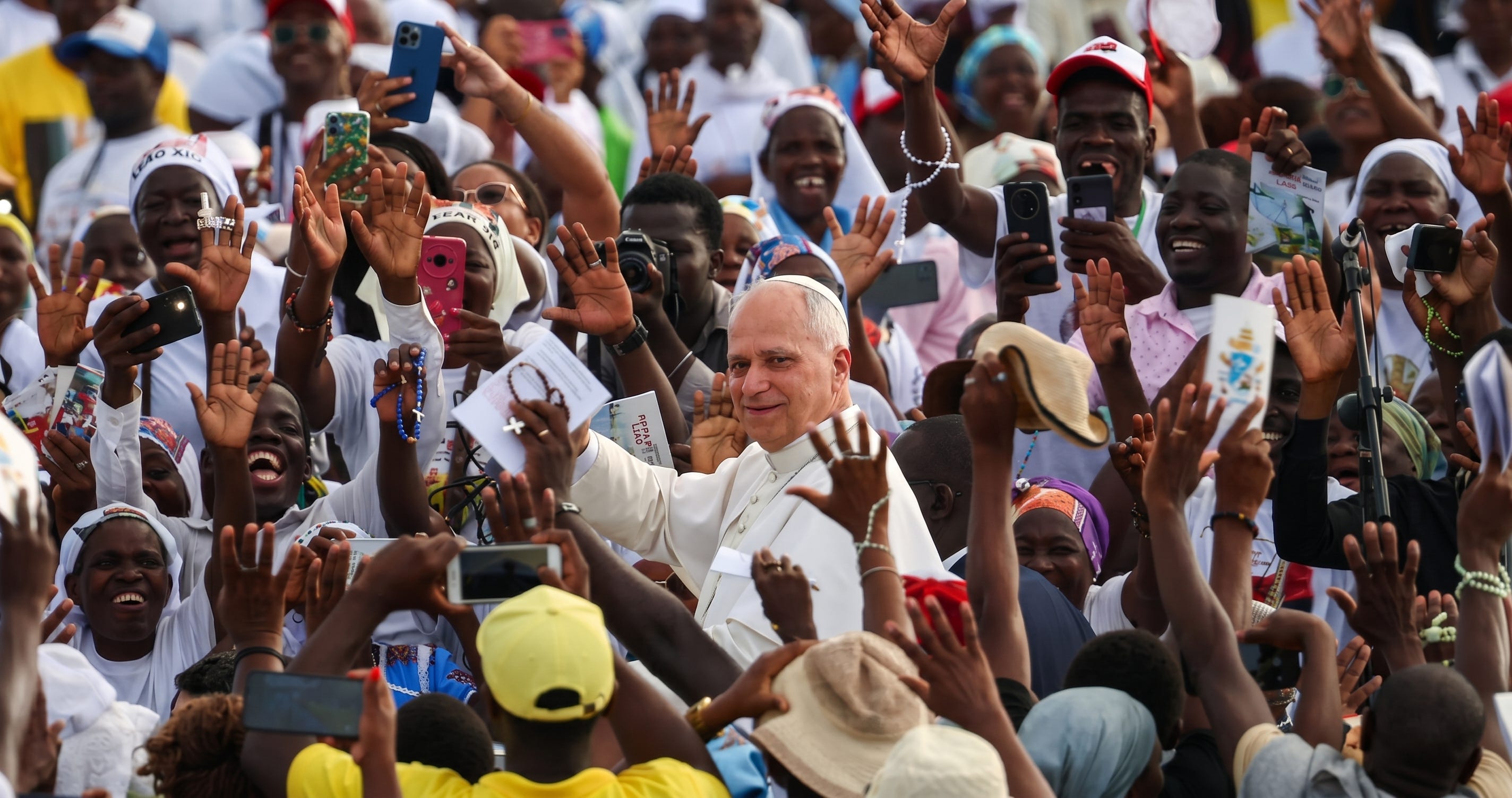
“Ravaged by Tyrants” — Pope Leo XIV's Africa Journey and the End of the ‘Quiet’ Papacy
Across Africa, the pope denounced “tyrants” and “colonization.” He asked us to read every speech in context of its audience — and we should ask how each one challenges us at home.
Thank you for reading! Letters from Leo is a reader-supported publication. To receive new posts and support this movement, consider becoming a free or paid subscriber.
Before you read on, join 65,000 Americans and sign our letter to President Trump demanding that he apologize for attacking Pope Leo XIV. We’ll deliver it to the president via JD Vance.
Andrea Tornielli, editorial director of the Vatican’s media operation, wants to correct a misunderstanding.
Pope Leo XIV “has not changed,” he told the Washington Post today.
“If one revisits the speeches from his first year as pope, it becomes clear that Leo has always been strong in substance.” Tornielli added: “Certainly, President Trump’s messages and [Leo’s] measured responses have drawn media attention. But this strength in the Pope’s words was there even before; perhaps the media did not always notice it.”
Anyone who has read this publication for the past several months has noticed it.
Across eleven days through Algeria, Cameroon, Angola, and Equatorial Guinea — roughly 17,700 kilometers, eighteen flights, homilies delivered in four languages — Pope Leo XIV gave the world a papacy the world has finally been forced to hear.
Whether the pope grew louder or the rest of us finally stopped plugging our ears is a question worth arguing about over coffee. What cannot be argued: the pontiff who stepped onto the tarmac in Malabo last week is no longer being called quiet.
As I told Newsweek recently, “The idea of the ‘quiet Pope Leo’ is a 2025 story. The 2026 Pope Leo is altogether different. He is speaking out, more comfortable in his own skin.”
Letters from Leo exists to connect Pope Leo XIV’s pontificate to our current moment in American politics.
Two threads of the African journey belong especially to that project: his sustained defense of democracy, and his sharpened rhetoric against corruption and authoritarianism. The pope framed both in their African contexts, and told reporters flying from Cameroon to Angola that much of what he said has since been subjected to “commentary on commentary.”
He insisted his speeches be read in light of the audience he addressed. That discipline deserves respect. A harder question follows behind it — how do the same words interrogate us at home?
During the middle of his trip on April 14, in a message to the Pontifical Academy of Social Sciences, Leo wrote that democracy “remains healthy only when rooted in the moral law and a true vision of the human person.”
Without that foundation, he warned, democracies collapse into “either a majoritarian tyranny or a mask for the dominance of economic and technological elites.”
Power, he added, is not an end but a trust — “true power comes from virtue, not strength.” He wrote those lines for scholars in Rome. The diagnosis applies anywhere a strongman or an oligarch mistakes their own political will for wisdom.
Two days later, in the cathedral of Bamenda — a city inside the heart of Cameroon’s Anglophone war — the pope moved from theological abstraction to direct accusation.
“The world is being ravaged by a handful of tyrants,” he said. He denounced “the masters of war” for spending billions on killing while “the resources needed for healing, education, and restoration are nowhere to be found.”
An Anglophone separatist alliance declared a three-day ceasefire in honor of his visit — the first time it had done so in a conflict that has killed more than 6,500 people and displaced over 650,000 since 2017.
The pope meant those words about that war. He later clarified that “the masters of war” referred to the separatist struggle in front of him, not to any head of state across the Atlantic.
Of course, no homily this pope preaches is sealed off from the wider conscience of the Church. The United States spent more than $916 billion on defense last year while Medicaid, housing assistance, and public schools went wanting. “The masters of war” are not only an ocean away from the White House, the Capitol, or the defense contractors who lobby both.
In Equatorial Guinea, the accusation sharpened again. Leo preached in Mongomo with Teodoro Obiang — the 83-year-old autocrat who has ruled for 47 years — seated before him, along with his son, a convicted French embezzler who serves as vice president of the country.
Before an estimated 100,000 faithful, the pope urged the nation to build a society “capable of engendering a new sense of justice,” to “serve the common good rather than private interests, bridging the gap between the privileged and the disadvantaged.”
In a country where oil revenue fills palaces while nearly half the population lives in poverty, that homily functioned as a public indictment, delivered from the altar, with the indicted in the front pew.
At the Basilica of the Immaculate Conception, he invoked Augustine — whose ancient Hippo in Annaba had been the pope’s first stop of the trip — and drew a line between the City of God and the earthly “lust for power and worldly glory that leads to destruction.” He warned directly about “the proliferation of armed conflicts” driven by “the exploitation of oil and mineral deposits.”
The next day at Bata Prison, standing in the rain with six hundred inmates, he told officials: “True justice seeks not so much to punish as to help rebuild the lives of victims, offenders, and communities wounded by evil.”
The U.S. State Department has documented torture, extreme overcrowding, and deplorable sanitation inside Equatorial Guinea’s prisons. Leo called those conditions by their name.
Some human rights advocates, including Equatorial Guinean exiles, worried the papal visit would sanitize Obiang’s regime. The concern was not unreasonable. Dictators have extracted photo ops from popes before. Leo’s homilies were the answer. Standing a few feet from the autocrat and his convicted son, the pope refused to soften a single syllable of Catholic social teaching.
A man being co-opted does not preach that way. Leo had claimed the stage for himself and, more importantly, for Christ.
There was also a quieter grace to the trip. In visiting an African church with ties to the slave trade, Leo recalled on his own Afro-Creole heritage — a reminder that the first American pope carries in his own blood the long memory of the continent he came to serve.
When Leo declined to debate the president of the United States, he explained that he came to Africa as a pastor, not as a pundit. The speeches in Bamenda and Mongomo were written weeks before Donald Trump called him “WEAK on Crime, and terrible for Foreign Policy.” None of those homilies was drafted with an American politician in mind. And yet the diagnosis fits our politics as it fits any African context.
I have argued from the beginning of this publication that my fervent belief is that just as God raised up a pope from behind the Iron Curtain to help defeat communism, God has raised up a pope from the Americas to help defeat authoritarianism.
That conviction has only deepened over the past week. Authoritarianism is a global pathology, and Leo treats it as such.
His “handful of tyrants” includes rulers who bomb cities, barons who plunder mines, regimes that cage critics, and majorities willing to turn democracy into a costume worn by oligarchs. The diagnosis belongs to no single continent — it is Catholic, in the oldest sense of the word: universal.
Which is why Americans have work to do. A country that exported Robert Prevost to the Church must refuse to re-import the strongman politics he is rebuking abroad.
Pope Leo XIV is America’s best and most powerful export. We must keep it that way.
If this publication speaks to you, consider joining us for the road ahead.
At Letters from Leo, we stand with Pope Leo XIV and the millions of American Catholics — and countless others of goodwill — who see what the pope saw in Africa: that authoritarianism is a global sickness, that the “masters of war” stalk every capital, including our own, and that democracy survives only when rooted in the dignity of the human person.
In an era poisoned by cruelty dressed as strength, we remain rooted in a faith that refuses to flinch before injustice or bow to the idols of fear and authoritarianism.
This is the fastest-growing Catholic community in the country because people are hungry for something deeper than rage and propaganda. They are looking for courage, for truth, for love made visible in action — and the witness of this pope, at last heard in full voice, has made that hunger unbearable to ignore.
If you believe this movement matters — Catholics and people of goodwill standing with the first American pope against authoritarianism at home and abroad — I am asking you to join us.
If you would like to invest in our mission, here are three ways you can help this Easter season:
Subscribe as a paid member to receive exclusive posts about the life and formation of Pope Leo XIV and help sustain this publication.
Donate with a one-time gift to fuel this project’s mission.
Share this post (and Letters from Leo) with a friend who might enjoy it.
Paid subscribers get the deeper work — the biographical series on Pope Leo’s Life & Formation, the ongoing Epstein-Bannon Investigation, and the archive of the essays that built this community. Your support is what makes all of it possible.
Whether you give $0, 8, $80, $800, or more, your presence here matters — no matter your faith or your politics.
Thank you for reading. I’ll see you on the road.


I would love to read your insights, Christopher, into this intersection: the pope's denouncing colonization, and also seeking more information about the church's own place in it, in particular Leo's wish to better understand the doctrine of discovery.
Had to work hard not to cry at him with the prisoners in orange prison gear. Now visiting prisoners in Africa is a very Jesus like thing to do in my humble view. Very Jesus like I believe.