
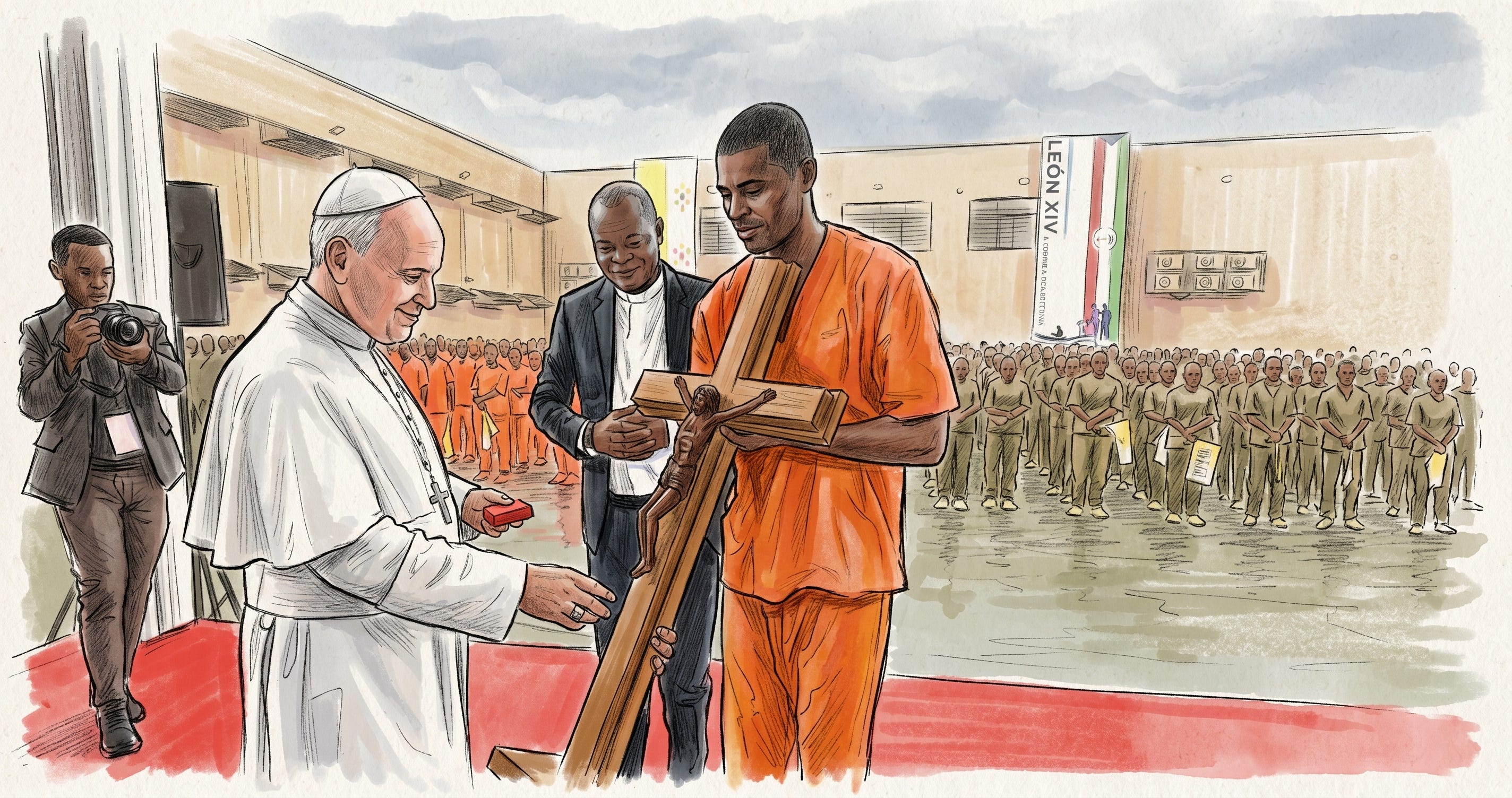
“God Never Abandons You” — Pope Leo XIV in Rainsoaked Bata Prison Visit
The first American pope walked into one of Equatorial Guinea's most notorious prisons, set aside his script, and told the inmates in off-the-cuff Spanish that God would never forget them.
Thank you for reading! Letters from Leo is a reader-supported publication. To receive new posts and support this movement, consider becoming a free or paid subscriber.
Before you read on, join 65,000 Americans and sign our letter to President Trump demanding that he apologize for attacking Pope Leo XIV. We’ll deliver it to the president via JD Vance.
The sky opened over Bata Prison on Wednesday morning. Pope Leo XIV had just begun speaking when the downpour arrived — a West African squall that soaked the pontiff’s white cassock, ran in rivulets down the faces of the inmates gathered in the prison courtyard, and turned a carefully staged visit into something that felt closer to Peter in the Acts of the Apostles.
Leo kept going. He set his prepared remarks aside, gripped the microphone, and shifted into off-the-cuff Spanish as the rain got worse. “You are not alone,” he told them.
“Your families love you and are waiting for you. Many people outside these walls are praying for you. If any of you fear being abandoned by everyone, know that God will never abandon you, and that the Church will stand by your side.”
Five words carried the morning: God never abandons you.
He pressed the message further, undeterred by the rain. No one is excluded from God’s love, Leo told the men of Bata. Even in situations of injustice and suffering, love retains the capacity to transform. Every person, regardless of their past, remains “precious in the Lord’s eyes.”
Today was the most animated off-the-cuff day of Leo’s pontificate. The second American pope has come alive on this 11-day African journey through Algeria, Cameroon, Angola, and Equatorial Guinea, and the freedom is especially pronounced when he preaches in Spanish — the language he spent two decades speaking as a missionary in Peru.
A pope who seemed reserved in his first year now leans into crowds, departs from scripts, and finds in Spanish a rhythm that English has yet to unlock. He laughs longer, speaks off-script more often, and moves through these countries with the visible ease of a man back in a room that feels like home.
Bata is one of Equatorial Guinea’s most notorious facilities, faulted for years by the U.N., the State Department, and Amnesty International for overcrowding, torture, and detainees who disappear behind its walls without their families knowing whether they are alive. The pope walked inside anyway.
The scene carried an unmistakable echo of Francis. On his final Holy Thursday, too weak to celebrate the Mass of the Lord’s Supper at St. Peter’s, Francis dragged himself to Regina Coeli prison in Rome to greet 70 inmates.
He often told reporters what he asked himself every time he crossed that threshold — “Why them and not me?”
A few days later, in one of his last acts of mercy before his death, Francis emptied his personal bank account — €200,000, the whole of it — to fund a pasta factory that employs young men at Casal del Marmo, the juvenile prison where he had washed the feet of inmates the week after his 2013 election.
Prisoners were the closest thing Francis had to a lifelong pastoral constant. Leo has now walked into a prison of his own, carrying forward a pontificate focused, like his predecessor’s, on the margins.
The politics could hardly be starker. Teodoro Obiang Nguema Mbasogo has ruled Equatorial Guinea for 47 years, since 1979, making him the longest-serving head of state on earth who is not a monarch. His regime stands accused of political detentions, torture, and what Amnesty International calls prisons full of “forgotten people.”
The day before the prison visit, Leo quoted Augustine’s City of God to Obiang’s face, drawing the contrast between “the earthly city centered upon the proud love of self” and the city built on love of God and neighbor. On Wednesday morning, Leo walked into the regime’s prison and told the prisoners themselves they were not forgotten.
The message travels. Equatorial Guinea is one of the African nations to which the Trump administration quietly paid $7.5 million to accept migrants deported from the United States — 29 third-country nationals transferred into Obiang’s custody since November.
And at home, the American Church’s fight over criminal justice has rarely been more urgent. The U.S. bishops continue to press for the abolition of the death penalty and for a carceral system that treats every incarcerated American as a bearer of human dignity.
Figures in the MAGA movement like Michael Knowles spent the last year attacking that teaching from the right, demanding the Church reopen the question of capital punishment. Leo’s visit to Bata was, among other things, its own kind of answer.
The rain kept falling. When Leo finished speaking and walked back toward the gate, the inmates erupted into dance in the soaked courtyard and began chanting one word, over and over, until the pope’s motorcade disappeared down the road: Libertad. Libertad. Libertad.
Freedom — the word the Gospel promises to every captive, impossible to contain inside a dictator’s walls. Pope Leo XIV, drenched and unbowed in the downpour, had just told the men of Bata it belonged to them.
At Letters from Leo, we stand with the men of Bata who are searching for redemption — and with every imprisoned person, every migrant vanishing into ICE detention, every American awaiting execution — whose dignity the Catholic Church refuses to surrender.
We believe what Leo told those prisoners in Spanish on Wednesday: that God never abandons the abandoned, and that a Church that forgets the incarcerated has lost the thread of the Gospel.
In an era when MAGA figures openly attack Church teaching on the death penalty and the Trump administration ships human beings to the prisons of autocrats for cash, this movement exists to hold the line.
We remain rooted in a faith that insists on the dignity of every person — the dictator’s prisoner, the deported migrant, the condemned inmate.
Letters from Leo is the fastest-growing Catholic community in the country because people are hungry for a Church that walks into the courtyard in the rain.
They want courage, clarity, and love made visible in action — and right now, with human beings disappearing into carceral systems on three continents, that hunger has never been more urgent.
If you believe this movement matters — Catholics and people of goodwill standing for human dignity against authoritarianism at home and abroad — I am asking you to join us.
If you’d like to invest in our mission, here are three ways you can help this Easter season:
Subscribe as a paid member to receive exclusive posts about the life and formation of Pope Leo and help sustain this mission.
Donate with a one-time gift to fuel this project’s mission.
Share this post (and Letters from Leo) with a friend who might need it today.
Paid subscribers get the deeper work — the biographical series on Pope Leo’s Life & Formation, the ongoing Epstein-Bannon Investigation, and the archive of the essays that built this community. Your support is what makes all of it possible.
Whether you give $0, $1, or $1,000, your presence here matters — no matter your faith or your politics.
Thank you for reading. I’ll see you on the road.


“You are not alone, “ are the words every human needs to hear at sometime or another during their lifetimes.
This moves me beyond words.