


More than 5,000 of you have now written to Pope Leo XIV through our Get Well Letter, and Letters from Leo will carry every one of them to the Vatican. If you haven’t added yours, sign your name and a prayer here.
Thank you for reading! Letters from Leo is a reader-supported publication and the fastest-growing Catholic community in the country. To receive new posts and support this movement, consider becoming a free or paid subscriber.
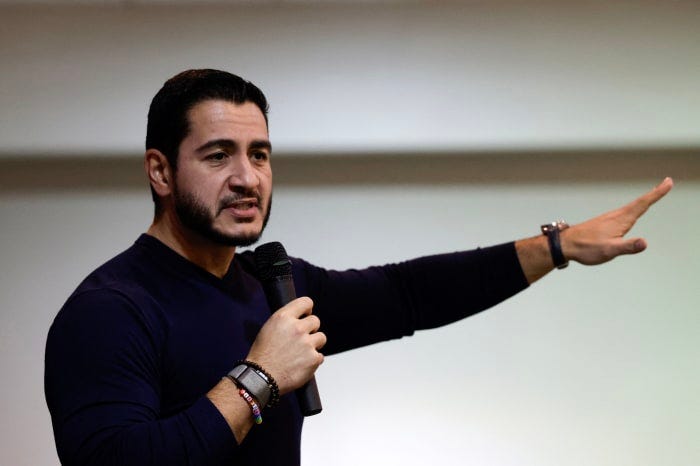
Abdul El-Sayed was taking questions at a town hall in Caro, Michigan, on Saturday when a young man in the crowd called out to him. He gave his name as Tommy.
“Will you disavow the Muslim Brotherhood?”
“Sure. Yeah, absolutely,” said the Democratic nominee for Senate in Michigan. Then he turned the question around: “Why are you asking the question?”
The exchange ran close to five minutes, and El-Sayed posted it to X himself. He pressed Tommy on what the question took for granted, namely that a Muslim candidate might owe “some allegiance to something that is not our Constitution.”
He asked whether Tommy had put the same demand to everyone else he knew (Tommy admitted he had not). Then El-Sayed brought up John F. Kennedy, who faced the same suspicion as a Catholic running for president.
“His answer, famously, was that he was not running to be a Catholic president,” El-Sayed told the room. “He was running to be president and happened to be Catholic.”
Tommy was no random voter. The Handbasket identified him as Thomas Teepell, who served as operations director for Sen. Josh Hawley of Missouri until February, according to the congressional staff records the outlet cited.
Tommy’s question didn’t come out of nowhere. Mike Rogers, the Republican nominee, has spent weeks tying El-Sayed to the Brotherhood, telling CNN the issue is “his relationship and his family relationship” with the group. President Trump calls him “Mohammed” at rallies and has labeled him a “Muslim radical.”
The newest round traces back to 2012 posts from El-Sayed’s half-sister about their mother’s student activism in the early 1970s.
Bridge Michigan examined the charges in September and found no direct evidence for Rogers’ claim that El-Sayed had pledged his support to the group, and he calls the idea that anyone in his family belonged to it “an insane thing to assume.”
El-Sayed answered the campaign against his faith with a thirty-second spot called “Prayer.” He sits in an armchair with a mug in his hands and looks into the camera.
“My name is Abdul. It means servant,” he says. “I pray every day.”
By the end of the spot, he makes a request few Democrats would put in a paid ad: “So yeah, we need a few more people of faith in Washington.”
Catholics should recognize Tommy’s question, because for most of American history it was asked about us.
A Protestant mob burned the Ursuline convent in Charlestown, Massachusetts, in 1834, and the suspicion outlived the fire by more than a century.
When Kennedy stood before the Greater Houston Ministerial Association on Sept. 12, 1960, he had to assure a room of Protestant ministers that “I am not the Catholic candidate for President.”
The charge against Kennedy is the one now aimed at El-Sayed. A man who prays a certain way, the theory goes, must take his orders from somewhere other than the Constitution.
The Church settled her own account with that charge five years after Houston, and the settlement applies to El-Sayed directly.
On Oct. 28, 1965, the Second Vatican Council promulgated Nostra Aetate, which opens its paragraph on Islam with a sentence every Catholic ought to know by heart: “The Church regards with esteem also the Moslems.”
Muslims, the council taught, “adore the one God,” and they revere Jesus as a prophet while honoring his virgin mother. The bishops then urged Christians and Muslims to “forget the past” and work together for peace and justice.
That December came Dignitatis Humanae, the council’s declaration on religious freedom, shaped in large part by the American Jesuit John Courtney Murray.
It grounds that freedom “in the very dignity of the human person.” Article VI of the Constitution had already settled the legal question in 1787: no religious test “shall ever be required” for federal office.
A Catholic in Dearborn gave that teaching a voice two months ago. On Aug. 18, Jake Lang carried his “Christian Crusader March” into the city, and roughly 2,000 protesters and counterprotesters converged on the library where the council had moved its meeting. Chris Anders, who introduced himself as “a proud Catholic Christian,” took the microphone.
“The same First Amendment that protects my right to go to Mass protects your right to the mosque,” he told the room.
Anders allowed that he and his Muslim neighbors “may not be brothers in faith,” but he called them “certainly and absolutely brothers and sisters in humanity.” He also named one of them as his barber, which is the kind of detail that makes the Crusader rhetoric hard to sustain in a real Michigan town.
Pope Leo XIV has been making this case since his first trip abroad. Flying home from Beirut last December, he told reporters that fear of Islam is “oftentimes generated by people who are against immigration.”
He pointed to Lebanon as “a land where Islam and Christianity are both present and are respected,” and said its lessons belonged in North America too. Christians, the pope said, should “perhaps be a little less fearful.”
Tommy told El-Sayed that he is a Christian, and El-Sayed answered him: “I want to protect your right to practice your faith as you choose, as a Christian man.” A Muslim candidate offered a Christian voter the very freedom the voter had just questioned, and he did it in a small town in Michigan’s Thumb with the cameras rolling.
The Church I belong to was on the receiving end of Tommy’s question for two centuries. We have no business asking it of anyone else.
At Letters from Leo, we stand with Abdul El-Sayed and with the Dearborn Catholic who told a crusader rally it did not speak for Christ, because no American’s prayer should ever become a loyalty test.
Our Church learned the cost of that suspicion in burned convents and whispered warnings about the pope. Vatican II answered with esteem for Muslims and a defense of religious freedom rooted in human dignity, and Pope Leo XIV has asked us to be less afraid. We intend to take him at his word.
This is the fastest-growing Catholic community in the country because people are hungry for a faith that welcomes the stranger instead of interrogating him. They are tired of hearing the name of Jesus shouted at people of God, and they want to hear it spoken the way he spoke to outsiders.
If you believe this movement matters — Catholics and people of goodwill standing for the dignity of every believer against the politics of fear — I am asking you to join us.
If you’d like to invest in our mission, here are three ways you can help:
Subscribe as a paid member to receive exclusive posts about the life and formation of Pope Leo and help sustain this newsletter.
Donate with a one-time gift to fuel this project’s mission.
Share this post (and Letters from Leo) with a friend who might enjoy it.
Paid subscribers receive our full series on Pope Leo’s Life & Formation, our Sunday Scripture Reflection Series, and the investigations you won’t read anywhere else.
Whether you give $0, $5, $50, $500, $1,000, or more, your presence here matters — no matter your faith or your politics.
Thank you for reading. I’ll see you on the road.

Thank you Chris, Abdul El Sayed is a good person and a Muslim. We all believe in the same God, pray for Abdul and his campaign and most of all please pray for Pope Leo and his recovery.❤️🩹
The fact that it’s thought that a person’s religious identity dictates their actions instead of being dictated by the Constitution comes directly from their Christian Nationalist beliefs that they believe allows them to discriminate and show no regard for others unlike them in race, ethnicity, religion and even political affiliation.