
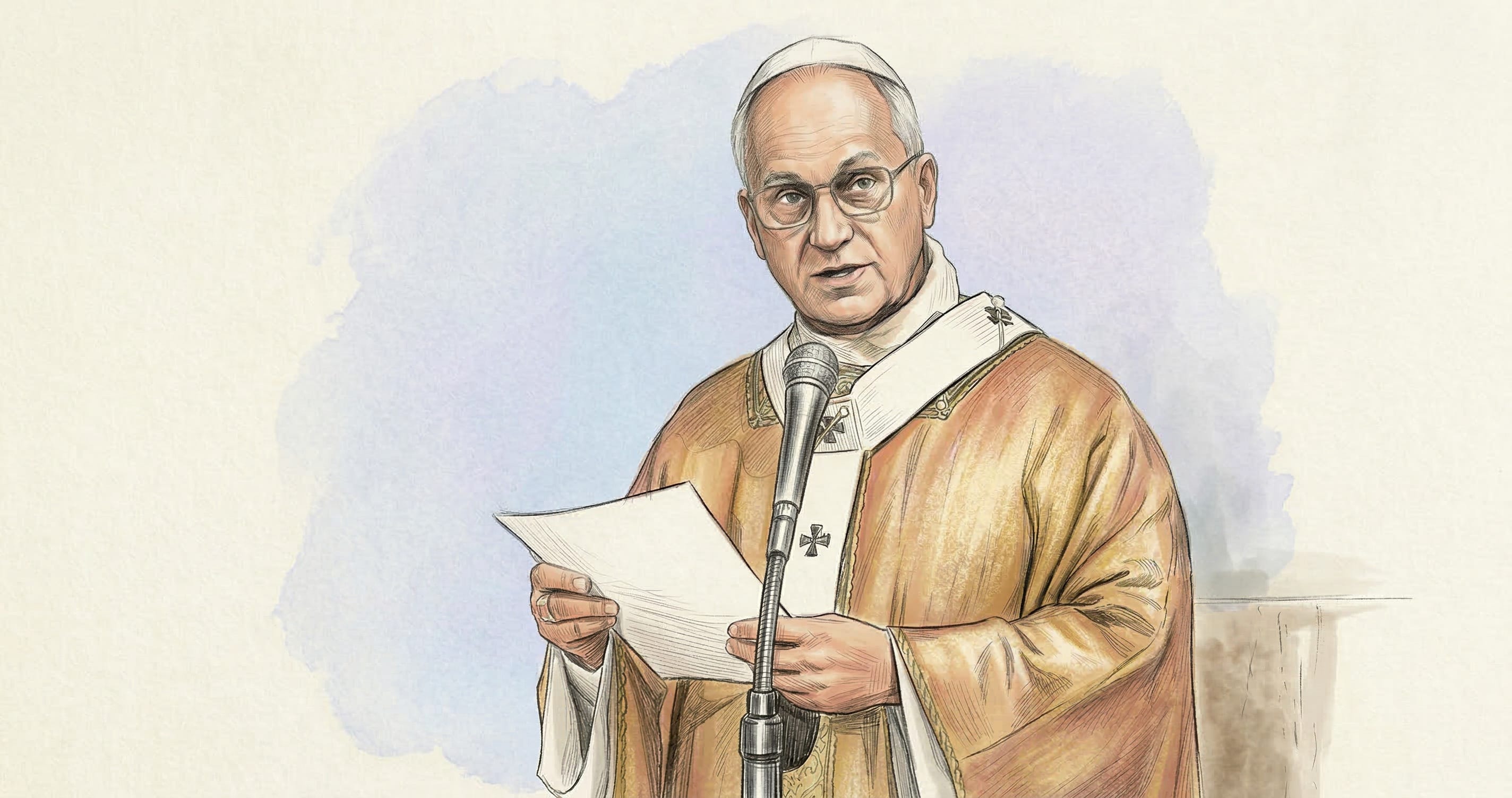
“God Cannot Be Enlisted in Darkness” — Pope Leo XIV Demands Ceasefire in Iran
Days after Pete Hegseth said the U.S. war in Iran is protected by God, Pope Leo XIV denounced those who “involve the name of God in choices of death.”
Dear friends —
On a single Sunday in March, Pope Leo XIV used every platform available to him — the Angelus, a parish homily, and the weight of his moral office — to demand an end to the war in Iran.
Today’s essay covers the full sweep of the pope’s remarks, from his ceasefire demand at the Angelus to his words at a working-class Roman parish hours later.
Thanks to your support, Letters from Leo can contextualize and deliver the pope’s words to an English-speaking audience within hours of their delivery.
We’re the only outlet in the world with the depth to connect Pope Leo XIV’s moral vision to the shifting ground of American politics every single day— because I’ve spent the past fifteen years deeply embedded in both the life of the Catholic Church and the machinery of U.S. political power.
If you’re already a paid subscriber, thank you. If not, I invite you to join us. And as always: if you need help with your subscription, just reply to this email.
On Sunday morning, from the window of the Apostolic Apartment overlooking St. Peter’s Square, Pope Leo XIV delivered his most forceful condemnation of the Iran war since the bombing began two weeks ago.
“For two weeks, the peoples of the Middle East have been suffering the atrocious violence of war,” the pope told the crowds gathered for the Angelus. Then he turned directly to the leaders responsible for the conflict: “Cease fire so that avenues for dialogue may be reopened.”
The words landed with the force of a verdict. For the first two weeks of the U.S.-Israeli campaign against Iran, history’s first American pope had measured his public statements carefully — appealing for diplomacy and dialogue without naming the United States or Israel directly, consistent with Vatican diplomatic tradition.
Today was different.
Leo spoke of the attacks “which have hit schools, hospitals, and residential centers.”
He expressed closeness to the families of those killed. Iranian authorities and the Red Crescent estimate between 1,230 and 1,300 civilians have been killed since February 28, though the figures have not been independently verified.
Among the deadliest incidents was a missile strike on a girls’ elementary school in Minab on the war’s opening day, killing between 168 and 180 people, most of them children.
“Violence can never lead to the justice, the stability, and the peace that people are awaiting,” Leo said.
He also expressed grave concern for Lebanon, where Israeli air strikes have killed more than 800 people and displaced over 800,000 from their homes. Drones struck targets across Saudi Arabia, Dubai, Qatar, and Kuwait on Sunday. The U.S. Embassy in Baghdad urged American citizens to leave Iraq immediately after a missile hit the compound on Saturday.
The war is metastasizing across the Middle East. The pope sees it.
From the Vatican to a Working-Class Parish
Hours after the Angelus, Leo traveled to the Sacred Heart of Jesus Parish at Ponte Mammolo in northern Rome — the fifth and final stop in a series of Lenten parish visits across the five pastoral sectors of his diocese.
Before Mass, Leo met privately with elderly residents and people with disabilities. He spoke with homeless individuals who use the parish’s support services. He sat with children from the oratory and with families — Peruvian, Ukrainian, Italian — who have made this parish on Rome’s periphery a genuine community of welcome.
The Gospel for Laetare Sunday was the account of Jesus healing the man born blind from John 9.
Leo preached on spiritual blindness, on the refusal to see suffering when it demands something of us. “We must overcome the prejudices of those who, faced with a suffering person, only see an outcast to be despised, or a problem to be avoided,” he said, “locking themselves in the fortified tower of selfish individualism.”
“In the world, many of our brothers and sisters suffer because of violent conflicts,” Leo said, “provoked by the absurd claim of resolving problems and differences with war, while it is necessary to dialogue tirelessly for peace.”
“Someone, then, presumes to involve the name of God in these choices of death,” he continued, “but God cannot be enlisted by the darkness. He comes, rather, always, to bestow light, hope, and peace upon humanity, and it is peace that those who invoke him must seek.”
The contrast with Washington could not be sharper. Defense Secretary Pete Hegseth — who has a Jerusalem cross tattooed across his chest and titled his book American Crusade — told CBS News that American troops in Iran are protected by “the providence of our almighty God.”
Military commanders across more than 50 installations have reportedly framed the conflict as a biblically sanctioned holy war, prompting 30 members of Congress to request an investigation into religious rhetoric at the Pentagon.
The pope’s words from Ponte Mammolo land squarely on this: someone presumes to involve the name of God in choices of death. Leo is not speaking in abstractions. He is describing what the United States government is doing right now.
In a war launched and sustained by leaders who profess Christian faith, the pope is telling them that God is not on their side — that invoking his name while ordering missile strikes is a presumption the Gospel will not sustain.
Two Weeks of Unrelenting Moral Pressure
Leo spoke of the attacks “which have hit schools, hospitals and residential centers.” He expressed closeness to the families of those killed. Iranian authorities and the Red Crescent estimate between 1,230 and 1,300 civilians have been killed since February 28, though the figures have not been independently verified. Among the deadliest incidents was a missile strike on a girls’ elementary school in Minab on the war’s opening day, killing between 168 and 180 people, most of them children.
Cardinal Robert McElroy, the archbishop of Washington, applied the Church’s just war doctrine directly to the conflict and found it wanting on every count.
“The criterion of just cause is not met because our country was not responding to an existing or imminent and objectively verifiable attack by Iran,” McElroy said. He added that “our goals and intentions are absolutely unclear” and that “it is far from clear that the benefits of this war will outweigh the harm which will be done.”
Cardinal Blase Cupich of Chicago confronted the grotesque spectacle of the White House social media operation.
“More than 1,000 Iranian men, women and children lay dead after days of bombardment,” Cupich said. “A real war with real death and real suffering being treated like it’s a video game — it’s sickening.”
At the Vatican, Secretary of State Cardinal Pietro Parolin rejected Washington’s “preventive war” justification outright, warning in an interview with Vatican News that “this erosion of international law is truly worrying: justice has given way to force; the force of law has been replaced by the law of force.”
And on Friday — just two days before Sunday’s ceasefire demand — Pope Leo posed a question to a gathering of priests that reads now like a direct precursor to everything he said this weekend. “Do those Christians who bear grave responsibility in armed conflicts,” Leo asked, “have the humility and courage to make a serious examination of conscience and to go to confession?”
The Political Undercurrent
The pope has not named names. He doesn’t have to. Vice President JD Vance and Secretary of State Marco Rubio are both Catholic — two of the most powerful Catholics in the United States government, both widely seen as frontrunners for the 2028 Republican nomination.
When the pope asks whether Christians who bear responsibility for armed conflicts have the courage to go to confession, the question arrives at their door with a very specific return address.
Whether Rubio’s hawkish embrace of the war or Vance’s more ambivalent positioning proves more politically advantageous in the 2028 primary remains to be seen. What the pope has made clear is that neither posture satisfies the moral demands of the faith both men profess.
Cease Fire
Pope Leo XIV spent an entire Sunday — morning, afternoon, and evening — telling the world that this war is an abomination.
The Angelus delivered the headline from the window of the Apostolic Palace: cease fire.
Hours later, from the pulpit of a working-class Roman parish, the homily supplied the theology: God cannot be enlisted by darkness.
And Friday’s question to the priests — whether Christian war-makers have the courage to confess — now reads as the moral prelude to everything that followed.
Taken together, the message is unmistakable. The first American pope is telling his own country — and every nation participating in this war — that the killing must stop.
A girls’ school in Minab was leveled on the first day of bombing, and the casualty figures have only climbed since. Entire neighborhoods in Tehran, Beirut, and cities across the region lie in rubble while the White House posts highlight reels.
This pope will not be silent. The question is whether anyone in Washington is listening.
At Letters from Leo, we stand with Pope Leo XIV and the millions of American Catholics — and countless others of goodwill — who believe that launching a war of choice against a nation of 88 million people, killing children in their classrooms, and treating the carnage as content is a moral catastrophe that demands the loudest possible objection from every person of conscience.
In an era where the force of law has been replaced by the law of force — where Christian leaders order airstrikes and then invoke God’s blessing — we remain rooted in a faith that measures power by its mercy, not its missiles.
This is the fastest-growing Catholic community in the country because people are hungry for something deeper than propaganda dressed up as patriotism. They want moral clarity grounded in the Gospel and the courage to say what the pope is saying: cease fire.
If you believe this movement matters — Catholics and people of goodwill standing for human dignity against the machinery of war — I am asking you to join us.
If you’d like to invest in our mission, here are three ways you can help:
Subscribe as a paid member to receive exclusive posts about the life and formation of Pope Leo and help sustain this newsletter.
Donate with a one-time gift to fuel this project’s mission.
Share this post (and Letters from Leo) with a friend who might enjoy it.
Paid subscribers have access to our ongoing biographical series on Pope Leo’s Life & Formation, The Epstein-Bannon Investigation, and the Lenten Reflection Series, along with the Q&A mailbag where you can ask me anything about American politics, Catholicism, Donald Trump, Pope Leo, JD Vance — or my own faith, biography, and life.
Whether you give $0, $1, or $1,000, your presence here matters — no matter your faith or your politics.
Thank you for reading. I’ll see you on the road.


“We must overcome the prejudices of those who, faced with a suffering person, only see an outcast to be despised, or a problem to be avoided,” he said, “locking themselves in the fortified tower of selfish individualism.”
beautiful, poignant words, I'm glad he's being more direct in his criticism of the responsible parties
I commend Pope Leo for speaking against war and calling out the leaders who are responsible for the unnecessary deaths of innocent civilians. This war makes no sense. Unfortunately, I don't think that those responsible for taking us to war really are Christians who follow the teachings of Jesus Christ. Nor do I think they have any desire to heed the advise of the leader of the Catholic Church.