
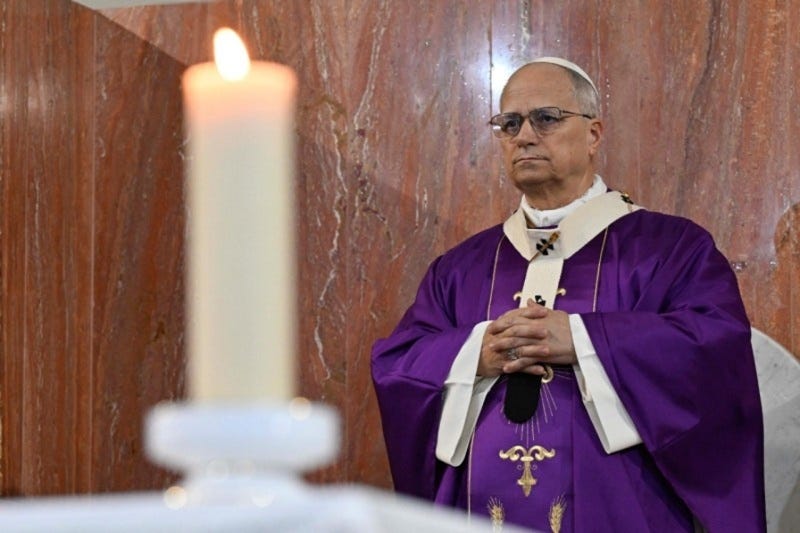
“Violence Is Never the Right Choice” — Pope Leo XIV Laments “War Again” In Middle East
He told the world to stop a war. Then he sat with mothers of addicted children in the Quarticciolo.
Thank you for reading! Letters from Leo is a reader-supported publication. If you find value in my work, please consider becoming a paid subscriber or making a one-time donation.
On Sunday afternoon, Pope Leo XIV stepped out of his car and into the Quarticciolo — one of Rome’s most dangerous neighborhoods and one of its largest open-air drug markets. It was the first time a pope had set foot in this corner of the city in 46 years, since John Paul II came on February 3, 1980.
He did not begin with a speech. He began by listening.
The pope met first with children on the parish sports field at the Church of the Ascension of Our Lord Jesus Christ, tended by the Dehonian Fathers — an order of priests who have stayed in the Quarticciolo when others left. The parish motto is “Let’s Build Community.” Leo told the children he was “very happy to be here with you this evening.”
Then he spoke frankly about the evil in their neighborhood — the drugs, the violence — and told them that human freedom means we can choose goodness, and that choosing goodness, again and again, is how we gradually transform the world.
“Always reject what harms your health,” the pope told them. “Say yes to what is good. Always no to drugs, yes to wellbeing.”
Then he turned, even there, to the war.
“I’m deeply concerned, and we don’t know how many days it will last, about the situation in the Middle East,” he said. “War again! And we must be heralds of Jesus’ peace, which God desires for everyone! We must pray much for peace, live in unity, and reject the temptation to harm others; violence is never the right choice.”
He told the children of the Quarticciolo that believers must be “messengers of peace.” He spoke of children in Gaza: “Many children in this world have no family, home, food, or bed. This is a tragedy we see. In Gaza, many children died, lost parents, school, and shelter.”
He met with the elderly and the sick. He told them that when they gather together despite their individual struggles, they experience a force far greater than any one person — the love of God, which makes them a family supporting one another. He urged the parish community to make its voice heard before the authorities, advocating for the vulnerable.
In his homily, Pope Leo preached the Transfiguration — the Gospel of the Second Sunday of Lent (Matthew 17) — and wove it into the fabric of what he had just witnessed. He told the parish that life is a journey that requires trust, and that we are always tempted to control everything, when the true treasure is found in accepting God’s hidden promises.
He used the image of the precious pearl hidden in the field. He connected Abraham’s journey of faith to the Transfiguration: both demand that we walk into the unknown, trusting that God’s light will meet us there.
He praised the parish’s commitment to building community and encouraged the young members of its Magis movement. He told them the Church needs their witness.
The Angelus
Hours earlier that morning, the pope had stood at the window of the Apostolic Palace and laid the theological groundwork for what he would do that afternoon.
Reflecting on the Transfiguration, Leo described Christ’s radiance on Mount Tabor as something that “foreshadows the light of Easter: an event of death and resurrection, of darkness and new light that Christ radiates on all bodies scourged by violence, crucified by pain, or abandoned in misery.”
He said the Transfiguration “transfigures the wounds of history, enlightening our minds and hearts.” Then he asked the crowd a question that hung in the Lenten air: “Does this captivate us? Do we see the true face of God with a gaze of wonder and love?”
Then the pope turned from Mount Tabor to the fires burning across the Middle East.
Less than forty-eight hours earlier, as I reported on Saturday, the United States and Israel launched a joint military assault on Iran — Operation Epic Fury — targeting sites across Tehran, Isfahan, and Qom. Iranian state media confirmed the death of Supreme Leader Ayatollah Ali Khamenei after 37 years in power.
Tehran retaliated with missile strikes against Israel and Gulf nations hosting American military bases. The bombs fell just days after an Omani diplomat announced that a breakthrough on Iran’s nuclear program was within reach — that peace was close.
Pope Leo XIV did not mince words.
“I address to the parties involved a heartfelt appeal to assume the moral responsibility to stop the spiral of violence before it becomes an irreparable abyss,” he said. He warned the world was staring at “a tragedy of enormous proportions.”
And then he delivered the line that will echo far beyond the square: “Stability and peace are not built with mutual threats, nor with weapons, which sow destruction, pain, and death, but only through a reasonable, authentic, and responsible dialogue.”
He called on diplomacy to “recover its role” and demanded that the good of peoples be promoted — “peoples who long for peaceful coexistence founded on justice.” And he closed with a plea that cut to the bone: “Let diplomacy silence the weapons.”
If you’ve been following this community’s coverage, none of this will surprise you. Pope Leo has been warning for months that the march toward war in the Middle East would end in catastrophe — issuing approximately 150 pleas against war in his first nine months as pope.
When the United States bombed three Iranian nuclear facilities last June, the pope stood in this same square and pleaded: “Stop the tragedy of war before it becomes an irreparable abyss.”
The White House did not listen. The bombs kept falling. And now the abyss has arrived.
The Light of Tabor Meets the Streets of Rome
The arc of this Sunday was remarkable. At noon, the pope preached the Transfiguration — Christ’s radiance piercing through darkness — and demanded that the nations stop a war.
By late afternoon, he was in the Quarticciolo, sitting with mothers of addicted children in a Roman neighborhood that most of the world has forgotten, telling children to be messengers of peace and telling the elderly that God’s love is a greater force than whatever has broken their families.
As I wrote in January, the God Pope Leo preaches is not a God who watches from afar. This is a God who steps into the suffering. On Sunday, Leo did exactly that — carrying the light of the Transfiguration from St. Peter’s Square to a forgotten Roman parish, from a plea for peace among nations to a quiet act of presence among the poor.
In the middle of Lent, in the middle of a war that should never have happened, Pope Leo XIV reminded us what it looks like when the Gospel is lived and not merely spoken.
At Letters from Leo, we stand with the millions of American Catholics — and countless others of goodwill — who believe that peace is not a naive aspiration but a moral imperative, and that the Church must stand with those who suffer, whether from the bombs of empires or the ravages of addiction.
In an era poisoned by cruelty and division, we remain rooted in a faith that refuses to flinch before injustice or bow to the idols of fear and authoritarianism.
We’re not just watching history. We’re making it.
This is the fastest-growing Catholic community in the country because people are hungry for something deeper than rage and cynicism.
They’re looking for courage, for truth, for love made visible in action — and right now, as bombs fall on Iran and a pope walks into a neighborhood others have abandoned, that hunger has never been more urgent.
If you’re ready to build a country — and a Church — that chooses dialogue over destruction, presence over indifference, and light over darkness, then I’m asking you to join us.
If you’d like to invest in our mission, here are three ways you can help:
Subscribe as a paid member to receive exclusive posts about the life and formation of Pope Leo and help sustain this newsletter.
Donate with a one-time gift to fuel this project’s mission.
Share this post (and Letters from Leo) with a friend who might enjoy it.
Paid subscribers have access to the Lenten Reflection Series and our new investigative series on Jeffrey Epstein and Steve Bannon’s attempt to take down Pope Francis.
You’ll also get access to the Q&A mailbag that opened last month, where you can ask me anything about American politics, Catholicism, Donald Trump, Pope Leo, JD Vance — or my own faith, biography, and life.
Whether you give $0, $1, or $1,000, your presence here matters — no matter your faith or your politics.
Thank you for reading. I’ll see you on the road.


I'm a fallen away Catholic (mainly due to women issues) but I read every word Leo is saying and pray for his protection and ongoing courage
We especially need to pray for peace this Lent. Pope Leo is correct about the folly of this war. It reminds me of the old saying that “fools rush in where angels fear to tread.”