


Dear friends —
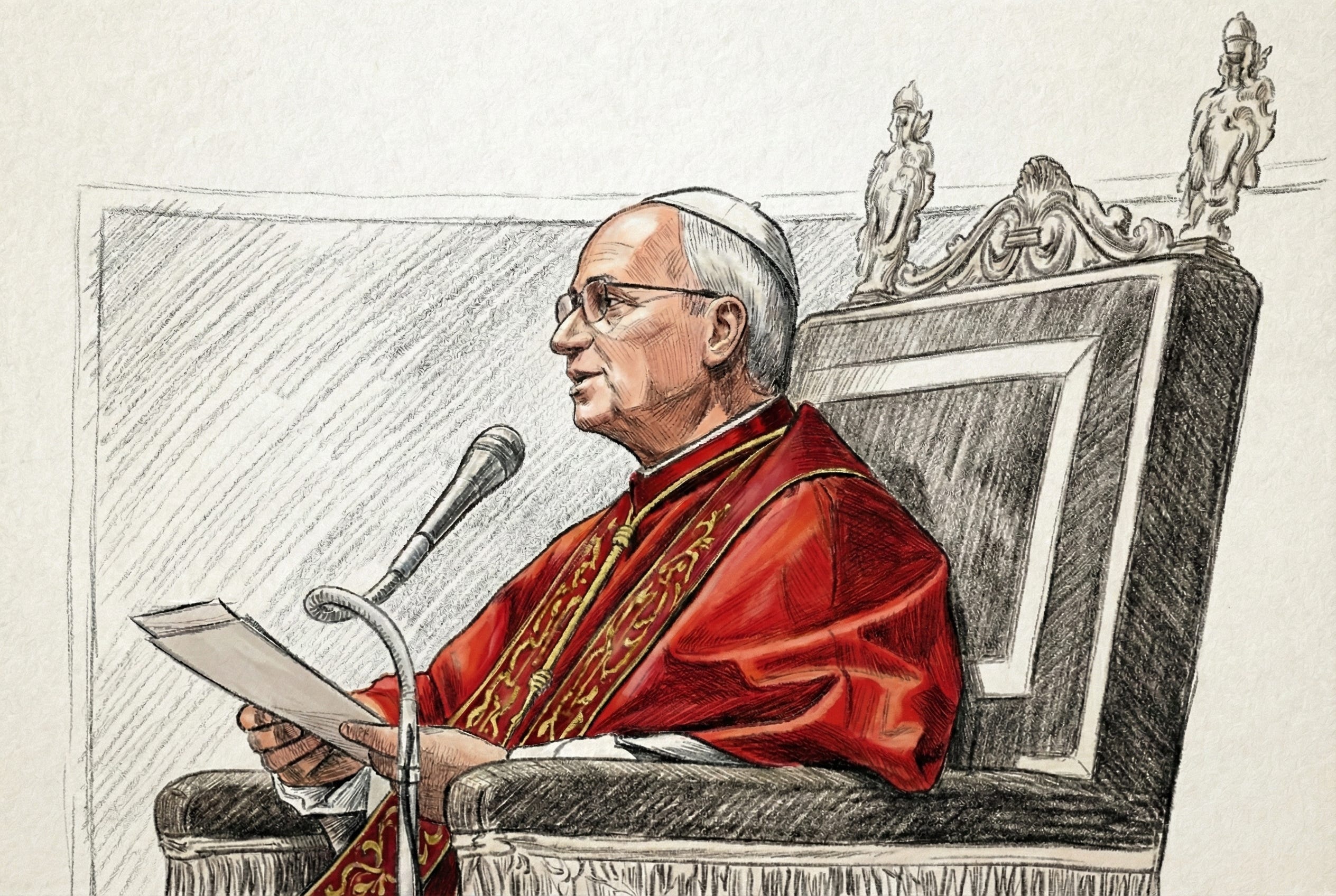
Today’s paid subscriber-only essay distills Pope Leo XIV’s State of the World Address delivered at the Vatican yesterday — a sweeping, 47-minute speech that is already shaping how this pontificate will be understood.
It was, by far, the longest major address Leo has given since ascending to the Chair of St. Peter. By the end, he looked visibly tired. But the length mattered. This was not ceremonial rhetoric. It was a statement of priorities.
Much of the media coverage has rightly focused on Leo’s forceful condemnation of war — especially given the timing. Just days after President Trump ordered a U.S. military invasion of Venezuela, Leo warned that “war is back in vogue,” denounced a “diplomacy based on force,” and insisted on the sovereignty of nations and the rule of law. The context was unmistakable.
But the address — and the moment surrounding it — revealed more than that.
In today’s piece, I also examine a visibly stiff exchange between Leo and Trump’s ambassador to the Holy See, Brian Burch, in the greeting line after the speech. The interaction raised an obvious question: was the tension connected to Burch’s public misrepresentation of Leo’s remarks on Venezuela last week — an extraordinary breach of U.S.–Vatican diplomatic norms?
That episode offers a window into something larger.
In this essay, I step back and ask what is beginning to emerge as uniquely Leo about this pontificate — especially in comparison to Pope Francis’s own annual State of the World addresses. Where Francis often spoke with sweeping, poetic urgency, Leo’s tone is proving more surgicial, more juridical, and, at times, more willing to confront state power directly — including, notably, the actions of his own country.
At the same time, Leo struck a more measured note on issues like abortion and family life: affirming Church teaching clearly, but without the rhetorical fireworks that characterized many of Francis’s speeches. That contrast matters. It tells us how Leo understands this historical moment — and where he believes the Church’s moral authority is most urgently needed.
Because the full address ran nearly an hour, today’s essay does the work of distillation — pulling out the core themes, the points of continuity with Francis, and the early signals of divergence. You can read it in just a few minutes and still grasp what this speech means for global politics, Catholic social teaching, and the trajectory of Leo’s leadership.
If you’re already a subscriber, thank you. Your support makes careful, independent analysis like this possible.
If you’re not yet subscribed, I invite you to join us today for full access to our reporting on Pope Leo XIV and his growing impact — along with our Sunday Reflection Series, written to help us think clearly and faithfully about following Jesus amid today’s political realities.
Thank you for reading. I’ll see you on the road.

Speaking to ambassadors at the Vatican yesterday, Pope Leo XIV did not mince words about the global slide into conflict.
“War is back in vogue and a zeal for war is spreading,” he warned. Leo lamented that the post-World War II principle barring nations from invading neighbors “has been completely undermined,” with military might supplanting dialogue.
He decried how peace is no longer pursued as a gift but rather “through weapons as a condition for asserting one’s own dominion” — a path that “gravely threatens the rule of law”.
Those lines dominated media coverage of the address, and rightly so. The world is on edge: Russia’s war in Ukraine rages, and in a shocking turn, the U.S. under President Donald Trump launched a military invasion of Venezuela days ago.
Pope Leo’s remarks came just after he publicly criticized that operation. The pope renewed his appeal “to respect the will of the Venezuelan people, and to safeguard the human and civil rights of all”. The context was unmistakable — Trump’s capture of Venezuelan leader Nicolás Maduro and threats of wider action.
The day after U.S. troops invaded Caracas, Leo issued a stark warning, insisting on Venezuela’s sovereignty.
In a significant breach of U.S.–Vatican diplomatic norms, President Trump’s ambassador to the Holy See, Brian Burch, subsequently released a statement that misrepresented Leo’s remarks in an effort to justify the U.S. military invasion.
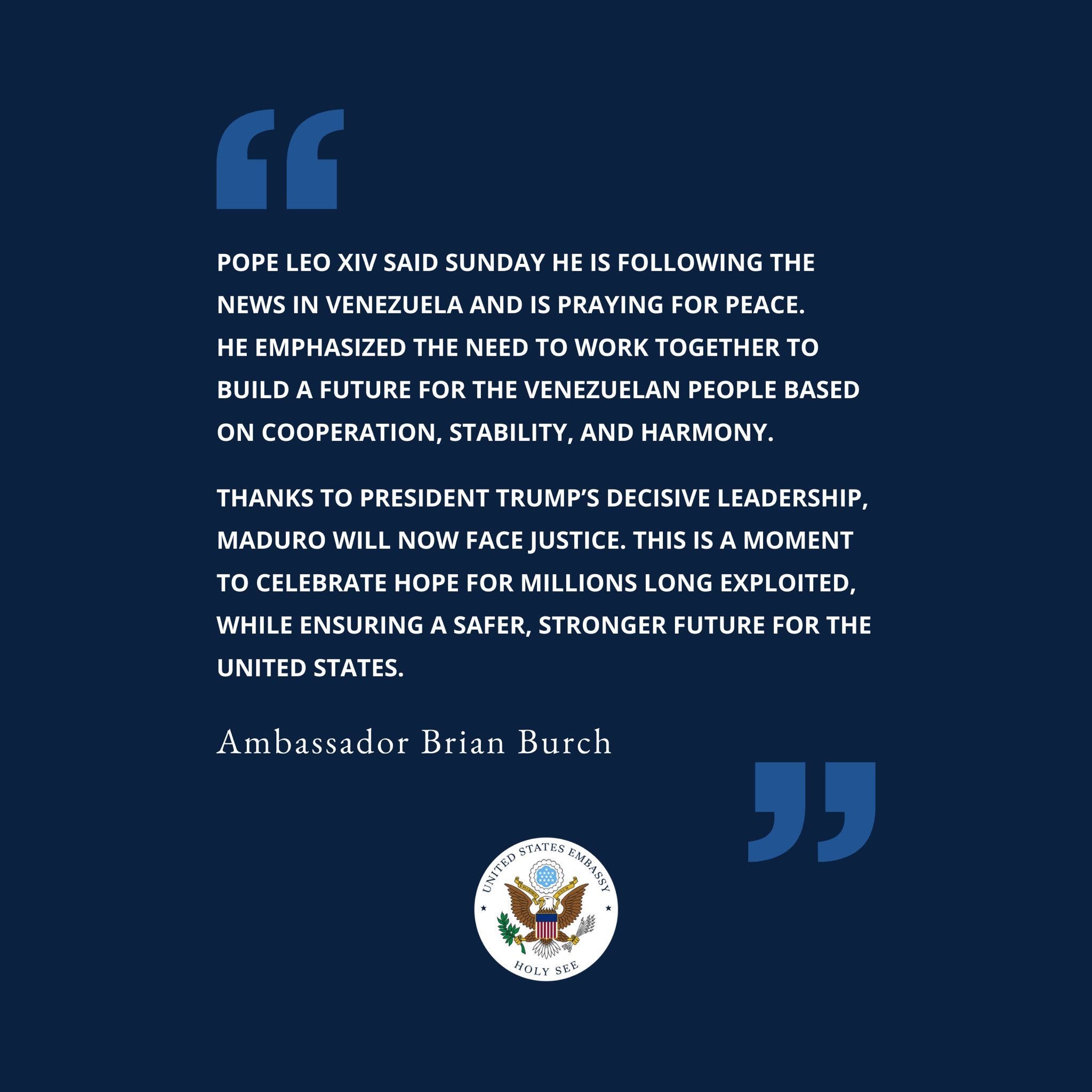
Such a public distortion is unprecedented in the forty-year history of formal diplomatic relations between the two governments.
In his formal address yesterday, Leo left no room for ambiguity, condemning a “diplomacy based on force” that endangers entire populations.
In the greeting line after the pope’s speech, Burch and Leo exchanged a noticeably stiff interaction. If anyone can read lips in the video below, please let me know what they said to each other.
Leo’s forceful appeals for peace aligns with the tone Pope Francis struck in his own annual addresses. Francis often used the forum to demand an end to wars — in 2023, he thundered that the “third world war” was already underway and begged for disarmament.
Like Francis, Leo enumerated conflicts from Ukraine to the Holy Land and appealed for an immediate ceasefire in war zones. He also urged reinvigorating multilateral institutions, calling on the United Nations to refocus on uniting humanity and curbing the “devastating effects of war”.
There is clear continuity: both popes see war as a “crime against God and humanity” and use these speeches to elevate peace as the paramount goal.

Yet Leo’s own emphasis is taking shape. As an American and a former Peruvian missionary bishop immersed in global justice issues, Leo is proving unafraid to challenge his homeland’s actions on the world stage.
His phrase about war being “in vogue” has a blunt, prophetic edge — implicitly reproving leaders who treat military solutions as fashionable. Francis, for his part, often spoke in sweeping terms about a “piecemeal World War III” and condemned the arms race and nuclear weapons.
Leo echoes those themes but zeroed in on the erosion of international norms in real time.
His invocation of St. Augustine’s City of God set the frame: he warned, as Augustine did, of prideful nationalism and “false representations of history” leading nations astray.
The result is a papal voice that is at once continuous with Francis’s peace teaching and distinctly Leo’s — morally urgent, and pointedly relevant to flashpoints like Venezuela.
A More Measured Voice on Social Issues
If Pope Leo came out swinging on war, he struck a quieter tone on issues of human life and family — at least by comparison to Pope Francis’s past addresses.
Francis was outspoken and colorful on abortion; in his 2023 speech, he flatly rejected any “‘right to abortion’” and lambasted that idea as a form of “ideological colonization” imposed by wealthy nations.
He has even likened abortion to “hiring a hitman” in unscripted remarks — vivid language that signaled how passionately he viewed the matter.
Leo, a doctrinally firm but pastorally cautious leader, has so far been more muted than his predecessor.
In fact, this diplomatic address is the most vocal Leo has been about abortion since becoming pope.
Here’s what Leo said, how it was different from Francis, and why it matters.
