
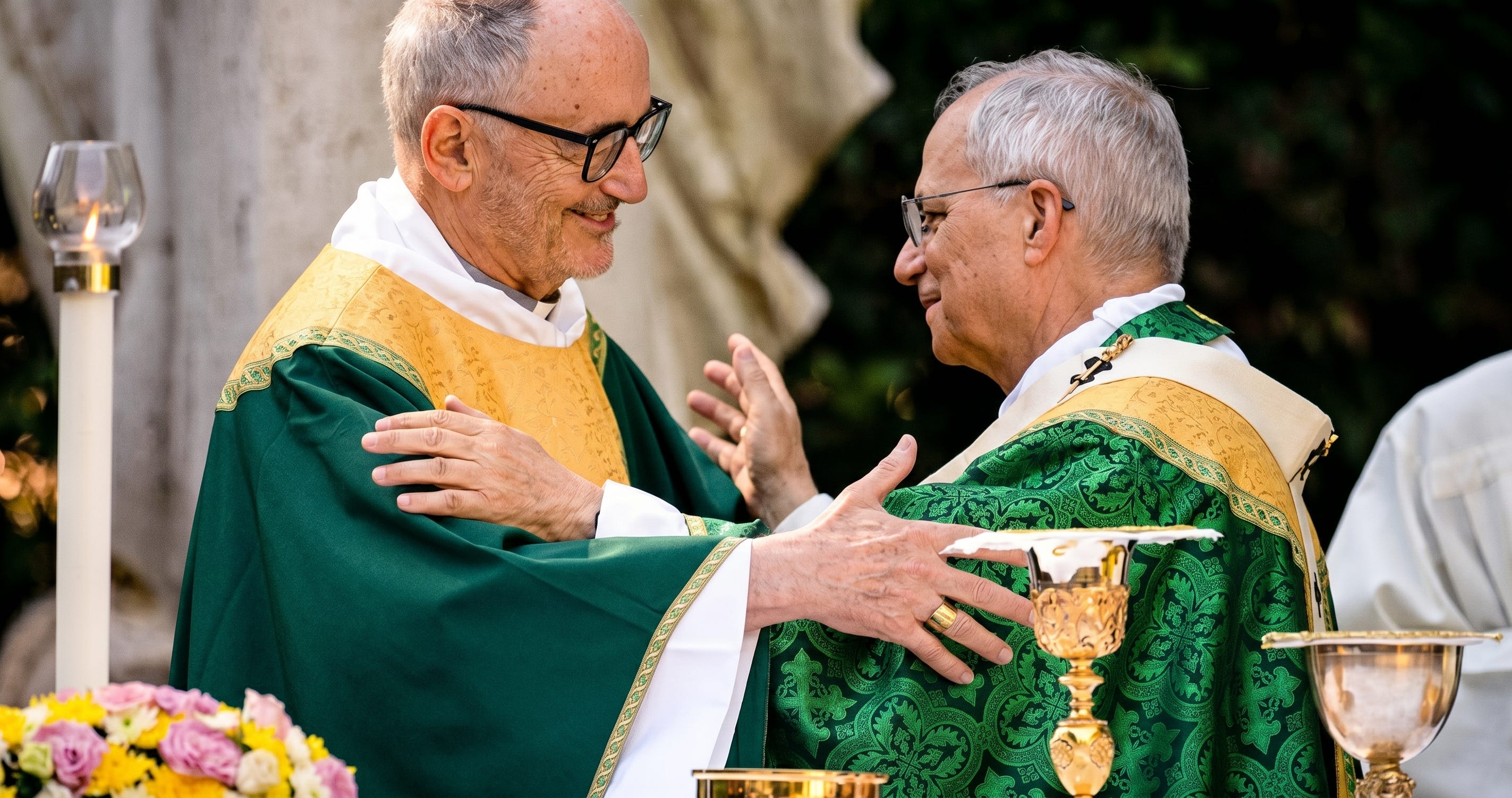
“Life Is Political” — Cardinal Michael Czerny Defends Pope Leo XIV’s Amidst Trump Attacks
Recorded on April 13 — the day Trump opened his tirade against Pope Leo XIV — and released only today, the new CBS interview shows why Czerny is the sharpest interpreter of this papacy.
Thank you for reading! Letters from Leo is a reader-supported publication. To receive new posts and support the mission, consider becoming a free or paid subscriber.
Cardinal Michael Czerny continues to be the best English-language interview in the Catholic Church.
The Jesuit prefect of the Vatican’s Dicastery for Promoting Integral Human Development is the cardinal most fluent in the social-justice grammar this papacy is being built on.
Czech-born and Canadian-raised, Czerny has served in Toronto, where he founded the Jesuit Centre for Social Faith and Justice, at the University of Central America in El Salvador, in Nairobi as founding head of the African Jesuit AIDS Network, and then in Rome at the inner core of Pope Francis’s curia and now Pope Leo XIV’s.
CBS News released a new sit-down yesterday between Czerny and Norah O’Donnell — roughly seven minutes on Pope Leo XIV’s first year, the moral case for the American bishops’ defense of migrants, the Church’s growing posture on artificial intelligence, and the line between political responsibility and partisan posture.
The conversation was recorded in early April — the week Donald Trump launched his now-famous tirade against Pope Leo in response to the CBS joint interview with Cardinals Blase Cupich, Robert McElroy, and Joseph Tobin that had the same night.
For nearly six weeks, the tape sat in CBS’s vault before going public this morning, dropping into a different news cycle with all the political wreckage of the past few weeks behind it.
I have followed Czerny’s back-and-forths with O’Donnell over the past few years closely. The pattern is steady: I never leave one of these interviews without learning something I didn’t walk in with.
The first thing to know about Czerny — what makes him such a strong English-language voice for Pope Leo’s mission — is that he refuses to play inside the cramped binaries American journalists keep handing him.
The pattern was on full display in his sit-down with O’Donnell a year ago, between Pope Francis’s funeral and the conclave that elected Leo. O’Donnell asked Czerny whether the cardinals were facing a choice of “continuity or change.”
Czerny refused the premise on the spot. “I can’t accept that question as it is,” he told her. “The choice is not between continuity and change. The choice is to go forward. And that includes both continuity and change. That has always been our way forward.”
In the new interview, he does it again. O’Donnell asks how the new pope is “fitting into that” — meaning continuity and change. Czerny answers gently but firmly: “It always includes continuity and change. That was not a very special insight. That’s just how every election of every pope — ”
He didn’t finish the sentence. The premise itself was the problem.
The pattern reappeared in a separate interview Czerny gave a year ago with EWTN’s Montse Alvarado, who tried to get him to confirm that the cardinals had been “checking boxes” — canon law expertise, global diplomacy, evangelization — as they discerned the next pope.
Czerny declined the framing. “We’re not checking boxes,” he replied. “We’re trying to get a sense of who can lead the Church in our mission of evangelization, beginning in 2025.”
When Alvarado then asked about migration, Czerny pushed the question further out: “Work is a greater issue than migration. Work affects most of us.” The choice of the name Leo, he reminded her, was a deliberate reach back to Leo XIII — the pope of Rerum Novarum and the dignity of labor.
He pulls the same move when O’Donnell asks how Pope Leo has “empowered” the American bishops to speak out on migration. “It’s exactly the other way around,” he replies.
“The bishops don’t need the Holy Father to empower them. They are empowered, and they are doing what their vocation and mission asks them to do, which is to respond to the challenges, the big challenges, the important challenges facing their people.”
That answer matters. Cardinal Cupich in Chicago, Cardinal McElroy in Washington, and Cardinal Tobin in Newark did not need a permission slip from the new pope to defend the gospel against Donald Trump’s ICE raids — they were already empowered by their ordination.
Pope Leo, in Czerny’s telling, does what a good pope does: he supports them as they do their job.
O’Donnell then asks Czerny whether the bishops’ migrant advocacy might be seen as “political.” His answer follows.
“Life is political,” Czerny tells her. “It’s not either political or not political. It is political because life is political. Political is how we live together and how we face our problems together. We can’t be non-political. We don’t have to be partisan, but let’s not get confused between partisan and political. Political means taking responsibility for our world and for its problems, especially as they affect those who are weakest.
“That’s politics. Everybody’s responsible for that. You don’t have to be a Christian. You just have to be a human being, and you’re responsible for what’s happening to your brothers and sisters.”
This is the truth of the gospel of Jesus Christ in a few breaths.
Catholics are called to be political because politics is taking responsibility for the people God has placed alongside us, and the refusal to abandon a neighbor is the most political act there is.
Opting out of that work, Czerny argues, means opting out of being human — never mind being Christian.
When O’Donnell asks why American Catholics seem to have shifted on migrants in the past year, Czerny gives her one sentence.
“Because people have experienced,” he replies, “that the migrants who have in many different ways become really our brothers and sisters are being cruelly treated. And we say, ‘No, you don’t treat my brother or sister like that.’”
That is the entire moral argument of the American Catholic immigration fight, compressed into a single line by a Jesuit who has lived this struggle on every continent.
On artificial intelligence — the subject of Pope Leo’s AI encyclical to be released on Memorial Day — Czerny previews where the Church is headed.
“What we’re going to hear is a message of both challenge and reassurance,” he says.
“The challenge is that we need to take responsibility — we, not just a few — for artificial intelligence. We have to struggle against certain control that is exercised now by a few in order to take human responsibility for this. But also the sense that, just like previous revolutions, the benefits of this revolution can and should and must reach all of us, not just a few.”
Those sentences are the philosophical core of Pope Leo’s papacy — on labor, on AI, on Silicon Valley’s wealth, on every revolution headed our way. The benefits of human progress and the responsibility for stewarding it both belong to the whole human family rather than a small group of owners.
Read Pope Leo’s encyclical alongside Czerny’s preview and you will see exactly where the Church is heading.
Czerny continues to be the best English-language interview in the Catholic Church because he refuses to let the question shape the answer. The gospel demands a particular reply, and that — not the version the questioner wants — is what comes out of his mouth.
Catholic social teaching, in his treatment of it, has real weight: a body of doctrine that issues actual verdicts on the immigration fight, the political-versus-partisan question, and the demands of love of neighbor at the southern border.
He is the English-language interlocutor this American Catholic moment desperately needs. America has spent the past year watching its government brutalize migrants, threaten foreign nations, and turn cruelty into a campaign aesthetic.
Interviewed by O’Donnell the week Donald Trump publicly attacked the new American pope, Czerny gave the country the reply the gospel actually demands.
“If we just stay home and complain,” the cardinal warns, “or stay on our phones and complain, our world is going to become more and more and more messed up.”
I will keep watching Czerny’s interviews. Each one teaches me something I didn’t bring into it.
At Letters from Leo, we stand with Cardinal Czerny and every bishop, priest, religious sister, and lay Catholic who refuses to let American politics conscript the gospel and refuses, equally, to surrender the gospel’s claim on American politics.
The Catholic Church is not a partisan vendor — she is the human family insisting on the dignity of every one of her members, especially the ones being thrown into unmarked vans, separated from their children, and shipped to foreign jails.
In an era poisoned by cruelty and bound by binaries that flatten faith into team colors, this community holds the line by refusing both fear and false neutrality. Catholics from every parish, people of goodwill from every other tradition, and human beings with eyes to see the migrants being terrorized — together, not a few — are taking responsibility for the people God has placed alongside us.
This is the fastest-growing Catholic community in the country because hundreds of thousands of Americans are hungry for a faith that takes responsibility — for migrants, for workers, for a world that AI may reshape beyond recognition — without ever pretending the gospel is above the fight.
If you believe this work matters — Catholics and people of goodwill standing for human dignity against a politics that has decided to brutalize the weakest among us — I am asking you to join us.
If you’d like to invest in our mission, here are three ways you can help this Easter season:
Subscribe as a paid member to receive exclusive posts on the life and formation of Pope Leo XIV and to help sustain this newsletter.
Donate with a one-time gift to fuel this project’s mission.
Share this post (and Letters from Leo) with a friend who might enjoy it.
As a paid subscriber, you’ll receive deep-dives on Pope Leo’s Life & Formation, our ongoing Epstein-Bannon Investigation, and the weekly Sunday Scripture Reflection Series — work no other publication is doing at this scale.
Whether you give $0, $8, $80, $800, or more, your presence here matters — no matter your faith or your politics.
Thank you for reading. I’ll see you on the road.


The questions so many interviewers ask seem to beg an unequivocal “either/or” stance. I love the Cardinal’s and Pontiff’s reframing of those questions.
I was raised Roman Catholic, and while I no longer believe in a specific supreme power, nor organized religion, I do believe in truth, kindness, love and our shared responsibility for all of humanity, the creatures of this Earth, and the Earth itself.
Pope Leo is steadfast and confident in those same beliefs, which gives him the courage to face down critics. He is every bit as inspiring as Pope Francis, whom I also greatly admired.
Pope Leo is a shining beacon of light in the darkness of a world in crisis. And he is surrounded by others who speak in clear, concise truths.