
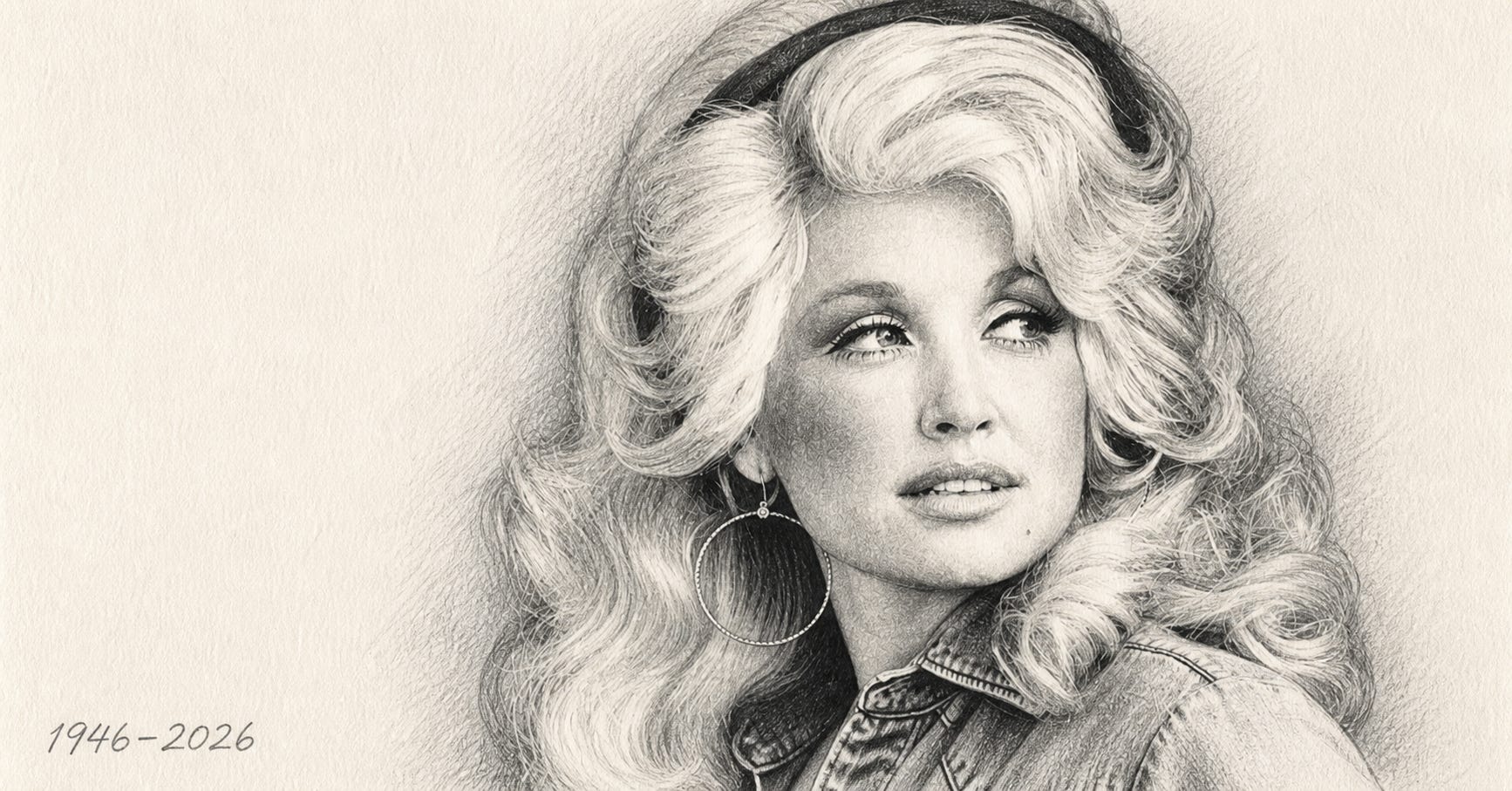
Dolly Rebecca Parton Dean died Tuesday in Nashville at the age of 80. Her nephew Bryan Seaver announced it in a video she had asked him to record for her death years in advance:
“Dolly has lived in the light and is in the arms of Jesus,” he said, “surely met by Carl, her parents, and countless others.”
I will admit up front that Dolly sits well outside the usual territory of these letters, which usually concern Pope Leo XIV, the Catholic Church, and the fight for human dignity in American public life. But outside of my faith and my family, nothing matters more to me than being a Tennessean and an American, so I feel obliged to speak on the life and death of one of the last people in America admired across every line that divides us.
When the news reached my desk earlier this afternoon, I immediately broke down in tears — and I suspect a good many of you did too.
She was born on January 19, 1946, in a one-room cabin on Locust Ridge in Sevier County, the fourth of twelve children of Robert Lee Parton and Avie Lee Owens Parton. For those of you who don’t know Tennessee, Sevier County is a beautiful community located in the Smoky Mountains but, like many places in the rural South, has for generations struggled with poverty and, more recently, alcohol and drug epidemics.
Her delivery doctor, Robert F. Thomas, was paid with a sack of cornmeal because that was all that her father had. “I remember the time we didn’t have electricity in the early days,” she said in recent years. “We barely made it, but we did make it. We had a lot of stuff that money can’t buy anyhow, things like love and kindness and understanding.”
The day after she graduated from high school in 1964, she left for the big city of Nashville. Within a few years, she was singing on Porter Wagoner’s television show, and by 1974 she had gone out on her own. The songs that followed (“Jolene,” “I Will Always Love You,” “9 to 5,” “Coat of Many Colors”) became a core part of American life.
That last one is about a patchwork coat her mother stitched from rags while telling her the story of Joseph in Genesis. It remains perhaps the best English-language song anyone has written about being poor and loved at the same time.
Her climb from that small East Tennessee cabin inspired millions of people who grew up with nothing. Most importantly, she never forgot where she came from.
In 1986, she opened Dollywood in Pigeon Forge, today the largest employer in that town. When wildfires tore through Sevier County in November 2016, her My People Fund raised $9 million for families who had lost their homes.
When the Tennessee legislature moved in 2021 to put a statue of her on the Capitol grounds, she asked lawmakers to withdraw the bill. “I don’t think putting me on a pedestal is appropriate at this time,” she wrote.
The gift that will outlast it all started in 1995 with her father. Robert Lee Parton could not read. “My daddy couldn’t read and write, but daddy was so smart, he could just do numbers in his head,” she said. So she started mailing a free book every month to every child in Sevier County, from birth until the first day of kindergarten.
In 2004, Gov. Phil Bredesen made Tennessee the first state to guarantee the program to every child under five, and governors of both parties have kept that promise since. Every Tennessee child gets a book in the mail each month because of her. Dolly Parton’s Imagination Library has now given away more than 300 million books across five countries.

Then there is the vaccine.
In April 2020, with the country shut down, she gave $1 million to Vanderbilt University Medical Center at the urging of her friend Dr. Naji Abumrad, a surgeon she had met after a car accident in 2013. That money helped pay for the early research behind Moderna’s COVID-19 vaccine, and when the New England Journal of Medicine published the trial results that November, the footnotes credited “the Dolly Parton Covid-19 Research Fund.”
The following March she rolled up her sleeve at Vanderbilt and sang “Vaccine, vaccine, vaccine, vaccine, I’m begging of you please don’t hesitate” to the tune of “Jolene,” and at the very moment the shot was hardening into a partisan marker, a 75-year-old woman from Sevier County moved more hesitant Americans than most public officials managed.
She was a trailblazer for women in a state that has produced a litany of them.
Wilma Rudolph left Clarksville for Rome in 1960 and came home with three gold medals. A few miles away, on a dairy farm in Henrietta, Pat Summitt was growing up to win 1,098 games as the head coach of the legendary University of Tennessee women’s basketball team.
The greatest of them may be Febb Burn, a widow from Niota who wrote her son Harry, a 24-year-old state legislator, a letter in August 1920 telling him to “hurrah and vote for suffrage.”

He did, on August 18 — 106 years ago last week — and Tennessee became the 36th and deciding state to ratify the 19th Amendment. American women vote today because a Tennessee mother got the job done.
Dolly belongs in that company. She walked into a Nashville that expected a girl from the hills to sing what she was handed, and instead she wrote her own songs and built a business under her own name.
In many ways she represents a bygone era of celebrity, when a person could have the character and the charisma to rise above the fray and be acclaimed by everyone.
Donald Trump mourned her Tuesday (“There has never been anyone like her, and never will”), as did Bill Clinton and Bernie Sanders. She guarded that standing on purpose. “I’ve got as many Democrats as I do Republicans as fans,” she once said, “and I’m not going to insult any of them because I care about all of them.”
She turned down the Presidential Medal of Freedom twice from the Trump White House, first because Carl was ill and again when the pandemic kept her from traveling. When the question came up again under President Biden, she hesitated for a different reason: “Now I feel like if I take it, I’ll be doing politics, so I’m not sure.”
Anyone who reads that refusal as a lack of courage misunderstands her. Funding a vaccine in the spring of 2020, when nobody knew whether one would work, took nerve. So did writing “Coat of Many Colors” for an industry that preferred its poverty sanded down, sentimental, and understated. She chose her fights with care and fought them without making an enemy of anyone on the other side.
As someone who once sought to represent this state in the United States Congress, I have held her up for years as the model of what character and integrity look like in public life. Of all the contributions I received in that campaign, few meant as much to me as the ones that came from members of the Parton family, including her sister Stella. I never got the chance to thank them. This essay is my feeble attempt to do so.
Above all of this, Dolly Parton was a Christian — a real one, the kind who practiced the Gospel of Jesus Christ instead of merely wearing the label for public notoriety. Her grandfather, the Rev. Jake Owens, was a Pentecostal preacher in the hills whose sermons, she wrote in Songteller, ran “so hot that you could feel the heat.”
What she carried out of that church was something gentler than the heat. Her whole Christian worldview fit in a single sentence, and she said it often. “I ain’t that good a Christian to think that I am so good that I can judge people. That’s God’s job, not mine.” Another time she put it this way: “We’re all God’s children. No matter how we try to get to heaven, we all wanna go there.”
That is a woman who was clearly touched by the Son of the Carpenter. She fed the minds of children she would never meet, helped heal the sick through a research fund with her name buried in a footnote, and built a public life on refusing to condemn anybody. Pope Leo XIV preached this summer about the merchant who sells everything he has for the pearl of great price. Dolly found the pearl young, in a cabin without electricity, and spent the rest of her life giving it away.
Carl Dean, her husband of nearly sixty years, died in March of last year. She admitted afterward that she had been neglecting “some health issues that I just didn’t pay attention to when I was watching over Carl.” Seventeen months later she went to join him.

Tonight I will stop by church to light a candle and pray for the repose of her soul. If you are a person who prays, I ask you to pray for her too. If you are not, read a book to a child this week; she probably would’ve liked that better than the candle anyway.
May the angels lead her into paradise. May the martyrs receive her at her coming, and may she rest, as her nephew said she wished after a lifetime in rhinestones, “in a beautiful bed of plush cotton.”
At Letters from Leo, we stand with the millions of Americans, Catholic and otherwise, who saw in Dolly Parton what a life poured out for other people actually looks like: a book in a child’s mailbox every month and a lifesaving shot in a stranger’s arm that she paid for before anyone asked.
In a country that has forgotten how to admire anything together, she was proof that character still travels across every line we draw.
That is the faith this community is built on, and it is why the fastest-growing Catholic community in the country exists. People across the nation and the globe are hungry for goodness they can trust, and they are finding it here.
If you believe that witness matters — a Tennessean’s conviction that the Gospel is something you practice, whatever you happen to argue about — I am asking you to join us.
Thank you for reading. I’ll see you on the road.


What a beautiful tribute. Thank you.
Beautiful remembrance for a lady beautiful inside and out. What will we do without her?