


Thank you for reading! Letters from Leo is a reader-supported publication and the fastest-growing Catholic community in the country. To receive new posts and support this movement, consider becoming a free or paid subscriber.
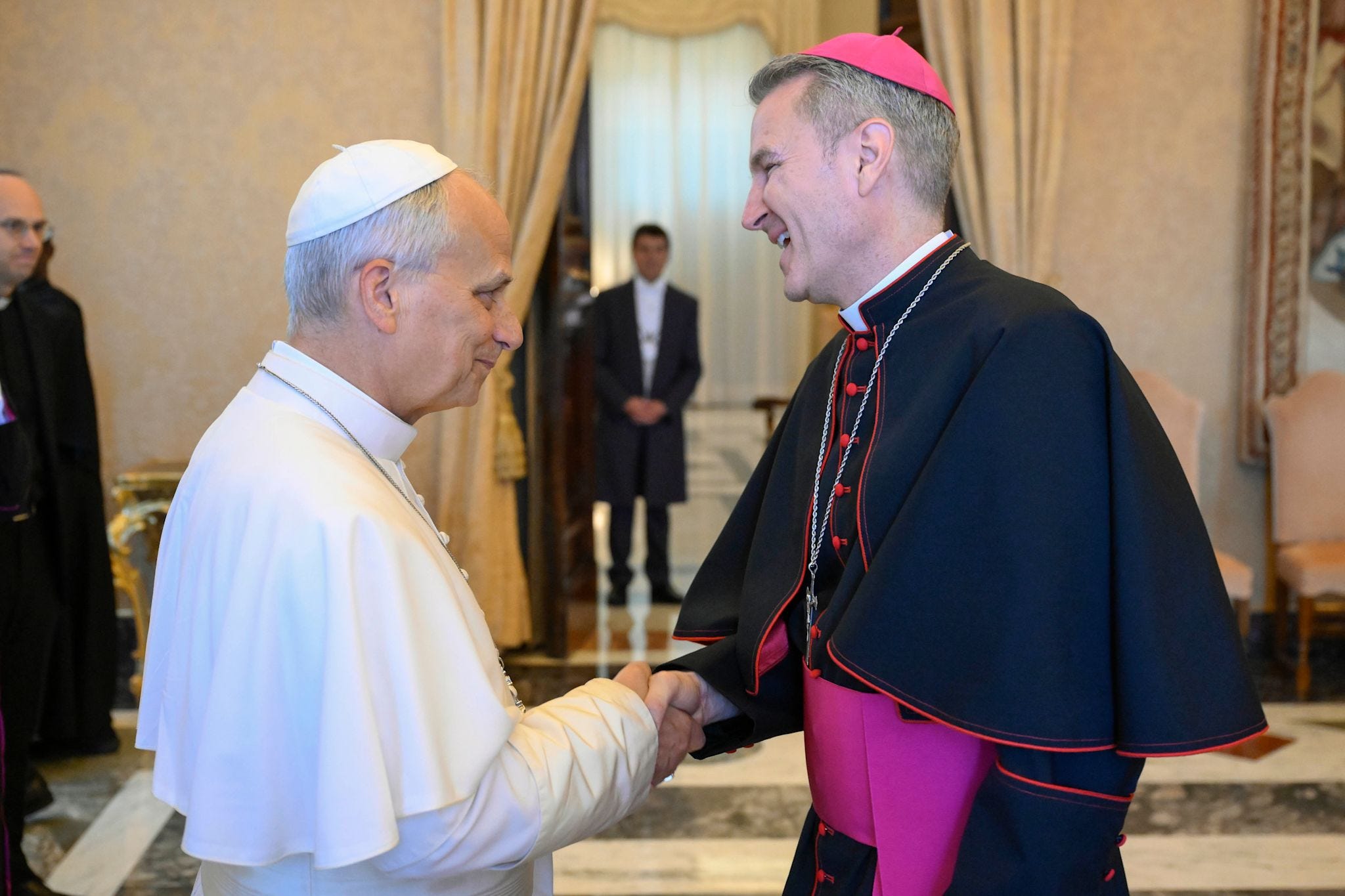
Pope Leo XIV welcomed about seventy representatives of the Catholic Near East Welfare Association to the Vatican on Friday, marking one hundred years since Pope Pius XI founded the papal agency in 1926.
Archbishop Ronald Hicks of New York, who chairs CNEWA’s international board, led the delegation with the agency’s president, Msgr. Peter Vaccari. Sister Raffaella Petrini, who governs Vatican City State, came with them.
Joseph Hazboun did not. The Bethlehem-born Palestinian Catholic who runs CNEWA’s Jerusalem office was stopped by Israeli authorities before he could board his flight from Tel Aviv to Rome, CNEWA spokesman Michael La Civita told OSV News.
Hazboun had the delegation’s gift for the pope in his checked luggage: a porcelain model of the edicule, the small shrine that encloses the tomb of Christ inside Jerusalem’s Church of the Holy Sepulchre, made specifically for Leo. “Unfortunately we came empty handed,” La Civita said. He called the episode one of the “arbitrary violations of human dignity” that CNEWA has spent a century working to undo.
Benjamin Netanyahu’s government has given no public reason for grounding him. Hazboun is no stranger to the agency’s donors; in September 2025 he briefed them on conditions in Gaza, where the agency supports the territory’s small Christian community.

What the pope told the delegation
Leo’s address, delivered in the Consistory Hall, read at times like a description of the man who was missing from it.
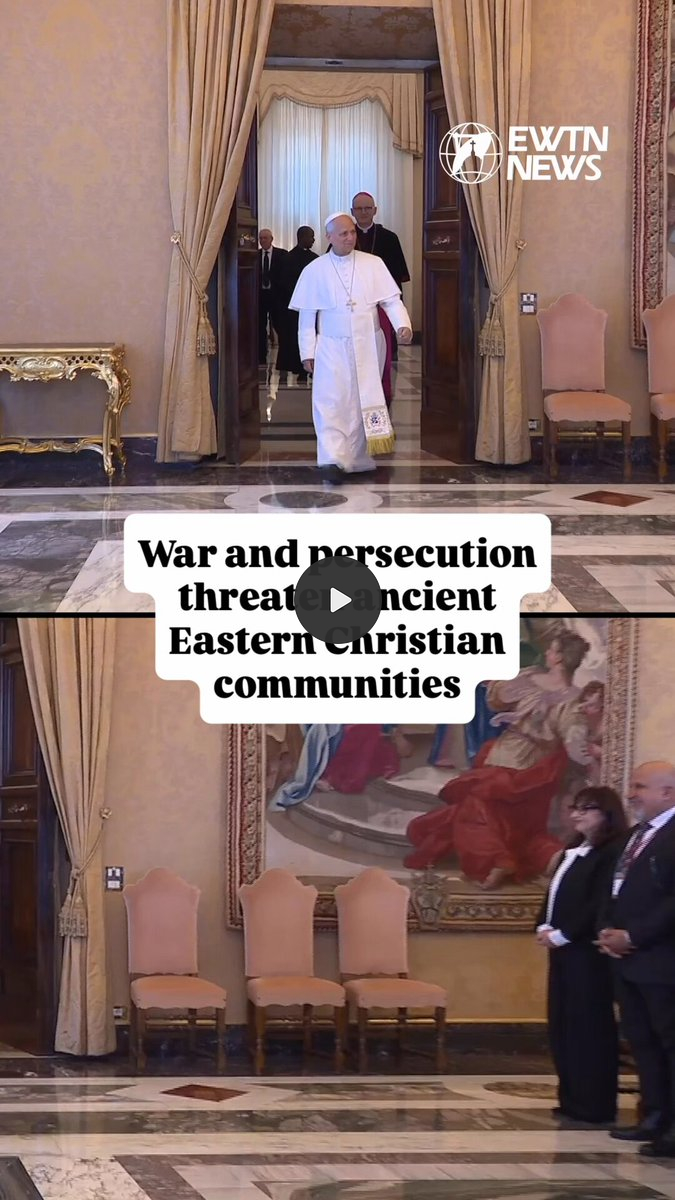
“Across the Middle East and in other regions, Eastern Christians continue to face the effects of war, persecution, instability and poverty,” the pope said. For that reason, he told the delegates, “accompanying Christians of the East in their homelands is an essential work of hope.”
He spoke with unusual directness about emigration. “When a Christian family is forced to leave its homeland, much more is lost than a place of residence,” Leo said, asking CNEWA to help those families understand that “suffering and uncertainty do not have the final word.”

Hicks greeted the pope warmly when the audience ended. The two men grew up a short drive apart in the south suburbs of Chicago (Hicks has said Leo’s childhood home sat fourteen blocks from his own), and Leo chose him for New York last December. Since his installation in February, Hicks has made a Church that “exists to go out and serve all” the theme of his time in New York. On Friday, the man his agency pays to serve Christians in the Holy Land could not get out of the airport.
A familiar pattern
The grounding of a papal agency’s director is a small event next to what came before it, and it fits a record that has been building for more than a year.
On July 17, 2025, Israeli fire struck Holy Family Church, the only Catholic parish in Gaza, killing three people and wounding its pastor, Father Gabriel Romanelli. Netanyahu phoned Leo the next day, and his office said Israel “deeply regrets that a stray ammunition hit” the church. Leo answered at the Angelus two days later by condemning the “barbarity of war” and reading aloud the names of the dead.
In March, Israeli tank fire killed Father Pierre el-Rahi, a Maronite priest who had run toward the wounded after a shell hit a home in the southern Lebanese village of Qlayaa. The Vatican named him within hours.
Three weeks later, on Palm Sunday, Israeli police stopped Cardinal Pierbattista Pizzaballa, the Latin patriarch of Jerusalem, as he walked privately to celebrate Mass at the Holy Sepulchre. The patriarchate said it was the first time in centuries that Palm Sunday Mass could not be offered there. Netanyahu’s office insisted the police acted with “no malicious intent whatsoever.” After Italy and France protested, he promised the cardinal “full and immediate access,” as I reported that day.
On April 19, a photograph surfaced of an Israeli soldier taking a sledgehammer to the head of a statue of the crucified Christ in Debel, a Christian village in southern Lebanon. Netanyahu said he was “stunned and saddened.” The Catholic bishops of the Holy Land, in a statement signed by Pizzaballa, expressed their “profound indignation.”
Nuns have not been spared either. In May, Israeli police released security footage of a man kicking a French nun outside the Church of the Dormition on Mount Zion, an assault I wrote about at the time. Weeks later, Sister Mary Meline told NBC News’s Richard Engel that strangers spit near her “every time I go to Jerusalem nearly,” as I reported then.
Most of those episodes ended with a statement of regret from the prime minister’s office, issued after the harm was done. Friday’s version was quieter. Nobody was shot and nothing was smashed; a Palestinian Catholic aid worker was simply turned back at the gate, with a gift for the pope already locked in the hold.
A Church that refuses to leave
Leo has never pretended the politics are simple. Flying to Lebanon last November, he called a Palestinian state “the only solution” to the conflict. “We all know that in this moment, Israel does not accept that solution,” he told reporters, before adding, “We are also friends of Israel.”
Friendship of that kind tells the truth. Pius XI built CNEWA so that Christians in the lands of the Bible would never feel abandoned by the rest of the Church, and Leo used Friday’s audience to say the agency’s work is about keeping those Christians home. Catholic teaching treats the freedom of the Church’s ministers to come and go as part of religious liberty itself, which belongs to the dignity of every person.
When a government blocks the director of a papal charity on the morning of his audience with the pope, it sends Christians in the Holy Land a message about how much room they have. Hazboun stayed in Jerusalem on Friday. Nobody sat in his chair in the Consistory Hall, and the edicule meant for Leo is presumably still in a suitcase somewhere between Tel Aviv and Rome.
At Letters from Leo, we stand with Pope Leo XIV, Archbishop Hicks and Joseph Hazboun, and with the Christians of the Holy Land who keep the Gospel alive in the places where it was first preached. Their presence there is a living witness, and no checkpoint or flight manifest gets to decide whether it continues.
In a season of war, the Church keeps choosing to stay with the people who suffer. It sends aid into Gaza and reads the names of the dead at the Angelus. On Friday, it held a seat open for a man Israel kept home.
This is the fastest-growing Catholic community in the country because people are hungry for a faith that tells the truth about power and stands with the poor. Christians in Bethlehem and Gaza are not a footnote to American politics, and our readers refuse to let them be treated like one.
If you believe this movement matters — Catholics and people of goodwill standing for the dignity of Eastern Christians and every person caught in war — I am asking you to join us.
If you’d like to invest in our mission, here are three ways you can help:
Subscribe as a paid member to receive exclusive posts about the life and formation of Pope Leo and help sustain this newsletter.
Donate with a one-time gift to fuel this project’s mission.
Share this post (and Letters from Leo) with a friend who might enjoy it.
Paid subscribers receive our biographical series on Pope Leo’s Life & Formation, along with exclusive investigations and the Sunday Scripture Reflection Series.
Whether you give $0, $5, $50, $500, $1,000, or more, your presence here matters — no matter your faith or your politics.
Thank you for reading. I’ll see you on the road.

Netanyahu is just plain evil!
I stand with all the Christians in Palestine and Israel. It is as difficult being a Christian as it is being a Muslim in Israel.