


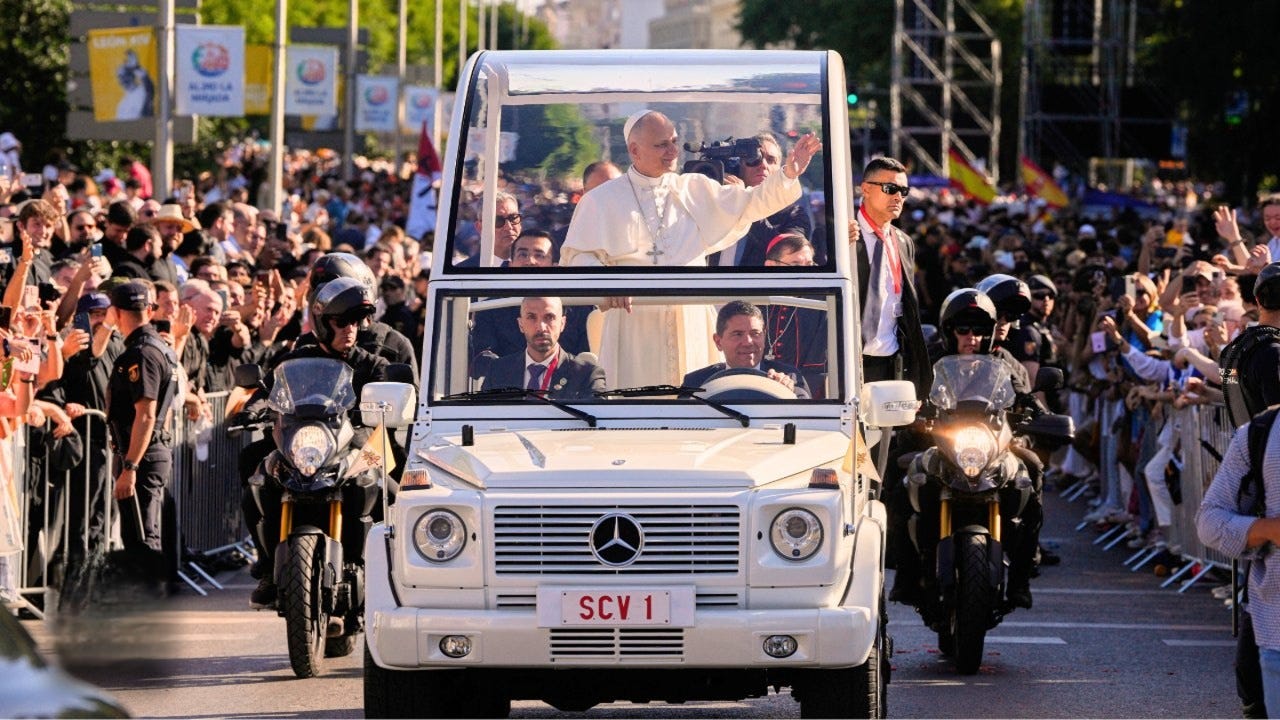
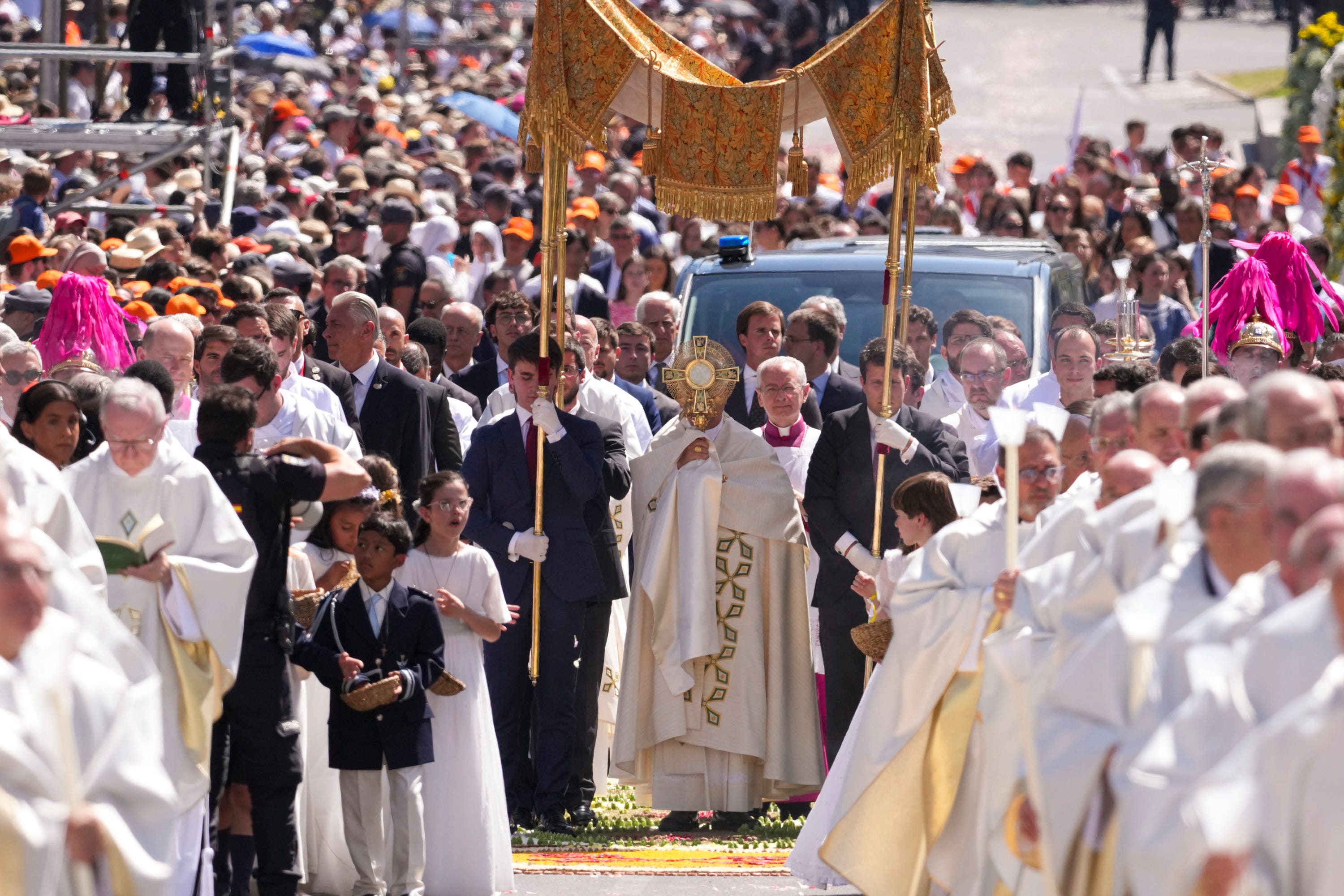
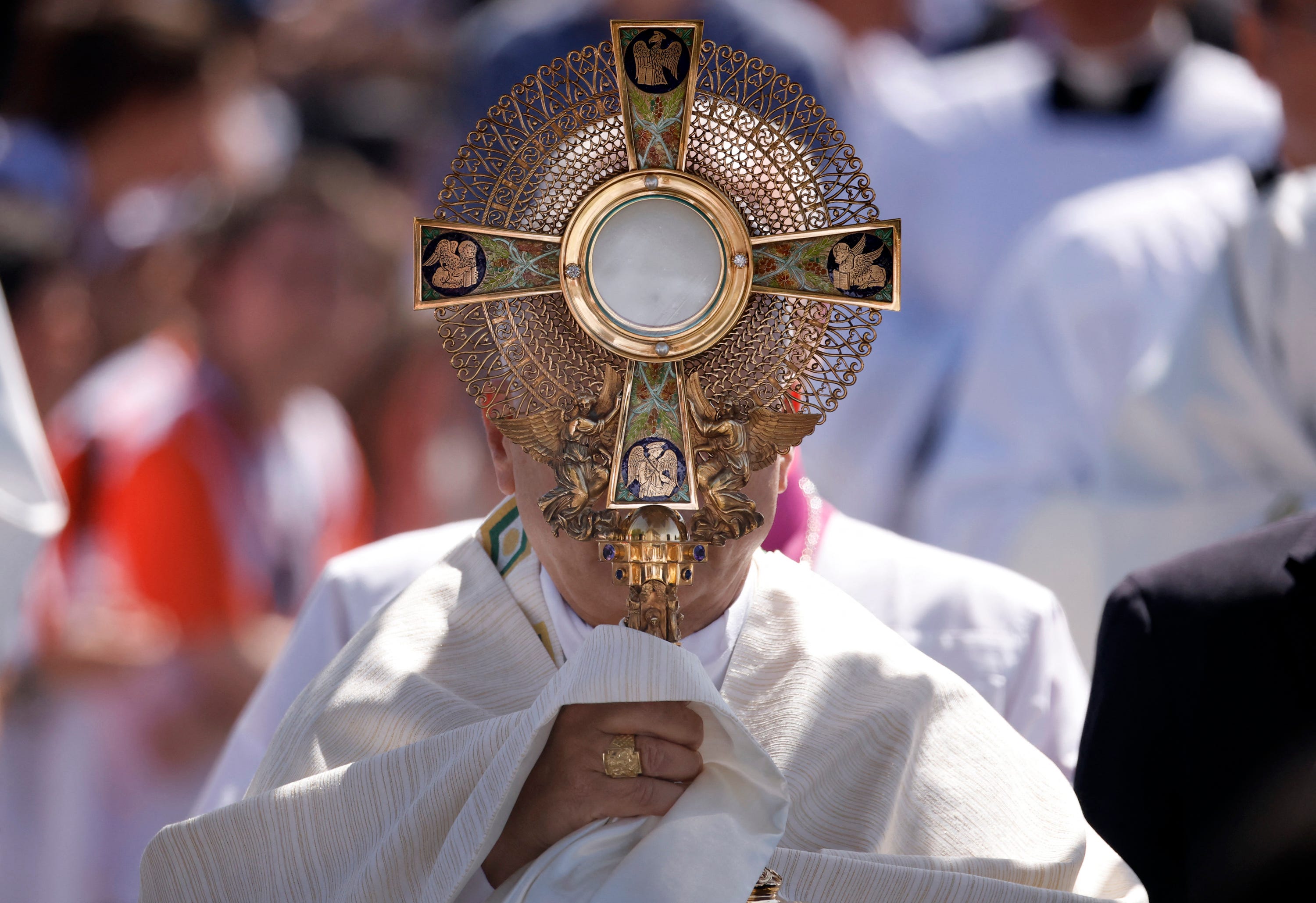
Pope Leo XIV celebrated the Solemnity of Corpus Christi in simple white vestments before 1.2 million people in Madrid’s Plaza de Cibeles on Sunday, then carried the Eucharist in a monstrance down Calle de Alcalá, where sixteen floral carpets woven from more than 30,000 carnations covered the pavement.
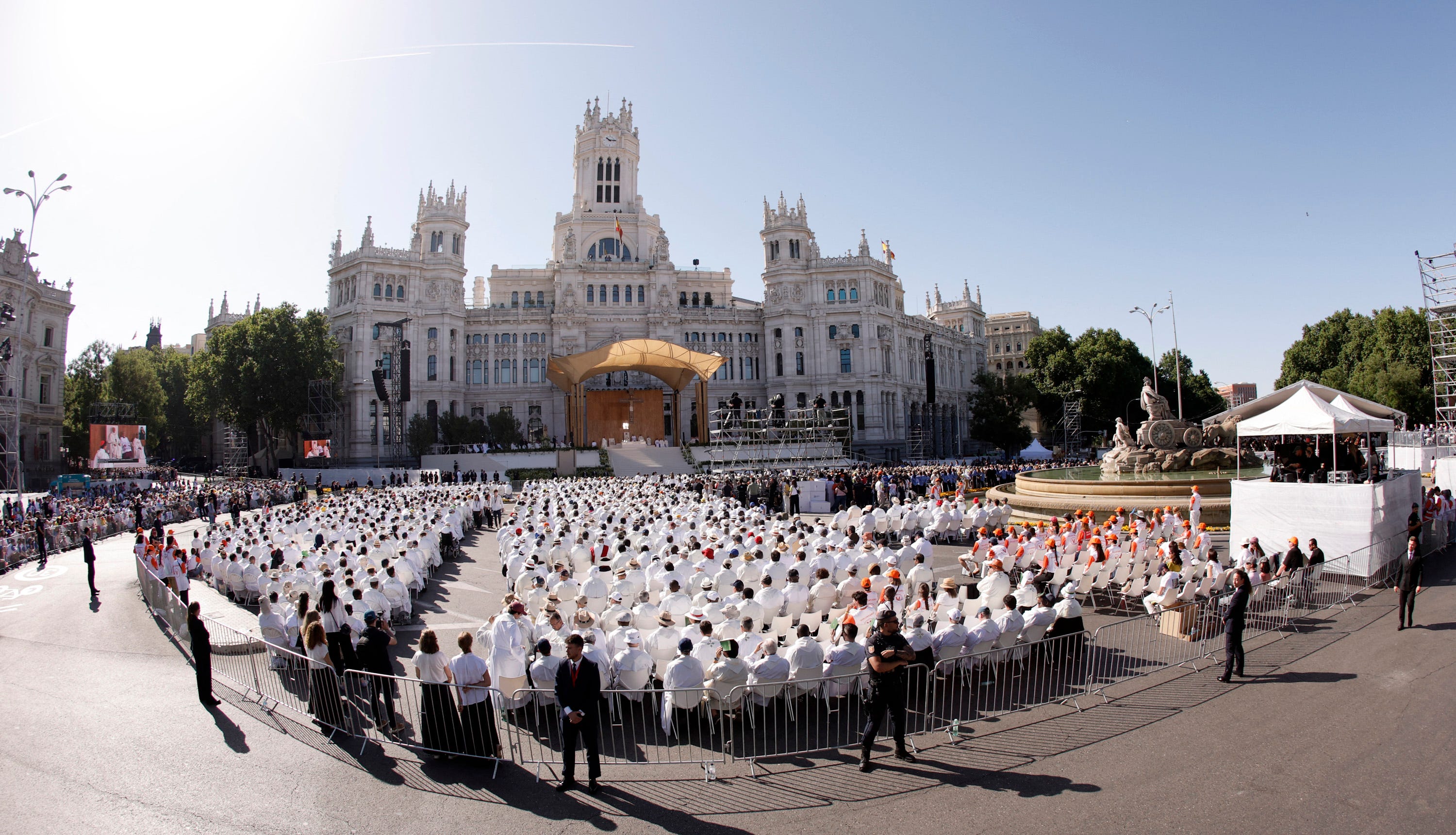
Local organizers put the crowd at 1.2 million. King Felipe VI and Queen Letizia attended the Mass, and boys and girls who had recently received their first Communion joined the procession behind the monstrance.
In his homily, the pope told Spain that its centuries of Eucharistic devotion must not become “a museum of the past to be visited” but should remain “a school of faith from which to draw even today.” Then he described the curriculum:
A school that teaches us to kneel before God and before our neighbor, because no one can kneel before the Lord and despise their brother; A school that teaches us of the gratitude of love that becomes a gift, so that it may flow among us and break the chains of all selfishness; A school from which we learn that God is a real presence and that we too are called to be present in the realities and challenges of society, not shying away, but personally committing ourselves to the building of the common good.
The pope pressed the point into the streets themselves. The Christ carried through Madrid in the monstrance, he said, “is the same one who identifies with the poor, the downtrodden, those who are alone and forsaken,” and it is “no coincidence” that the Church in Spain has long joined Corpus Christi to its annual Day for Charity.
He also told the crowd what the feast is not. Eucharistic devotion cannot remain “a comfortable, private faith,” Leo said; the procession exists to pull believers “out of our selfishness and indifference” and to make them “builders of a new world.”
The homily reached back to Deuteronomy — “Remember the long way that the Lord your God has led you” — and warned against “the temptation of trusting in other idols and feeding on bread that does not satisfy.”
Leo closed with St. John of the Cross, who recognized the hidden presence of the Lord while imprisoned in Toledo around Corpus Christi in 1578: “For I know well the spring that flows and runs, although it is night.”
That Eucharistic spring, the pope said, “does not enclose us in private devotion” but “sends us out to refresh our brothers and sisters, our families, the poor, the suffering, and those who have lost hope.”
Sunday was the second day of the pope’s June 6–12 journey through Madrid, Barcelona, and the Canary Islands — the first papal visit to Spain in 15 years.
On Saturday, Leo warned the country’s political class at the Royal Palace against the politics of polarization, visited a Caritas-run center serving Madrid’s homeless, and prayed with hundreds of thousands of young people in the heart of the city, as I reported this weekend.
Sunday’s program also included a private meeting with his Augustinian brothers and a gathering with leaders of Spanish culture, business, and sport at the Movistar Arena, and the journey includes a first-ever papal address to Spain’s parliament.
Leo has been blunt with Spain before. In November, he told the country’s senior bishops that far-right ideology is the gravest threat facing the nation’s social cohesion, and that far-right forces “seek to win the Catholic vote” while instrumentalizing the Church for partisan ends.
The Spanish bishops’ conference has disputed that characterization, saying the pope spoke about “the risks of subordinating faith to ideologies without mentioning any specific group.”
But the National Catholic Reporter noted ahead of this trip that the Spanish Catholic magazine Vida Nueva confirmed through its own sources that Leo warned the bishops about Vox by name. The record of that meeting remains contested.
Kneeling before God and the poor has a history of importance in this papacy. Here’s what I mean.
