On the Feast of St. Christopher, A Letter From My Heart
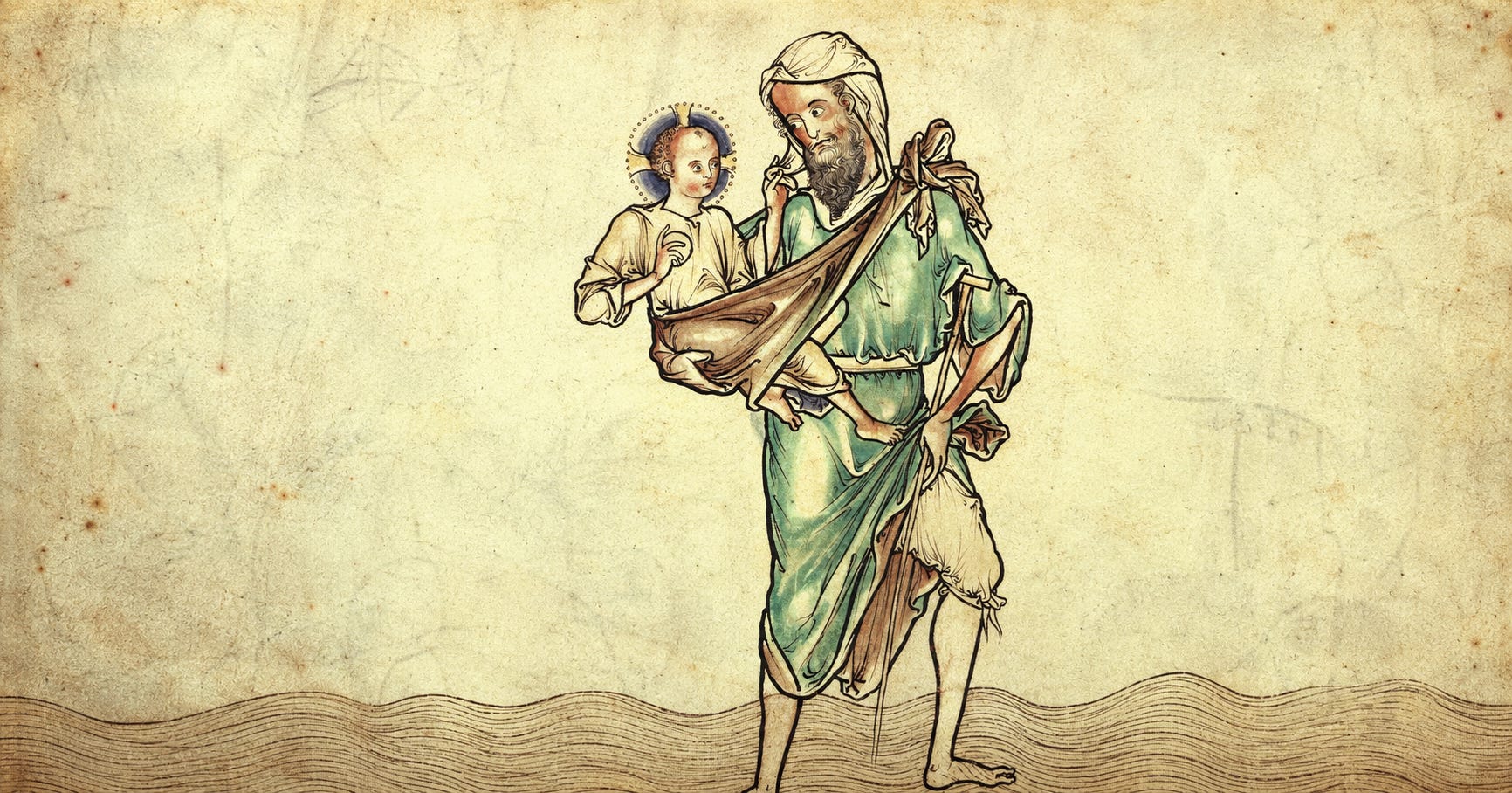
Today is the feast of the saint I was named for, a ferryman who carried a child across a flooding river and nearly drowned doing it. Pope Francis warned that when we stop moving, things go wrong.

Thank you for reading! Letters from Leo is a reader-supported publication and the fastest-growing Catholic community in the country. To receive new posts and support this movement, consider becoming a free or paid subscriber.
I know it’s late, but I can’t sleep, and today is the feast of St. Christopher, the saint whose name I carry, so I thought I would write you a letter.
Now, to be clear, my parents named me without religion in mind. In fact, Christopher was the second most popular name for boys born in the United States in 1989.
But as I grew up in Tennessee and began my own journey of faith, I found much more meaning in my birth name.
The Church knows almost nothing about St. Christopher. A third-century martyr, killed under Decius or maybe under Maximinus, the records give a death and a name and very little else.
Everything we love about him arrives through the Legenda aurea, Jacobus de Voragine’s thirteenth-century collection of saints’ lives — a collection of fables rather than a documented history.
In it, a giant named Reprobus went looking for the greatest king in the world so that he could serve him. He quit the first emperor he found, who made the sign of the cross at the mention of the devil. Then he took service with the devil, until the devil swerved off the road to avoid a crucifix.
A hermit told him the king he was looking for was Christ, and handed him work suited to his frame: carrying travelers across a river that had drowned better swimmers than him.
One night a child asked to cross. Halfway over, the current rose and the boy on his shoulders grew so heavy that the giant was certain the river would take them both.
He reached the far bank. The child told him he had just carried the weight of the world, along with the one who made it.
They baptized him Christophoros — Christ-bearer.
Paul VI’s 1969 revision of the General Roman Calendar took Christopher off the universal list because the historical evidence was too thin to sustain a feast for the whole Church. Nobody de-canonized him.
July 25 is still kept in parishes across the world, medals are still blessed, and truck drivers and pilots and mothers watching a teenager back out of the driveway still reach for him.

There is something clarifying in that for me. My patron is a saint with a contested file and an unimpeachable job description: stand in the current, and get people to the other side. He is the patron of all of us traveling on a journey.
Notice that the legend never shows Christopher praying on the bank. He is always in the water, mid-crossing, under a load that keeps getting heavier. His holiness is a matter of motion.
On March 14, 2013, the morning after his election, Pope Francis preached to the cardinals who had just chosen him. He built the entire homily on movement — journeying, building, professing — and gave a line that has become a motto of sorts for me: “Journeying: our life is a journey, and when we stop moving, things go wrong.”

He described the failure mode too. Build on anything other than stone, he told those cardinals, and you get what children get on the beach: the sandcastle is swept away, and nothing solid remains underneath.
Thirteen years later, that reads like a diagnosis of American life. So much of this nation has not moved forward in a generation. A political Catholicism mistook stasis for fidelity and let the cruelest voices in this country define what our faith demands of us. Water rises fastest on the people standing still.
Verso l’alto
Pier Giorgio Frassati never stood still. He was a Turinese kid from a wealthy and largely irreligious family, a Third Order Dominican, an alpinist, a street-level agitator who brawled with Mussolini’s blackshirts and quietly spent his allowance on the poor of his city.
Polio killed him at twenty-four in 1925, most likely caught from the sick he was visiting, and his family discovered at the funeral that the streets of Turin were packed with mourners they had never met.
On a photograph from his final climb he wrote two words: verso l’alto. To the heights.

Pope Leo XIV canonized him on September 7, 2025, alongside Carlo Acutis — the first saints of this pontificate. In the homily, Leo pointed straight at that photograph: a young man climbing in the Val di Lanzo, face turned toward his goal, and the inscription in his own hand.
Understand what the phrase is doing. Frassati wrote it on the way up rather than from the summit. Direction is the entire content of it. He kept moving, and in that journey, found life.
What Benedict knew
This is where I part company with a version of Catholicism I run into every day online — the kind that treats the faith as a fixed set of correct propositions to be defended against the wrong people. Our faith has propositions, and I hold them.
But Benedict XVI opened Deus Caritas Est by refusing to let propositions be the foundation: “Being Christian is not the result of an ethical choice or a lofty idea, but the encounter with an event, a person, which gives life a new horizon and a decisive direction.”
A new horizon and a decisive direction. Both phrases matter equally. We look up towards a new horizon. And we look out towards a clear direction.
Benedict — the professor, the systematician, the man who spent twenty-four years as the Church’s chief doctrinal officer before his election — put the encounter first and the system second.
Christianity begins as something that happens to you. What follows is a road.
What we are building
Tens of thousands of us have had that encounter and cannot reconcile it with what is being done to this country under the banner of our faith. That gap is why Letters from Leo exists.
The project here is to take that experience — the encounter itself, the thing that reorganizes a life — and rebuild a nation on the highest of what it teaches us: the dignity of every person regardless of paperwork, the common good understood as an obligation rather than a slogan, a preferential option for the poor, and solidarity as a decision you make about strangers.
Underneath all of it sits the claim that makes us genuinely dangerous to this political moment.
We believe in redemption.
Think about what that commits us to. The man in the detention facility in Louisiana is not a finished case, and neither is the addict, the felon, the deported father, or the kid nobody ever picked first. The country that did all of this to them can still become something else.
And neither are you a lost cause.
Authoritarian movements need human beings to be permanently what they have been labeled — the criminal alien, the enemy within, the vermin, the problem. They need us to be hopeless. Redemption detonates that. No idea in our politics cuts deeper, and we hold it on divine authority.
The pattern of the job
So here is what my patron means to me on his feast. He gives me the pattern of the work: stand in the current where it runs hardest, take the weight when it doubles, get people to the far bank.
And the story is honest about the cost. You go under. The child is heavier than the world because the child is holding the world, and no version of carrying leaves you dry.
Everyone doing this work in America right now knows that weight precisely — the priests at the border, the nuns posting bond, the parishioners who show up at an ICE check-in so that somebody is there as a witness.
We are not going to stop moving. This country will be rebuilt on the dignity it keeps promising and withholding, and the rebuilding will be done by people who refuse to believe that anyone is beyond saving.
Verso l’alto. Toward the heights — from wherever you are standing when you read this, in whatever water you are already in.
To everyone who has been knocked down, counted out, or left behind, this is your home.
At Letters from Leo, we stand with every person in this country who has been told they are a closed case — and with the Catholics and people of goodwill who refuse to accept that verdict about anyone, including their enemies.
We stand with the carriers — Catholics and countless others of goodwill who keep moving when the water rises, refuse to accept cruelty as the price of order in America, and still believe this nation can be rebuilt on the dignity of every person in it.
We are rooted in a faith that began as an encounter rather than an argument, and that encounter obligates us. It sends us into the water where the current runs hardest, on behalf of the people the powerful have written off.
This is the fastest-growing Catholic community in the country because people are starving for something sturdier than rage and propaganda. They want a moral vision that can carry weight, and right now the weight is enormous.
If you believe this movement matters — Catholics and people of goodwill standing for human dignity against a politics built on permanent condemnation — I am asking you to join us.
If you’d like to invest in our mission, here are three ways you can help on this sacred day:
Subscribe as a paid member to receive exclusive posts about the life and formation of Pope Leo and help sustain this newsletter.
Donate with a one-time gift to fuel this project’s mission.
Share this post (and Letters from Leo) with a friend who might enjoy it.
Paid members get the full biographical series on Pope Leo’s life and formation, our Sunday Scripture Reflection Series, and the exclusive investigations that no one else in Catholic media is willing to run.
Whether you give $0, $5, $50, $500, $1,000, or more, your presence here matters — no matter your faith or your politics.
Thank you for reading. I’ll see you on the road.


Thank you for this eloquent message on the feast day of your patron saint. Let us strive to move forward on our journeys of faith, knowing that redemption is truly possible.
Beautiful - thank you!