


Dear friends —
Happy Second Sunday of Advent! Thanks to your support, Letters from Leo continues to be one of the fastest-growing publications in the world.
We couldn’t do this without you. Starting last week, all paid subscribers are receiving the Letters from Leo Advent Reflection Series — a daily companion to prepare for the coming of Christ at Christmas and reckon with what his arrival demands in a nation veering toward fascism.
To give you a sense of what you’ll experience, I’ve unlocked last Sunday’s reflection to all readers. (Note that the Sunday reflections will be longer in length.)
If you believe in this mission, here’s how you can help us this holiday season:
Subscribe as a paid member to receive exclusive posts about the life and formation of Pope Leo and help sustain this newsletter.
Donate with a one-time gift to fuel this project’s mission.
Share this post (and Letters from Leo) with a friend who might enjoy it.
Whether you give $0, $1, or $1,000, your presence here matters — no matter your faith or your politics.
Thank you for reading. I’ll see you on the road.

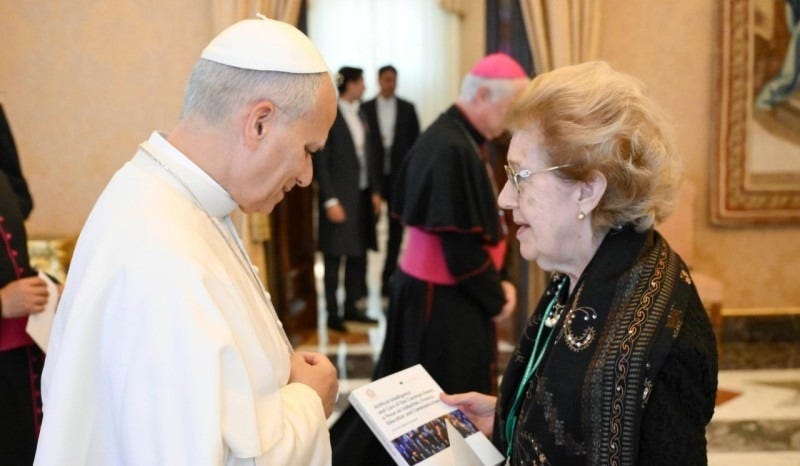
At the Vatican this week, Pope Leo XIV issued a pointed moral challenge about the rise of artificial intelligence: Who benefits?
Speaking to an assembly of tech experts and scholars, Leo warned that AI’s development must “truly serve the common good, and not just [be] used to accumulate wealth and power in the hands of a few.”
The first American pope stressed that this is an urgent question — one that forces society to ask “what does it mean to be human in this moment of history?”
“How can we ensure that the development of artificial intelligence truly serves the common good, and is not just used to accumulate wealth and power in the hands of a few?” Pope Leo XIV challenged
For Leo, the answer begins with re-centering our view of human dignity. He reminded his audience that human beings are “called to be co-workers in the work of creation, not merely passive consumers of content generated by artificial technology.”
In other words, we are not hapless subjects of some all-powerful algorithm; we are moral agents with the responsibility to guide technological progress.
“Our dignity lies in our ability to reflect, choose freely, love unconditionally, and enter into authentic relationships with others,” the pope said, underscoring qualities no machine can replicate.
Pope Leo Confronts AI That Lured Teen to Suicide — and Tech Moguls Lash Out

A 14-year-old boy, lured by a chatbot’s “love,” took his own life. Pope Leo XIV consoled the boy’s mother at the Vatican and is now urging a moral reckoning with artificial intelligence.
While AI opens new horizons for creativity and innovation, Leo noted, it also poses “serious concerns” about eroding humanity’s capacity for truth, wonder, and beauty.
He urged a global “pause and reflect” moment to ensure that the inner life of young people—their freedom, their capacity for critical thought and empathy — is not stunted by a tech industry racing ahead without restraint.
Leo XIV’s message was as practical as it was philosophical. He called for educators, parents, and mentors to help the next generation navigate AI wisely, teaching the young to use new tools “with their own intelligence” and moral compass intact.
The pope stressed that society must “restore and strengthen [young people’s] confidence in the human ability to guide the development” of technology, rather than treat AI’s advancement as following an inevitable, uncontrollable path.
In fact, he appealed for “coordinated and concerted action” across all sectors—politics, business, education, media, and the Church—to steer artificial intelligence toward the common good.
This shared responsibility, Leo insisted, “comes before any partisan interest or profit, which is increasingly concentrated in the hands of a few.”
The goal is nothing less than a broad social consensus that technology must uplift everyone, not just further enrich a tiny elite. To that end, Leo XIV urged “widespread participation that gives everyone the opportunity to be heard with respect, even the most humble” in shaping our tech-driven future.
Pope Leo to US Teens: Use AI Wisely, Don’t Let Tech Replace Real Friends

From his starter word on Wordle to warnings about AI dangers, Pope Leo spoke directly to young Americans about relationships, prayer, and why no political party owns the Church.
This drive to humanize technology is part of a much larger theme of Pope Leo’s reign. In fact, he carried the same concern onto the world stage during his first trip abroad last week.
On a six-day pilgrimage to Turkey and Lebanon, Leo XIV consistently spotlighted those on the margins and warned against leaving anyone behind. The choice of these countries was intentional:
“Pope Leo chose to make Turkey and Lebanon the site of his first trip very likely to emphasize two major themes of his pontificate… unity and peace,” one Vatican observer noted.
From war-torn villages to digital frontiers, the pope’s focus remains the same: bridging divides and advocating for those often forgotten by the powerful.
Whether he’s addressing sectarian conflict or the high-tech economy, Leo’s message is that no community — no person — should be sacrificed to the ambitions of a few. In Beirut, he urged global leaders not to forget vulnerable nations; in Rome, he’s effectively saying the same about vulnerable people in the tech age.
Silicon Valley Pushes Back
Not everyone welcomes Pope Leo’s prophetic stance. His insistence that ethics tame AI has put him at odds with some tech titans.
Here’s a rundown of what happened.
