
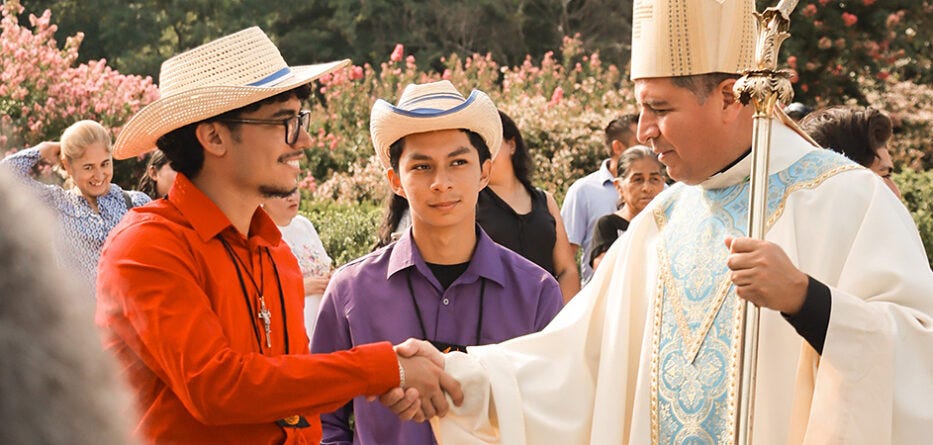
Pope Leo XIV Sends Former Undocumented Migrant to Trump’s West Virginia — Fulfilling the Retweet That Foretold His Papacy
Three weeks before his election, Cardinal Prevost retweeted Bishop Menjivar’s rebuke of the Trump-Bukele deportation campaign. Now he has put the same man in charge of Catholic life in coal country.
Robert Prevost’s last act on social media before he became pope was a retweet.
It was April of last year. Donald Trump had hosted Salvadoran president Nayib Bukele in the Oval Office, where the two men laughed about the unlawful deportation of a U.S. resident to El Salvador’s CECOT prison.
Cardinal Prevost saw the post — a Rocco Palmo dispatch citing the words of Washington Auxiliary Bishop Evelio Menjivar — and reposted it to his Twitter following.
“Do you not see the suffering?” Menjivar had asked in the Catholic Standard. “Is your conscience not disturbed? How can you stay quiet?”
Three weeks later, Prevost was Pope Leo XIV. The retweet quietly disappeared from his feed, but the conviction that put it there did not.
On Friday, the pope named Menjivar the lone Catholic bishop of West Virginia — a state that is more than 90 percent white and that voted for Donald Trump by 42 points. The man Prevost had endorsed in his final unguarded act online now leads the only diocese in a state where MAGA sentiment runs deep.
Menjivar is the first United States bishop born in El Salvador. He came here without papers.
As a teenager in Chalatenango, he tried to cross the southern border three times before he succeeded in 1990 — smuggled with his brother in the trunk of a car at the Tijuana–San Diego crossing.
Once in California, he worked construction, janitorial jobs, and as a parish receptionist while learning English at night and earning a high school equivalency. By 2004, he had finished seminary at the Pontifical North American College in Rome and been ordained a priest of the Archdiocese of Washington. Pope Francis named him a bishop in 2023.
His story is the one Donald Trump’s administration would deport — and, today, the first U.S.-born pope has named him a successor of the Apostles.
Menjivar’s appointment came alongside three others. Pope Leo named Father John Gomez, a Colombian-born priest, as the new bishop of Laredo, the border diocese in south Texas.
To the Archdiocese of Washington, he sent two new auxiliaries: Father Gary Studniewski, a Toledo-born former U.S. Army captain who served eighteen years as a military chaplain and now pastors the Shrine of the Most Blessed Sacrament in northwest Washington, and Father Robert Boxie III, a 45-year-old Black priest who serves as Catholic chaplain at Howard University and becomes the youngest sitting bishop in the United States.
I have experienced both of Washington’s new auxiliary bishops in recent years. Father Studniewski and Father Boxie are kind-hearted, generous priests — the kind of pastors any local Church would be fortunate to have.
Boxie, a Vanderbilt-educated chemical engineer who graduated from Harvard Law before he entered seminary, has challenged the White House’s race-baiting campaign against diversity. He has been outspoken about it.
“I think at its core, it’s what America is all about,” he said in a recent interview. “We are a diverse nation with people from all over the world. Diversity is a good thing. Diversity is of God.”
“So much of our history has been exclusive, especially when it comes to race,” he added. “And it’s just un-American; it’s un-Christian; it’s anti-Catholic.”
This is the priest the pope has now made a bishop in the nation’s capital — blocks from a White House where Stephen Miller dictates immigration policy and where the words “diversity, equity, and inclusion” have been struck from federal use.
In 2019, Boxie offered a homily at the March for Life Mass that captured the breadth of his pro-life conviction. “How can you love the life you do not see in the womb if you do not love those lives you do see — the sick, the stranger, and the poor?”
Friday’s announcements were not isolated. Pope Leo’s first American bishop appointment was Michael Pham — a Vietnamese refugee — to lead the Diocese of San Diego last summer. In December, he named a migrant bishop to Mar-a-Lago and a pro-migrant bishop to Monterey. Today’s announcements extend the line.
So many of Leo’s chosen leaders are exactly the kind of Americans this administration considers enemies of the state.
The pope is taking the lives that most directly indict the cruelty of Trumpism and entrusting them with the institutional authority of the Catholic Church in the United States. He has sent a Salvadoran migrant to Appalachia, a Colombian immigrant to the Texas border, a Vietnamese refugee to San Diego, and a Black Howard chaplain to the capital.
The American hierarchy is being repopulated, in real time, by the kind of people the administration would prefer not to exist.
For West Virginia, the message is profound. The state’s lone Catholic bishop will now be a man whose biography includes an undocumented entry, manual labor, and English as a second language.
He will preach in coal country in his own accent, baptize the babies of West Virginia families, and bury Catholics in a state whose mountains will now hear the homilies of a man who learned English at night while sweeping floors in California.
The Trump-Vance White House is wrong; he does belong: Pope Leo XIV has said so. And in saying so, the pope completed the act he began three weeks before his election — when he let the world know, in a single retweet, exactly which side of this country’s moral crisis he intended to stand on.
At Letters from Leo, we stand with Bishop Evelio Menjivar and the immigrant Catholics he is now sent to shepherd in West Virginia, with Bishop-Elect Robert Boxie and the Black Catholics whose dignity Washington keeps trying to legislate away, and with Bishop-Elect John Gomez and the border Catholics of Laredo who are being treated as enemies of the country they helped build.
We stand with Pope Leo XIV, who is rebuilding the American hierarchy in their image — the kind of Church Donald Trump cannot intimidate, and Stephen Miller cannot deport.
In a country where the federal government now treats migrants as criminals and the word “diversity” as a slur, this Church is offering something else: a hierarchy whose leaders look like the people Christ chose to identify with — the foreign-born, the racial minority, the worker who came up from nothing.
This is the fastest-growing Catholic community in the country because the moment demands one. Readers come here for a movement that names the cruelty of this administration without flinching, grounds its resistance in the Gospel rather than partisanship, and refuses to pretend the Church can be neutral while immigrants are being disappeared.
If you believe this movement matters — Catholics and people of goodwill standing for human dignity against the deportation regime now embraced from the White House to the southern border — I am asking you to join us.
If you’d like to invest in our mission, here are three ways you can help this Easter season:
Subscribe as a paid member to receive exclusive posts about the life and formation of Pope Leo and help sustain this newsletter.
Donate with a one-time gift to fuel this project’s mission.
Share this post (and Letters from Leo) with a friend who might enjoy it.
Paid members receive my full biographical series on the life and formation of Pope Leo XIV, the American pope who now carries Francis’s mission into a new era. You’ll also get access to exclusive investigations, including my ongoing Epstein-Bannon Investigation, and the best of our full archive.
Whether you give $5, $50, $500, $1,000, or more, your presence here matters — no matter your faith or your politics.
Thank you for reading. I’ll see you on the road.


I look forward to welcoming Bishop Menjivar to West Virginia.
For most of my life, I have been part of the loyal opposition, in many matters. Now I find myself being sheltered, upheld and reinforced, by the Pope himself. These appointments are stellar! They are exactly what Jesus would do-- to include, to bless, to help and strengthen people on the margins. Like God the Father, the blower of dandelions of creativity all over the universe, he is showing us valuable diversity, opening up the limits of tribalism, to brotherhood. Widening the circle, and strengthening our ability to be the Body of Christ. The book "The Future is Peace" just came out. It is by an Israeli Jew and a Palestinian Muslim, who feel like brothers, and who model peace, justice, truthfulness even in tough conversations, and who want to rebuild peace with mutual respect in the Holy Land. Their brotherhood came from the excruciating loss of family members to "the other side". Read the book, and share it. Learn about conflict resolution. Help us get there. We can be better at interfaith dialogue, and recognition of 'the family of man'.