
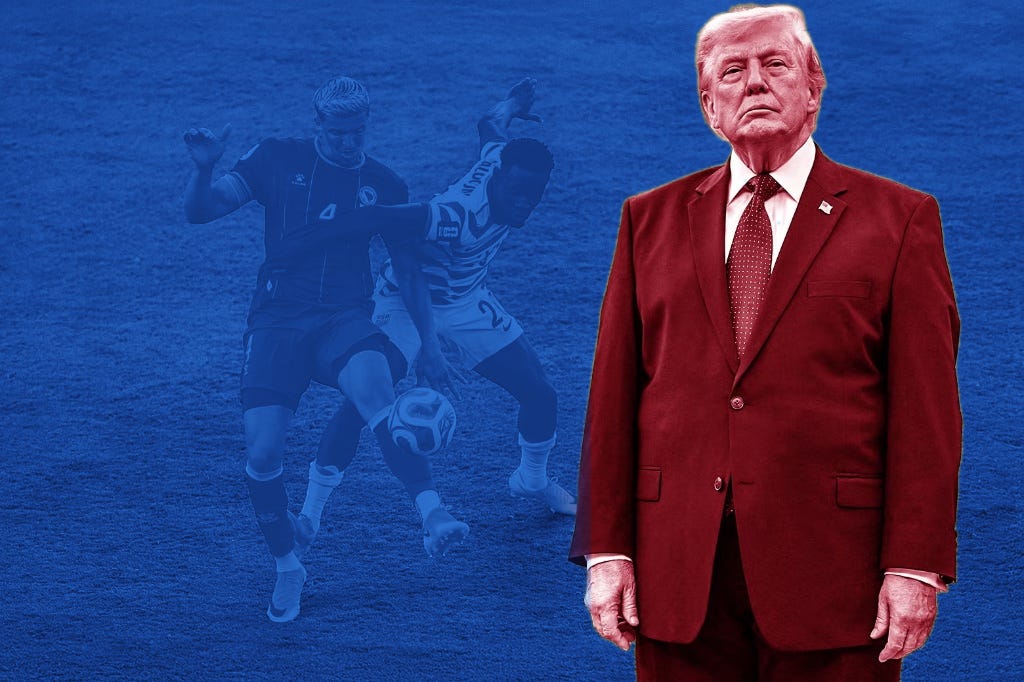
“Reversing a Great Injustice” — Donald Trump, FIFA, and the Argument Saint Paul Condemned
Folarin Balogun’s red card was nonsense, and I cheered for the United States against Belgium earlier this week. Saint Paul, John Paul II, and Pope Leo XIV all warn against what the White House did to erase it.
Thank you for reading! Letters from Leo is a reader-supported publication and the fastest-growing Catholic community in the country. To receive new posts and support this movement, consider becoming a free or paid subscriber.
I want my rooting interest on the record from the first sentence: I am an American, I wanted the United States to beat Belgium earlier this week, and I thought the red card shown to Folarin Balogun last Wednesday was nonsense.
The professionals thought so too. ESPN’s officiating analysts concluded that the video assistant referee misapplied FIFA’s own protocols in Santa Clara, leaning on slow-motion replays that made incidental contact with Bosnian defender Tarik Muharemović look deliberate. Mauricio Pochettino, the American coach, insisted it was never a red card. England coach Thomas Tuchel put it flatly to reporters in Mexico City: “it is not a red card.”
Balogun carried the injustice better than anyone. “I have to accept it,” the striker said Friday, suggesting a yellow card “would have been fair.” The leading American scorer at this World Cup, with three goals, prepared to sit out the knockout match against Belgium.
Then his president picked up the phone.
Donald Trump called FIFA president Gianni Infantino after the match and asked him to review the suspension, the Associated Press reported. A U.S. official told Axios that the government also sent FIFA “additional evidence” for its disciplinary committee to weigh. On Sunday, FIFA announced that Balogun’s automatic one-match ban was suspended for a probationary year under Article 27 of its disciplinary code — the first time in more than sixty years that a red card at a World Cup has carried no suspension.
Trump took his victory lap on Truth Social within hours: “Thank you to FIFA for doing what was right, and reversing a great injustice!”

World football answered with fury. UEFA, the European governing body, said the decision “crossed a red line” and expressed “disbelief at such an unprecedented, incomprehensible and unjustifiable decision.” Sepp Blatter, the former FIFA president whose own tenure ended in scandal, wrote that “red cards are not overturned by political phone calls. They are overturned by rules, evidence and independent bodies.” Belgium’s federation called itself “astonished” and filed a formal challenge, which FIFA rejected before kickoff.
Tuchel, who believes Balogun was wronged in the first place, asked the question that now hangs over the rest of this tournament: “Who overturns this decision then and when? And on what grounds? How far does this go now?”
Trump confirmed the call himself from the Oval Office on Monday. “All I did was ask for a review. I didn’t say, ‘You have to do this,’” he told reporters, describing the collision as “two guys running full speed that happened to crash into each other.” Then he went after Raphael Claus, the Brazilian referee who showed the card, calling him “very suspect” and urging the press to “check his past.”
The deepest irony sits in Balogun’s passport.
He is American because his Nigerian mother, visiting relatives in the summer of 2001, gave birth to him in Brooklyn — a citizenship of pure birthright. Trump’s lawyers stood before the Supreme Court this term and argued that children born to parents visiting this country temporarily deserve no such citizenship; the justices struck down his executive order on June 30, the day before Balogun took the field against Bosnia.
America’s bishops had already met the administration at the courthouse door: the USCCB filed a Supreme Court brief calling the order “immoral” and urging the justices to protect God-given human dignity, as I reported in February. Had the administration’s rule governed in 2001, the striker Trump calls the victim of “a great injustice” could never have played for the United States at all.
None of it happened in a vacuum. FIFA opened an office in Trump Tower last year, and Infantino says the president is expected to help hand over the World Cup trophy on July 19. After Trump’s second inaugural rally, the FIFA chief declared on Instagram that “together, we will make not only America great again, but also the entire world.”
The inaugural “FIFA Peace Prize” Infantino draped on Trump in December belongs to the same courtship.
The award had no jury, no nominees, and no published criteria, and it arrived weeks after the Nobel committee passed the president over for Venezuelan opposition leader María Corina Machado — a snub Trump felt keenly, having claimed to have ended as many as eight wars, a tally no independent fact-checker can substantiate. Infantino had posted that Trump “definitely” deserved the Nobel. A man who invested in a president’s favor was never going to send the White House to voicemail.

Here is where I part ways with the celebration.
Set aside whether Balogun deserved to play. He did. The question that should unsettle American Catholics — one the Church has faced since its first generation — is whether a good outcome can sanctify a corrupt process.
Saint Paul answered it in his letter to the Romans. His critics accused him of preaching exactly this logic — why not “do evil that good may come of it”? — and Paul refused to dignify the accusation, writing that those who reason this way deserve their condemnation (Romans 3:8). From that single verse the Church built one of the load-bearing walls of its moral teaching: the ends never justify the means.
John Paul II spent an entire encyclical defending that wall. Veritatis Splendor, published in 1993, rejects by name the moral theories — consequentialism chief among them — that judge an act primarily by its results. “If acts are intrinsically evil,” the Polish pope wrote, “a good intention or particular circumstances can diminish their evil, but they cannot remove it.” Corrupting a process to reach a just result produces something other than justice. What it yields is a favor, and favors from the powerful always arrive with a bill.
A clip that keeps resurfacing on X makes the same point through satire. Samson Owimba Ojiayo, a Kenyan human-rights activist with a long record of fighting graft and police brutality, went viral for a speech mimicking the creed of the officials he opposes: “Corruption is not bad. Corruption is only bad if I am not involved.” He meant it as ridicule, and the week’s news kept proving the ridicule fair.
That is what happened Sunday. FIFA has written codes, disciplinary panels, and an appeals body. Belgium’s federation cited three separate FIFA rules that make a one-match ban automatic after a red card. If the system produced an unjust result — and it did — the remedy was to reform the system in public, for every player.
Instead, the most powerful man on earth made a private phone call, and a governing body with offices in his family’s tower discovered a dormant clause that had never once been used this way in World Cup history. Every wronged player without a president’s phone number stands exactly where Balogun stood on Thursday.
Pope Leo XIV has told us what sport is for. Preaching at the Jubilee of Sport in June 2025, the first American pope — a White Sox fan who has quietly become the patron of American and European sport alike — said that “being a ‘good sport’ is more important than winning or not.”
Sport carries moral weight, Leo argued, because in a competitive society “where it seems that only the strong and winners deserve to live, sport also teaches us how to lose,” forcing us to confront “our fragility, our limitations and our imperfections.” Strip that away, he warned, and sport collapses into “an empty competition of inflated egos.”
Read those words against this week. Balogun lived Leo’s teaching — he accepted a call he knew was wrong, said so without bitterness, and prepared to pay a price he did not owe. His president, who lost nothing, found even a borrowed defeat unbearable, and in erasing it he showed a watching world that American power means never having to lose by the rules.
Small corruptions rehearse large ones. A White House willing to lean on FIFA over a soccer suspension has already told you how it regards every other referee in American life — the courts, the inspectors general, the election boards.
The saddest part is that this has been a glorious World Cup — a living illustration of Leo’s homily. Lawrence, Kansas, adopted Algeria’s national team as its own, translating city signs into Arabic, learning the visitors’ anthem, and turning out 2,500 strong just to watch a training session.
Boston and Scotland’s Tartan Army fell for each other so completely that the Boston Globe pronounced the city brokenhearted when the fans moved south, days after Mayor Michelle Wu pulled on a Scotland jersey to sign a twinning agreement with Glasgow.
Supporters have spent a month crossing America between host cities, and the stories they carry home run in one direction: they came for the soccer and are falling in love with the American people. A quiet reconciliation between the United States and the watching world has been underway all summer, built on nothing grander than hospitality. Into that month of grace walked the president with a phone.
So I cheered as loudly as any American on Monday night, and the cheering bought me what the phone call bought the president: nothing. Belgium won 4-1 in Seattle, Balogun played and never found the net, and Charles De Ketelaere sent the United States out of its own World Cup while Rudi Garcia’s side moved on to face Spain.
I can hold that disappointment alongside a harder truth: a Church that has carried Romans 3:8 for two thousand years cannot applaud when power launders a wrong into a favor. The United States never needed a compromised federation to win a World Cup, and a trophy lifted that way would not have been worth the lifting.
At Letters from Leo, we stand with everyone — Catholics and people of goodwill alike — who believe that the manner of a victory is part of the victory itself, on a soccer pitch and in a republic. The Gospel never lets us trade integrity for outcomes, and the conscience of a free people shouldn’t either.
This is the fastest-growing Catholic community in the country because readers are hungry for something sturdier than spin — for moral clarity that holds even when our own side benefits from the corruption. Meeting that hunger is the whole reason this movement exists.
If you believe this movement matters — Americans, Catholics, and people of goodwill insisting that human dignity and honest dealing outrank raw power — I am asking you to join us.
If you’d like to invest in our mission, here are three ways you can help during this critical time:
Subscribe as a paid member to receive exclusive posts about the life and formation of Pope Leo and help sustain this newsletter.
Donate with a one-time gift to fuel this project’s mission.
Share this post (and Letters from Leo) with a friend who might enjoy it.
Paid subscribers receive the full archive, including the biographical series on Pope Leo’s life and formation, the Epstein-Bannon investigation, the Pope Leo Takes On AI series, and the Sunday Scripture Reflection Series.
Whether you give $0, $5, $50, $500, $1,000, or more, your presence here matters — no matter your faith or your politics.
Thank you for reading. I’ll see you on the road.


Apart from the misuse of the word soccer, where football is meant, i fully agree. 😉
Fox News got a news thing that blamed Joy Reid from Joy’S house for the loss it seems. I find this childish. I will pray for everyone in this matter. Joe Klein writes Sanity Clause a, very kind gentleman.