


Dear friends,
Letters from Leo is publishing daily Lenten reflections through Easter, available exclusively to paid subscribers.
Each meditation will explore what it means to follow Jesus more faithfully — not as partisans first, but as Christians whose consciences are shaped by the Cross.
It’s Holy Week, which means these are the most important reflections of the year, and it’s not too late to join. New yearly subscribers and one-time donors of $80 or more receive a free copy of Christopher Lamb’s revelatory new book on Pope Leo XIV — but tonight at midnight PT is the deadline to claim yours.
These reflections are personal writing: vulnerable, searching, and grounded in the conviction that repentance, renewal, and resolve are not abstract concepts but daily choices.
I invite you to walk with us in these final days of the most sacred week of the year.

“I give you a new commandment, says the Lord: love one another as I have loved you.” — John 13:34
There is a room somewhere in Jerusalem. We do not know whose house it belonged to, or what happened to it after that night. The Gospels call it a “large upper room, furnished and ready.” Mark includes that detail — furnished and ready — as if the room itself had been waiting.
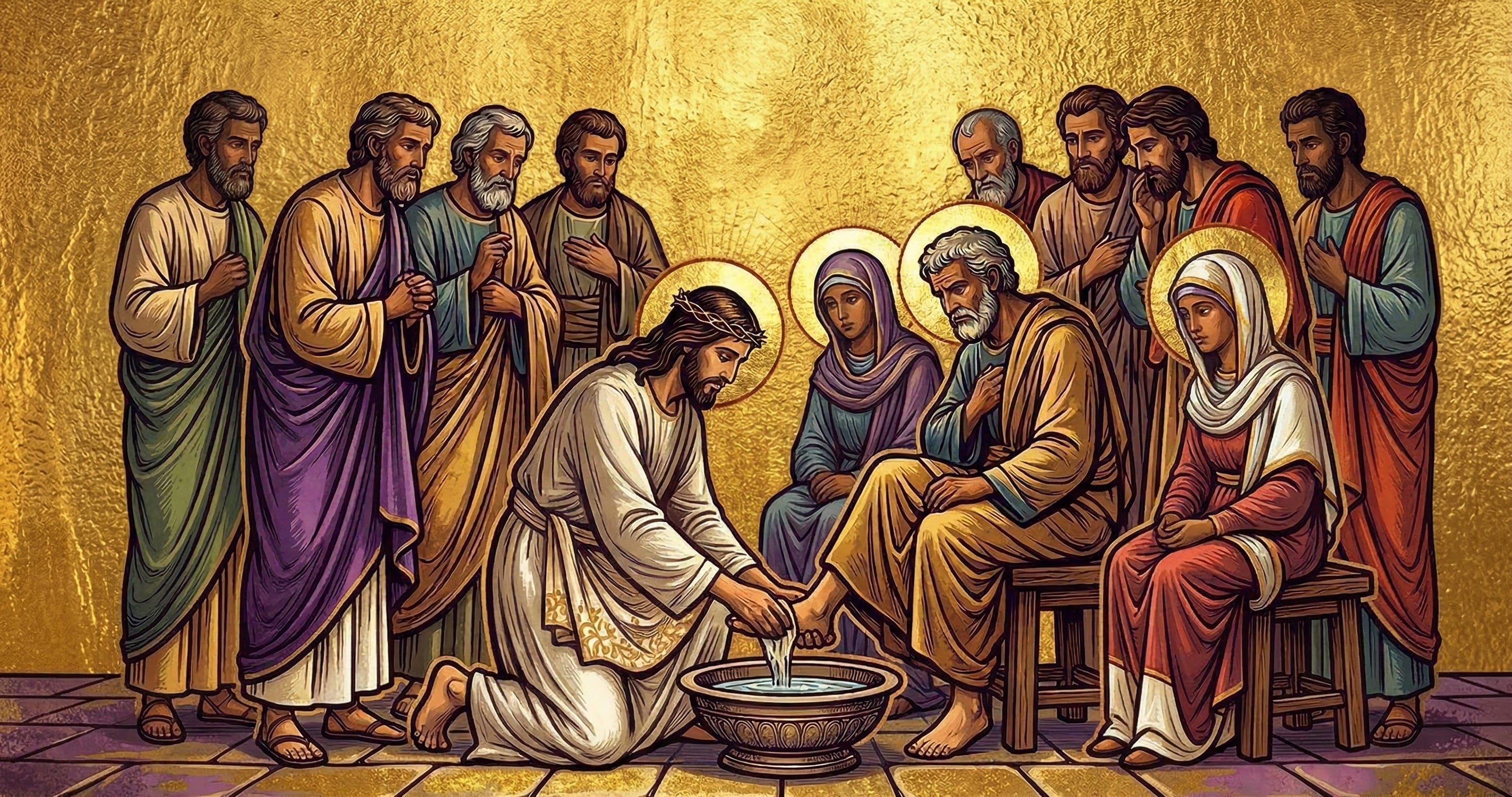
Tonight, the Church reads John 13:1–15. Before the feast of Passover, Jesus rises from supper, takes off his outer garments, ties a towel around his waist, pours water into a basin, and begins to wash his disciples’ feet. There is no announcement nor explanation. The God of the universe kneels on a stone floor and reaches for the feet of those who will, within hours, abandon him.
I have read this passage every Holy Thursday for as long as I can remember, and it has never stopped unsettling me.
The scene contains the entire Gospel compressed into a single gesture — one so quiet, so domestic, so easy to sentimentalize that we almost miss what it costs.
Consider what Jesus knows at this moment. Judas has already made his deal. Yesterday we sat with that betrayal — the thirty pieces of silver, the question at the table, the kiss that will come in the garden. Peter will deny him three times before the rooster crows. Every man in this room will scatter when the soldiers arrive.
Jesus knows all of it. He washes their feet anyway.
That is the part we rush past. He does not wash the feet of the faithful. The basin reaches the ones who are about to fail him — the man who will sell him for silver, the man who will swear under oath that he never knew him.
Pope Leo XIV, in his homily at the Mass of the Lord’s Supper this evening, named the inversion at the heart of this scene.
“We tend to consider ourselves powerful when we dominate, victorious when we destroy our equals, great when we are feared,” he said. Jesus takes a towel and does the opposite. Leo called it a “gratuitous and humble gesture” that reveals “the true omnipotence of God.” The almighty on his knees. Power that looks like a basin of dirty water.
The first reading tonight is Exodus 12 — the Passover instructions. Kill the lamb. Smear blood on the doorposts. Eat in haste, with your sandals on, your staff in hand, ready to flee. Death is passing over, and the angel of the Lord does not negotiate. The blood on the wood is the only thing between you and annihilation.
Paul, in the second reading, connects these two moments across a thousand years.
