
The Quiet D-Day Father Who Kept Pope Leo XIV on the Path to the Priesthood
Louis Prevost rarely spoke for the record. One answer across a kitchen table in Dolton, Illinois, may have changed the history of the Church.
Thank you for reading! Letters from Leo is a reader-supported publication. To receive new posts and support my work, consider becoming a free or paid subscriber.
Since the white smoke rose over the Sistine Chapel in May of last year, the world has come to know the woman who raised Pope Leo XIV. Mildred Martínez Prevost has been profiled, traced through New Orleans census records, and celebrated for the Ave Maria she sang from the family pew on Chicago’s South Side. The faith that formed the first American pope, the story usually goes, came down through his mother.
Far less has been written about the man who sat beside her in that pew.
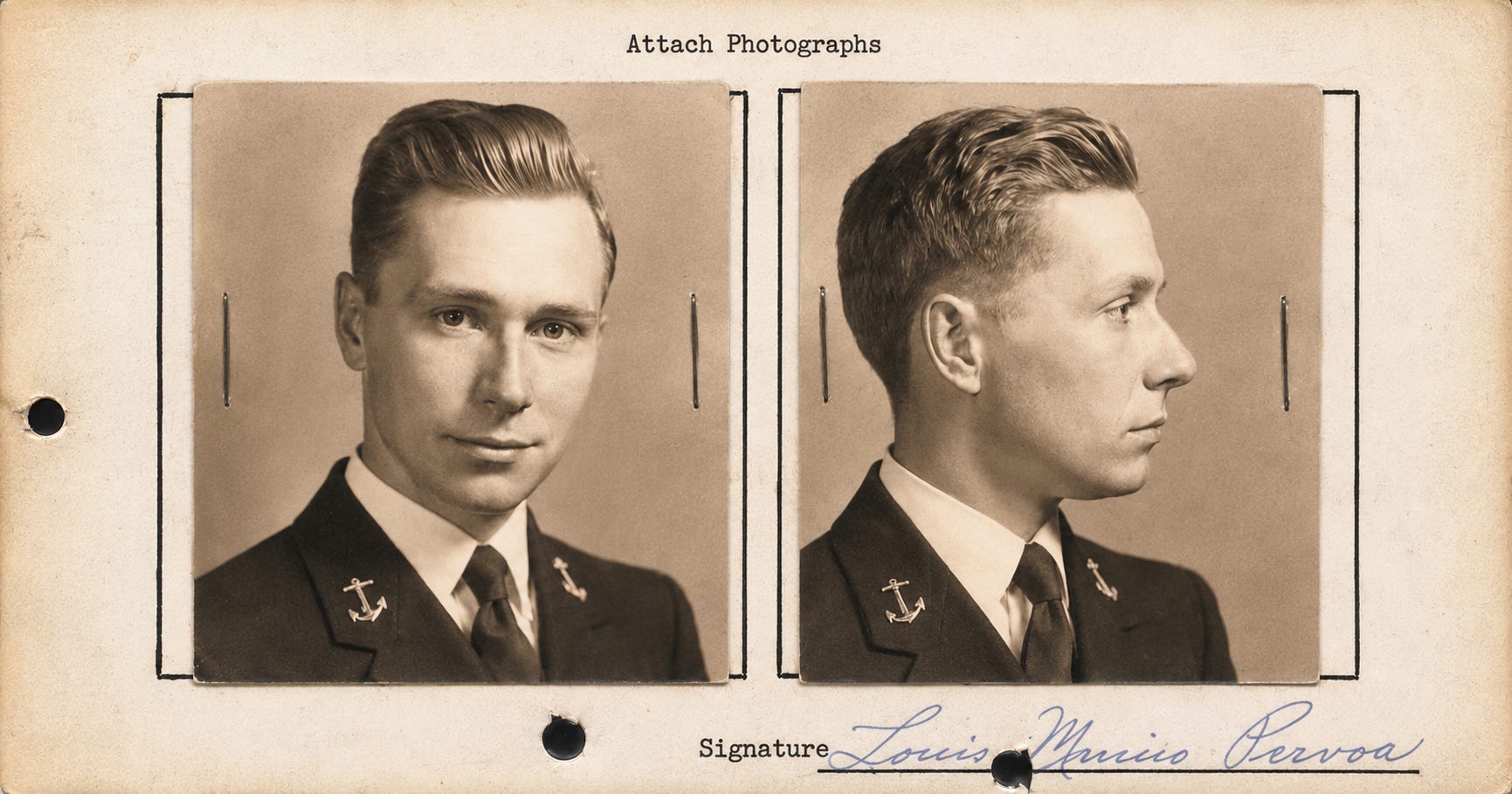
Louis Marius Prevost left a thinner record. He gave no grand interviews and died in 1997, nearly three decades before his youngest son stepped onto the loggia of St. Peter’s.
What we know of him comes from public documents and a handful of memories his sons have shared. The more I read, the more he strikes me as a Joseph-figure — a father who stays in the background, says little, and pours his whole vocation into making another’s possible.
Joseph, after all, does not speak a single word anywhere in the Gospels.
A sailor from the South Side
Louis Prevost was born in Chicago in 1920 and grew up in Hyde Park, the son of a Sicilian immigrant from Milazzo and a Frenchwoman born in Le Havre, on the coast of Normandy.

That last detail carries a quiet irony.
In the summer of 1944, the Navy sent young Louis to the Normandy coast his mother had left behind a generation earlier. Commissioned the previous November at the age of twenty-three, he served as executive officer of a tank landing ship and took part in the D-Day landings at Normandy on June 6, 1944, as part of Operation Overlord.
He went on to command an infantry landing craft, ferrying soldiers and Marines onto the beaches of southern France during Operation Dragoon. He spent fifteen months overseas and rose to lieutenant, junior grade. The war in Europe ended on May 8, 1945. Eighty years later to the day — May 8, 2025 — his son was elected pope.

Like so many of his generation, Louis came home and went quietly to work. He earned a master’s degree from DePaul, married Mildred in 1949, and bought a small house in Dolton, Illinois, where the two of them raised three boys.
He became a school principal and later a district superintendent south of the city. He taught catechism, led the parish Altar and Rosary Society, and raised his sons in the same rhythm of Mass and prayer that had shaped him. When the Second Vatican Council turned the Mass toward the people in their own tongue, he stood up as a lector, helping his neighbors in Dolton pray the new English liturgy.

The conversation at the kitchen table
The most revealing thing we have about Louis Prevost is a story his son told on Italian television in 2024.
The future pope was a young man then, training for the priesthood and unsure he wanted it. He brought his doubt to his father. “Maybe it would be better I leave this life and get married,” he remembered saying. “I want to have children, a normal life.”
Louis neither argued nor pushed back. He answered, his son recalled, “in a very human but deep way.” Yes, he said, the intimacy between a husband and a wife is a real and beautiful thing — he knew that intimacy with Mildred. But there is another intimacy, too, between a priest and the love of God.
“There’s something,” the future cardinal remembered thinking, “to listen to here.”
What Joseph teaches
A weaker father might have steered his son toward the collar to feel proud, or talked him out of his doubt to spare himself the loss. Louis did neither. He widened the frame, named the thing his son already loved, and left the choice where it belonged.

This is what the Church means by spiritual fatherhood, and it is why Joseph still matters. The carpenter of Nazareth is given no recorded words in scripture. He is known instead by what he does: taking Mary into his home, fleeing to Egypt to protect the child, teaching a boy a trade and how to pray. His holiness lives in his presence, his protection, and his readiness to raise a son whose mission would one day surpass his own.

Pope Francis drew out the same truth on the day his own papacy began. Preaching on the Solemnity of Saint Joseph in 2013, he called Joseph the custos — the discreet, silent guardian who protects Mary, Jesus, the family, and all creation — and he insisted that the tenderness such care demands is no weakness. “We must not be afraid of goodness, of tenderness,” Francis said; in Joseph, that tenderness is “not the virtue of the weak but rather a sign of strength of spirit.”
There is a temptation, especially now, to imagine that fatherhood means control — that the strong father is the one who dictates the path and demands the outcome. Louis Prevost points to something truer. The strongest thing he ever did for his son was to step back at the exact moment a lesser man would have stepped in.
Every pope has had a father, and most of them vanish into history. John Paul II remembered waking in the night to find his own father on his knees in prayer, and he called that home his “first seminary.” Benedict XVI was raised by a rural Bavarian policeman who anchored the household in daily prayer, and Francis grew up watching his father, an Italian-born railway accountant in Buenos Aires, build a new life far from home. Leo XIV carries his own version of that inheritance — a man who crossed an ocean to fight a war, came home to teach children, read scripture aloud to his parish, and, when it counted most, told his son to listen for the love of God.
The quieter parent
On this Father’s Day, with his mother’s story already so well told, the quieter parent deserves a moment of his own.
Louis Prevost did not live to see what his youngest boy would become. He rests in Assumption Cemetery in Glenwood, in the south suburbs where he spent his life. Yet the gentleness he offered across a kitchen table in Illinois now shapes the way a pope speaks to 1.4 billion Catholics — patient, unhurried, more inclined to make room for others than to fill the silence himself.
His other sons carried the inheritance too. The Prevost brothers have weathered a hard public year, and through it they have held to the conviction that family is forever — a lesson learned in that small house in Dolton.


Bob Prevost learned his gentleness somewhere. I suspect a good deal of it came from a man who, like Joseph, said very little and said exactly enough.
This Father’s Day, we are giving thanks for the quiet fathers — the ones who show up at the kitchen table, kneel in the back pew, and shape their children through presence and patience far more than through words.
At Letters from Leo, we believe the witness that changes the world most often looks like Louis Prevost — hidden, faithful, patient enough to let love do its slow work.
The Gospel is carried forward as much by the fathers and mothers at kitchen tables, by the catechists and teachers who raise the next generation to know the love of God, as it is by popes and cardinals.
In a culture that prizes noise, dominance, and the loudest voice in the room, this community holds to something older and steadier: the dignity of every human person, the quiet strength of the family, and a faith that will not bow to fear or cruelty.
This is the fastest-growing Catholic community in the country because people are hungry for exactly that — for tenderness with a spine, for a Church that still believes the world can be repaired one act of love at a time.
If you believe this movement matters — Catholics and people of goodwill standing for human dignity and the sacredness of the family against a politics of contempt — I am asking you to join us.
If you’d like to invest in our mission, here are three ways you can help on Father’s Day:
Subscribe as a paid member to receive exclusive posts about the life and formation of Pope Leo and help sustain this newsletter.
Donate with a one-time gift to fuel this project’s mission.
Share this post (and Letters from Leo) with a friend who might enjoy it.
As a paid member, you’ll also receive our biographical series on Pope Leo’s Life & Formation, our Sunday Scripture Reflection Series, our reporting on how Pope Leo Takes On Silicon Valley, and exclusive reporting like the Epstein-Bannon Investigation — the work that keeps this community grounded and growing.
Whether you give $0, $5, $50, $500, $1,000, or more, your presence here matters — no matter your faith or your politics.
Thank you for reading. I’ll see you on the road.


Thank you so much for your words about the two Josephs. It brings back memories of my father, long deceased, who, although he became an agnostic, was a father like St. Joseph and Louis Prevost. i remember how he gave me support but room to make my own choices. And it made me again thank the good Lord for him.
A lovely tribute.