


Thank you for reading! Letters from Leo is a reader-supported publication. To receive new posts and support my work, consider becoming a free or paid subscriber.
JD Vance’s new memoir reached bookstores last week, and folded into its story of a hardscrabble boy who found God is a confession that every American Catholic — and indeed every American voter — should examine.
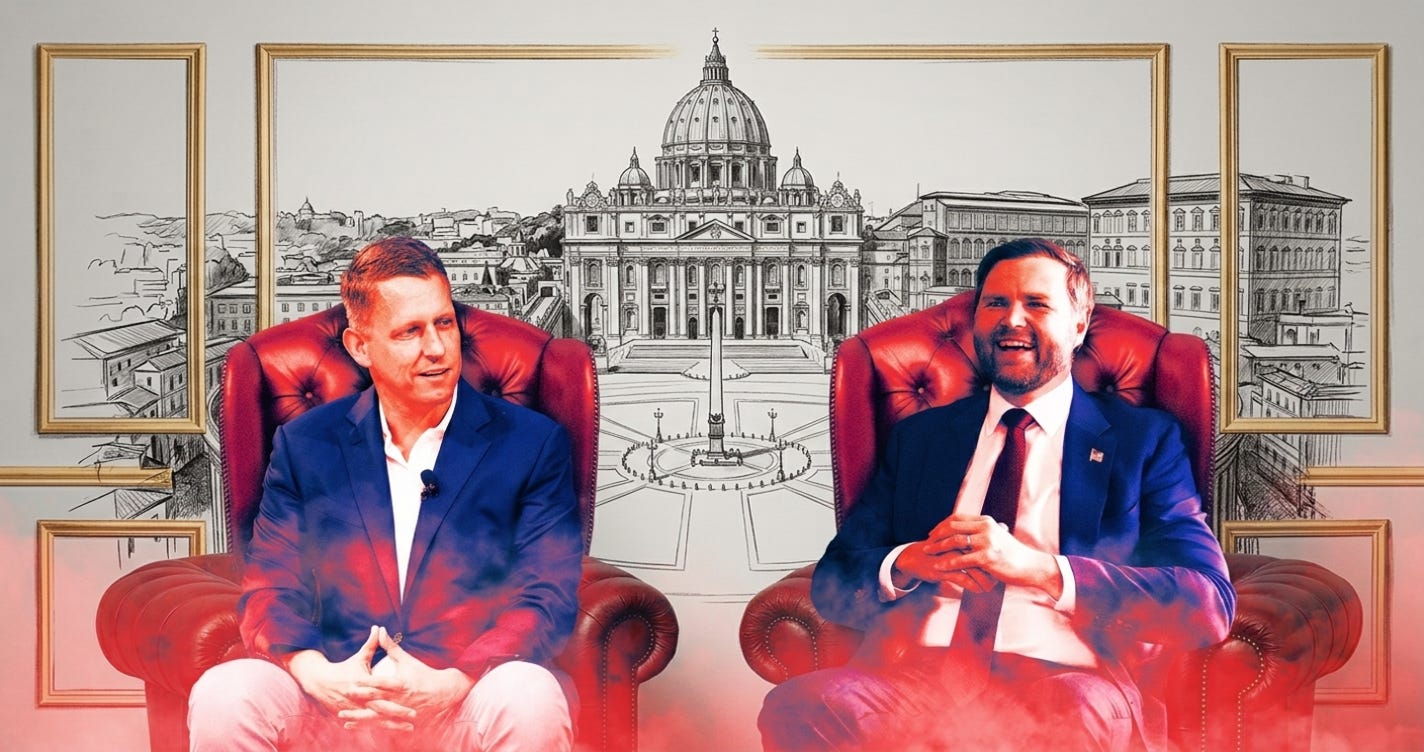
The vice president partially credits his conversion to Peter Thiel, the Silicon Valley billionaire who has bankrolled his rise.
In Communion: Finding My Way Back to Faith, published June 16 by Harper, Vance returns to the year his certainties came apart. He had assembled a tidy rule for himself at Yale Law School, and then in 2011 he sat through a talk by Thiel that wrecked it.
“Possibly the smartest person I’d ever met, he identified very openly as a Christian,” Vance writes, adding that Thiel “defied the simple social template I had constructed — that dumb people were religious and smart people were atheists.”
By then Vance had talked himself into atheism, an admirer of Ayn Rand who treated unbelief as the mark of a serious mind. Thiel broke the spell — here, Vance thought, sat a man of obvious genius who also knelt and prayed. The meeting pushed Vance toward the French thinker René Girard, whom we will come back to, and on toward his baptism in 2019 and the second-highest office in the land.
Here is where the story turns strange. The man who seeded the Catholic conversion now sitting in the vice presidency spent last autumn delivering sold-out lectures on a single subject — the coming of the Antichrist.
With Thiel’s protégé a strong contender for the presidency in 2028, his convictions about God are no longer a private curiosity.
Let me be plain about what I am not arguing. I do not contest Thiel’s intelligence for a moment.
In a January 2020 email to Facebook’s leadership — Mark Zuckerberg, the policy chief Nick Clegg, and the investor Marc Andreessen among them — Thiel diagnosed the souring of millennials and Gen Z on capitalism with more candor than most of his peers could manage.
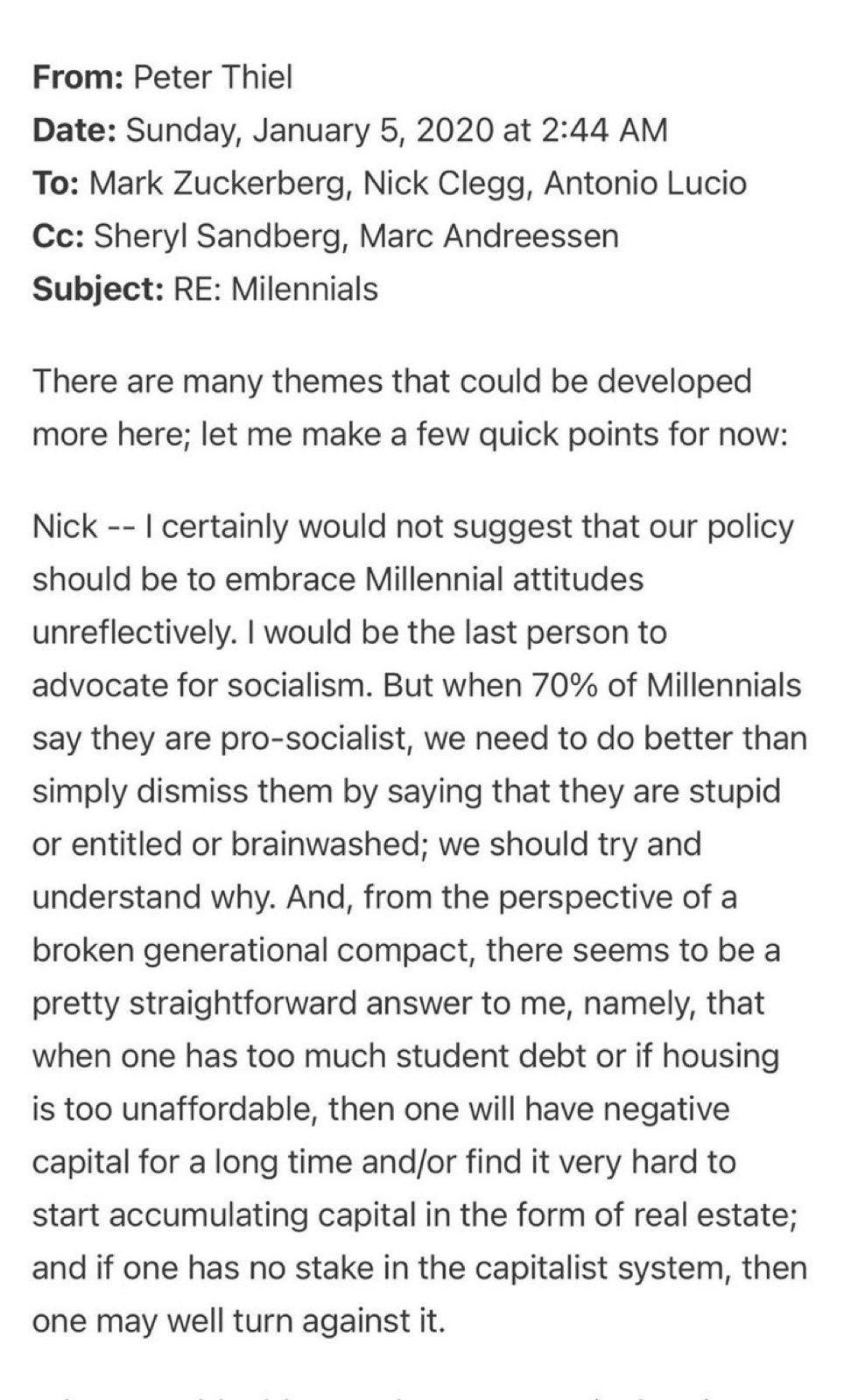
Crushing student debt and unreachable housing, he wrote, leave the young with negative capital for years, and a generation that holds no stake in the system has little reason to defend it. He warned that writing them off as stupid or entitled or brainwashed would fix nothing.
His prescription is another matter, and I have my doubts about it. The diagnosis was astute.
Thiel grew up Lutheran, the son of devout German immigrants who settled in Foster City, California. He knew his Bible young and never quite put it down. The faith that shaped him as a adult, though, arrived at Stanford in the late 1980s, inside a lecture hall belonging to Girard — the literary critic and Catholic convert whose theory of human violence became the cornerstone of Thiel’s worldview.
Girard taught that we learn our desires by copying one another, and that the envy this breeds was discharged, in archaic societies, by turning on a scapegoat — an innocent victim whose lynching let the community feel briefly at peace. What Christianity exposed, in his reading, was the lie buried in that ritual. The Gospels tell the story from the side of the victim and insist he is innocent, stripping the old mechanism of its cover. Girard saw this unveiling as the singular achievement of the faith, the moment the human race was handed a mirror.
Vance has said this is what drew him in. He took up Girard’s account of a God who takes the scapegoat’s place rather than a lawgiver issuing commands, and he has named mimetic theory a turning point in both his faith and his politics.
Thiel walked through the door and kept going somewhere stranger. He has described his own beliefs as “somewhat heterodox,” once saying, “I believe Christianity is true but I don’t sort of feel a compelling need to convince other people of that.” His is a Christianity of the library and the boardroom, intellectually ‘serious’ and emotionally remote, devout in its claims and unbothered by the pews.
Read him closely, and Thiel seems to take from Christianity mainly its account of power. The drama that grips him is the unmasking of violence and the struggle over who commands history.
What he rarely dwells on is the center of the thing — God taking on flesh, a poor man from Nazareth bearing the sorrows of the world, and the demands that man laid on his followers, the rich ones most of all. The Jesus who tells a wealthy young ruler to sell everything does not seem to keep Thiel awake at night.
Press him on what God is doing right now in human history, and the answer turns dark.
Here’s what I mean.
