
Thank you for reading! Letters from Leo is a reader-supported publication and the fastest-growing Catholic community in the country. To receive new posts and support this movement, consider becoming a free or paid subscriber.
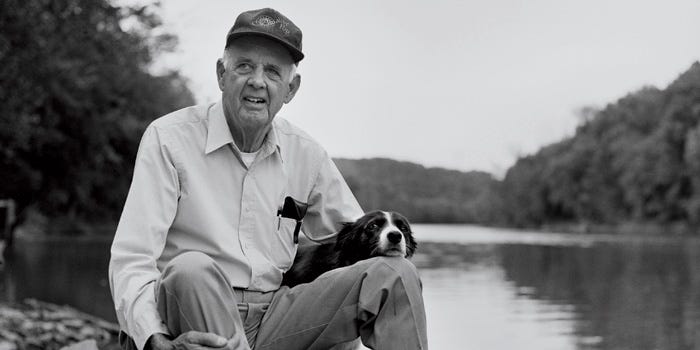
Wendell Berry died Monday at his home in Port Royal, Kentucky. He was 92.
For sixty-one years he farmed the same hillside above the Kentucky River, and from that hillside he wrote more than fifty volumes of poems, novels, and essays. Nearly all of them defend one idea: creation is a gift held in trust, and no economy built on waste can keep faith with the poor.
On Sunday, Pope Leo XIV stood at his Angelus window and asked the world to keep Tuesday’s World Day of Prayer for the Care of Creation, the opening of the month-long Season of Creation. “Caring for our common home calls for a conversion of heart,” the pope said, “so that what has been used to bring about destruction may instead be directed toward life.”
Berry died the next day. On Tuesday, Leo celebrated the Mass for the Care of Creation in the Laudato Si’ Garden at Castel Gandolfo — an American pope praying beneath Italian trees while America mourned the writer who taught its churches to see the ground under their feet as holy. “It is not yet too late,” he told the faithful gathered in the garden, “and the Season of Creation calls us to a profound conversion.”

He was born in Henry County in 1934 and came of age among its tobacco farmers. In the early 1960s he taught creative writing at New York University, holding the kind of job young writers are told never to leave, and friends warned him that going home would bury his career. He went home anyway. On July 4, 1965, a year into a teaching post at the University of Kentucky, he settled his family at Lane’s Landing, a small farm near Port Royal, and he stayed for the rest of his life.
Berry was never one of ours. He worshiped at the Baptist church in Port Royal and described himself as a “marginal” Christian, a man who kept churches at arm’s length (in good weather he preferred the woods) even as he took the Gospel very seriously. Catholics claimed him all the same.
“Though Berry is a Protestant, he embodies Catholic social teaching on economics,” America Magazine wrote in 2017, and it is hard to name an American writer who did more to ready the Catholic imagination for Laudato Si’. When Pope Francis published his encyclical on our common home in 2015, Berry’s readers already knew the argument; he had been making it for half a century.

“We are holy creatures living among other holy creatures in a world that is holy,” he wrote in “Christianity and the Survival of Creation,” a lecture he delivered in 1992 at the Southern Baptist seminary in Louisville on the Church’s duty to the natural world. The Bible, he observed there, is “a hypaethral book” — an outdoor book, “open to the sky,” best understood in the places it describes.
He saved his hardest sentences for Christians. “Christian organizations, to this day, remain largely indifferent to the rape and plunder of the world and of its traditional cultures,” he charged in the same lecture, and he called the destruction of nature “the most horrid blasphemy.” Catholic Worker farmers and parish study groups have been underlining those pages ever since.
His work for justice began with race. The Hidden Wound, published in 1970, argued that slavery and segregation had damaged white Kentuckians like him alongside the Black neighbors they wronged. “If the white man has inflicted the wound of racism upon black men,” he wrote, “the cost has been that he would receive the mirror image of that wound into himself.”
The convictions kept widening.
His 1968 statement against the Vietnam War declared that he could no longer imagine a war he would believe to be useful or necessary. In January 2009, he issued a public statement against the death penalty from Port Royal:
“As I am made deeply uncomfortable by the taking of a human life before birth, I am also made deeply uncomfortable by the taking of a human life after birth.”
Cardinal Joseph Bernardin gave that instinct its Catholic name, the consistent ethic of life. Berry reached it on his own, from Scripture and from soil.
He paid for what he believed. In December 2009, he pulled his papers from the University of Kentucky after the school accepted $7 million from coal executive Joe Craft and named a dormitory the Wildcat Coal Lodge.
“I couldn’t live with the university administration’s decision to form an open alliance for money with the coal industry,” he said at the time. Two years later, at 76, he joined a weekend sit-in at Governor Steve Beshear’s office with Kentuckians for the Commonwealth to protest mountaintop-removal coal mining.

Kentucky’s Catholics found him early.
In December 1967, he drove to the Abbey of Gethsemani with his wife Tanya and the poet Denise Levertov to spend an afternoon with Thomas Merton, who died the following year; Berry later sent poems to Merton’s little magazine, Monks Pond.
And when his family sought a home for the farming program built on their land’s legacy, they chose St. Catharine College, a small Kentucky school run by the Dominican Sisters of Peace. “I believe the world and our life in it are conditional gifts,” Berry said then. “You have to take good care of it.”
The pope who opened the Season of Creation on Tuesday was born in Chicago, and he has spent his pontificate sounding like a man with a copy of Berry’s works close at hand.
Last October he told MAGA climate skeptics to repent, warning that ridicule of a warming world is contempt for the poor. A plea to world leaders to “listen to the cry of the earth” followed within weeks, as did his declaration that housing, work, and land are “sacred rights”.
In July at Castel Gandolfo, Leo preached on a God who sows seed even on rock and thorn, and he broke bread there with two hundred of Rome’s poor.
In his message for this World Day of Prayer, Leo wrote that “we are called to safeguard the many ‘ecosystems’ entrusted to us: the ecosystems of creation, of human relationships and of the human heart itself.”
On Tuesday he put it more plainly, asking the faithful to place “in ‘silent mode’ the many noises generated by human activity, so that we may hear the melodious voice of creation.” Berry gave sixty years to exactly that labor.

He compressed the whole theology into three lines of a poem about writing poems: “There are no unsacred places; / there are only sacred places / and desecrated places.” Anyone who has seen a mountaintop-removal site knows which category the coal companies chose. The Season of Creation now beginning is the Church’s annual argument for the other one.
His Mad Farmer poem ends with a two-word command that Christians have passed hand to hand for decades, and this week it reads like a bequest: “Practice resurrection.”
At Letters from Leo, we stand with everyone who learned from Wendell Berry that the Gospel begins in the dirt — with farmers holding onto family land, and with the millions of Catholics and people of goodwill who refuse to let the poor pay the bill for the plunder of God’s world.
Pope Leo opened this Season of Creation on Tuesday by telling the world it is not yet too late. Berry spent sixty-one years on a Kentucky hillside showing what that conversion costs and what it yields. This community exists to carry the same witness into American public life, where an administration sworn to extraction treats land and people alike as fuel.
This is the fastest-growing Catholic community in the country because people are hungry for something deeper than rage and propaganda, and because a witness like Berry’s proves the hunger can be fed.
If you believe this movement matters — Catholics and people of goodwill defending human dignity and God’s creation against an economy of extraction — I am asking you to join us.
If you’d like to invest in our mission, here are three ways you can help:
Subscribe as a paid member to receive exclusive posts about the life and formation of Pope Leo and help sustain this newsletter.
Donate with a one-time gift to fuel this project’s mission.
Share this post (and Letters from Leo) with a friend who might enjoy it.
Paid members receive the exclusive series on Pope Leo’s life and formation — his Chicago childhood, his years in Peru — along with the Sunday Scripture Reflection Series and full access to our archive.
Whether you give $0, $5, $50, $500, $1,000, or more, your presence here matters — no matter your faith or your politics.
Thank you for reading. I’ll see you on the road.


and all the people bowed their heads as he passed by
Thank you for this reflection on a beautiful life