

At His Second Consistory, Pope Leo XIV Advances What Pope Francis Started
He kept the Latin Mass off the table and put listening, the margins, and the laity at the center.

Thank you for reading! Letters from Leo is a reader-supported publication chronicling Pope Leo XIV, the Catholic Church, and the fight for human dignity in American life. To receive new posts and support this work, consider becoming a free or paid subscriber.
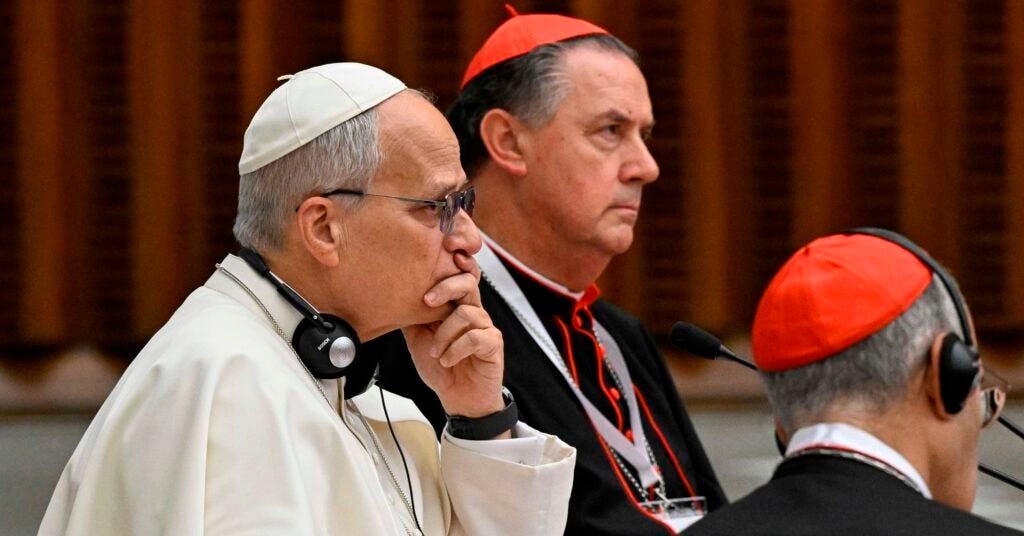
Over the weekend, Pope Leo XIV walked into the Paul VI Hall, took his seat among 178 cardinals, and asked them to do something cardinals rarely do: break into small groups and listen to one another.
For two days the College of Cardinals worked through four themes he had set for them — the wounds of a fractured world, the culture of power, the common good, and the implementation of the Synod.
Leo sat with them through the plenary sessions and when the gathering closed on Saturday evening, he gave the cardinals his own reading of what they had just done.
Many conservatives have written off synodality as a strange innovation of Francis’s making. Leo told the cardinals they were instead recovering something ancient, a part of the Church’s venerable past. A consistory, he said, is meant to be a place of communion.
Not a parliament, not a congress where opinions or interests prevail, but an experience of communion in the service of the mission.
Anyone who watched the last pontificate heard the echo. For more than a decade, Pope Francis taught that the synod existed to help the Church listen before it decided, never to stage a contest for control. Leo has taken that conviction and made it the spine of his own papacy.
This was his second consistory in six months, and the format had drawn complaints the first time. After January’s meeting, some cardinals grumbled that the round-table structure felt “very controlled,” the outcomes set in advance. Leo answered the criticism by widening the method rather than dropping it — he added an open dialogue session and a private channel for the cardinals to write him directly, then asked them to try again.
The method itself carries a long pedigree. Those small groups are running what the synod calls “Conversation in the Spirit,” a practice the Church borrowed from the Jesuits and their Spiritual Exercises.
It rests on what Ignatius called the Presupposition — the discipline of reading a neighbor’s words in the most generous light they can bear before reaching for the harshest one. Part of why the format unsettles some cardinals is that it asks exactly that of them: to assume good faith in the brother across the table.
Many of them had arrived hoping for a different agenda. Conservatives wanted the liturgy discussed, and with it a reckoning over Traditionis Custodes, Francis’s 2021 order restricting the traditional Latin Mass.
That fight had already had its quiet moment in January, when a document defending the restrictions — written by Cardinal Arthur Roche — was handed to the cardinals but never discussed. Leo kept the liturgy off the table again this week and steered the College toward the questions he wanted to ask.
He has grown precise about what synodality is. He told the cardinals it amounts to no fixed procedure and no calendar of meetings, calling it instead “an attitude, an openness, a willingness to understand.” Cardinal Mario Grech, who runs the Synod office, gave him a line he repeated back to the room: synodality “is a spiritual style.”
The pope also answered the fear directly. Some of the men in front of him suspect that synodality drains authority away from bishops and from the pope himself. Leo argued that authority survives only when it serves communion, when it widens participation and keeps the whole body walking together.
At the opening Mass in St. Peter’s, he made the point personal. “You will find in me one who asks, not commands,” he said, before defining the office itself: “The authority of primacy belongs to the one who listens and only then leads, to the one who learns and only then teaches, always following the one and only Teacher.” It is a note he has struck again and again since his election.
The conviction beneath it is one he has returned to often: that the truth is something the Church receives and shares, never something any one of us owns alone. A pope who believes that will listen, because he expects to learn something he does not already hold.
None of this loosens the Church’s grip on what it believes. Leo wants the people who lead it to carry that belief differently — closer to the ground, and far slower to pronounce from on high.
Here is where Leo’s project comes into view. A church that listens before it speaks has not gone soft on the truth. His wager is that the Holy Spirit still speaks through the entire People of God — through the bishop and the catechist, through the mother burying a child, the migrant at a checkpoint, the teenager standing at the edge of his own despair.
He kept circling back to those people. In his closing remarks he said the cardinals had moved him by the way they spoke of the young and “the suffering that sometimes leads them to despair — and at times to the extreme despair of taking their own lives.” He told them the poor are “not merely the recipients of our care, but protagonists of the hope that God continues to kindle throughout history.”
Then he made room at the center for Catholics who hold no office at all. The work of lay women and men in public life, he said, is essential to the Church’s mission, a “political charity” that deserves the community’s backing.
He announced a gathering this October to take stock of Amoris Laetitia, Francis’s teaching on family life, and promised that ordinary families would sit in the room and tell their own stories.
The cardinals were not the first group he gathered for this. In the days before they arrived, Leo sat down with the leaders of the synod’s continental teams — bishops among them, but also priests, religious sisters, and lay men and women — who had just spent three days working through the machinery of carrying synodality toward the global assemblies planned for 2027 and 2028.
The people drawing that road map are not only the men in red.
He could have let the whole project lapse. Plenty in Rome, and plenty of Catholics here in the United States, hoped he would. Instead, he has kept the study groups Francis launched to examine the Church’s hardest questions — including its pastoral approach to LGBTQ Catholics — moving through their work, and he has told the bishops to carry the same listening home.
He wants synodality practiced in dioceses and parishes, with lay people inside the conversation rather than waiting at its edges.
In January, Bishop Robert Barron — a delegate to both Synod assemblies — pressed the case for caution. Synods were useful for setting practical strategy, he argued, but should not become “a defining and permanent feature of the Church’s life.” If synodality had to continue, he wrote, let it stay modest.

Leo XIV has now given his answer: it is continuing, and he means it to be both permanent and central.
Much of the consistory turned on the fifth chapter of Magnifica Humanitas, Leo’s first encyclical, which argues that war is born long before any army moves, inside a culture of power that shapes how human beings think, trade, and even pray. The cure he keeps prescribing is the posture he asked of the cardinals: cooperation in place of domination, the slow labor of looking at an adversary and recognizing a brother.
He closed the two days with a joint appeal for peace. “We must not resign ourselves to violence,” he said. “Violence will not have the last word. God continues to open paths of reconciliation and peace throughout history.”
He reached for the Gospel to describe the days themselves. The cardinals had begun, he said, under the image of the good Samaritan, the traveler who stops for a wounded stranger.
He ended with the road to Emmaus, the disciples who walked in sadness until a stranger fell in beside them and “set their hearts ablaze.” That, he told them, was something of what these two days had been: a walk taken together, in the hope that the Lord was walking too.
The stakes reach well past Rome. In a moment when public life so often rewards the loudest voice and the closed fist, Leo is assembling an institution around a different instinct — that no one can truly lead the people he refuses to hear.
He knows the distance ahead. Synodality, he reminded the cardinals, is learned only “by practicing it,” and communion is “never a result achieved once and for all,” but a daily conversion. He brought these consistories back after years without them, so the conversation would not stop, and he promised the cardinals another in 2027.
None of this leaves much room for doubt. Leo treats the synodal Church as the work of his pontificate, not a storm to wait out — one that listens first, reaches its margins, and gives lay women and men a place at the heart of the mission. The road Francis opened runs forward from here, and Leo is making no secret that he means to walk it.
At Letters from Leo, we stand with a pope who believes the Gospel is heard before it is preached. A Church that listens to the migrant, the grieving mother, the young person on the edge of despair, and the layperson with no title at all is a Church that still trusts the Spirit to speak through the whole People of God.
This is the fastest-growing Catholic community in the country because people are hungry for that kind of faith — a faith that goes out to the margins instead of guarding the gates, that answers cruelty with communion and fear with hope.
If you believe this movement matters — Catholics and people of goodwill standing for human dignity in a culture that too often rewards domination — I am asking you to join us.
If you’d like to invest in our mission, here are three ways you can help:
Subscribe as a paid member to receive exclusive posts about the life and formation of Pope Leo and help sustain this newsletter.
Make a one-time gift to support my work.
Share this post (and Letters from Leo) with a friend who might enjoy it.
Paid members keep this work alive and get the fuller story: our ongoing series on Pope Leo’s life and formation, the Epstein-Bannon investigation, the deep dives in Pope Leo Takes On AI, and the weekly Sunday Scripture Reflection Series.
Whether you give $0, $5, $50, $500, $1,000, or more, your presence here matters — no matter your faith or your politics.
Thank you for reading. I’ll see you on the road.

What great insight and summary of this Consistory.
Thank you...a great summary. If you read Robert Prevost's doctorate on the role of the Augustinian Prior, which he wrote in his early 30s, you will see this same statement woven throughout: “...authority belongs to the one who listens and only then leads, to the one who learns and only then teaches, always following the one and only Teacher.” This is how he led as prior in Peru, as prior general of the Augustinians for 12 years, and as bishop in Chiclayo. Of course he will lead as Vicar of Christ in the same way! Synodality has been woven into who he is from the beginning of his work as a young priest & missionary in Peru.