


Dear friends —
Alex Pretti’s final act was one of mercy.
He was a Catholic nurse, a Minnesotan, and a man of justice. In his last moments, he reached down to help a woman to her feet after she’d been pepper-sprayed and thrown to the ground by Trump–Vance ICE agents.
Seconds later, Alex was dead — shot and killed in the street by the very forces he’d tried to calm.
We lost a brother that day. A martyred Catholic brother. And his blood now cries out from Minnesota’s frozen ground.
In any just Church — in any living Church — his name would be on every bishop’s lips. His life would be honored. His witness would be lifted up. Many of our prelates have done so.
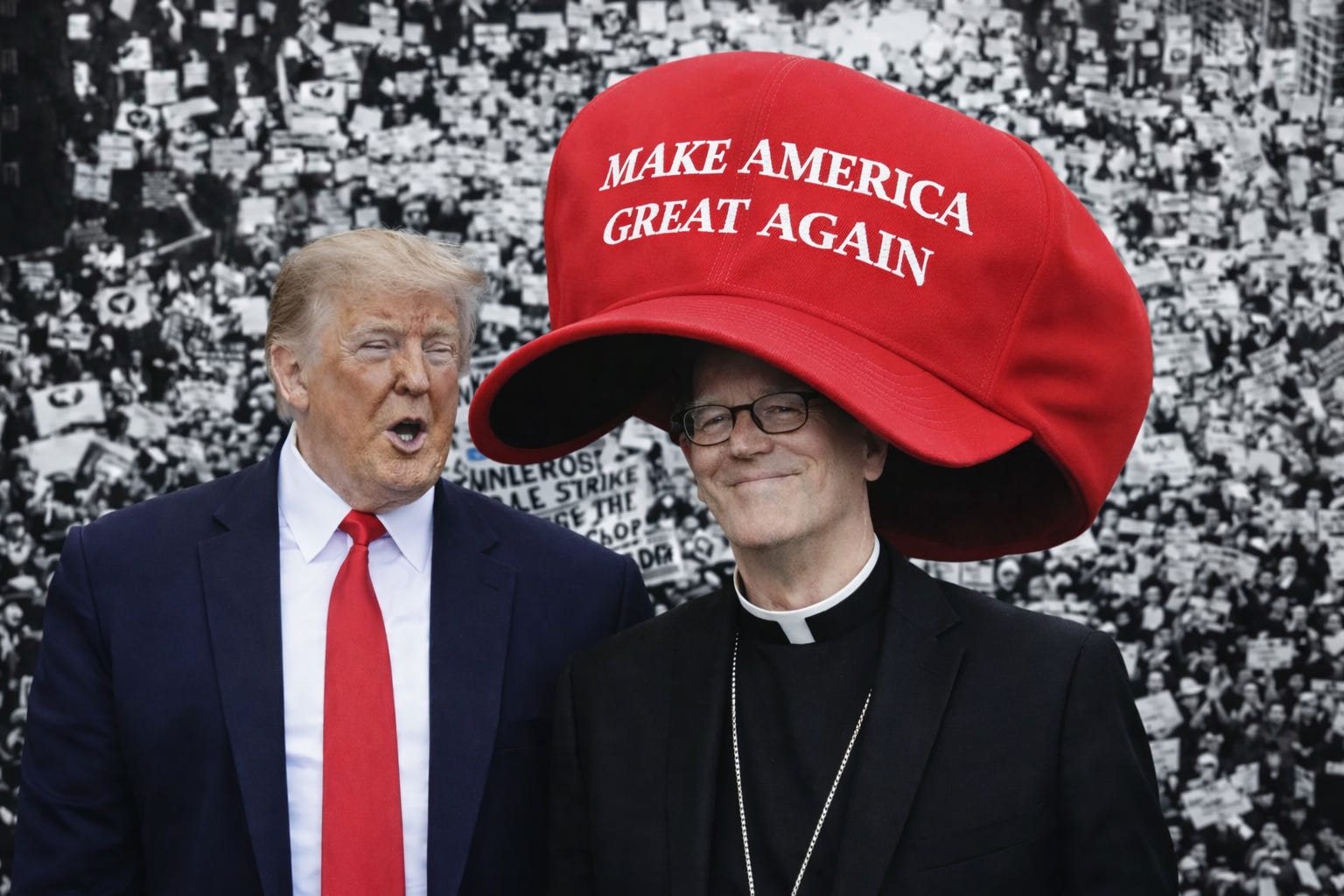
But once again, his homestate Bishop Robert Barron has gone quiet.
Not a statement. Not a tweet. Not a word.
Today’s subscriber only essay is about that silence — and what it reveals. About power. About fear. And about what happens when a bishop builds his ministry on media clout and partisan proximity instead of Christ.
We explore the scandals engulfing his Word on Fire empire, the emerging social media crisis that now shadows his leadership, and the deeper MAGA alignment that’s shaped his ministry’s direction for years.
The people of God deserve better. And in Alex’s name, we must demand it.
If you’re already a paid subscriber, thank you. If not, I invite you to join us.
Paid subscribers have access to the Sunday Scripture Reflection Series and the Q&A mailbag that opened this past week, where you can ask me anything about American politics, Catholicism, Donald Trump, Pope Leo, JD Vance — or my own faith, biography, and life.
Letters from Leo is open to anyone who wants to be informed and inspired by our pope — and to turn that inspiration into action that leaves America and the world more just, less cold, and more alive with hope.
If you’d like to invest in our mission during this new year, here are three ways you can help:
Subscribe as a paid member to receive exclusive posts about the life and formation of Pope Leo and help sustain this newsletter.
Donate with a one-time gift to fuel this project’s mission.
Share this post (and Letters from Leo) with a friend who might enjoy it.
Whether you give $0, $1, or $1,000, your presence here matters — no matter your faith or your politics.
Thank you for reading. I’ll see you on the road.

A rosary now hangs from a wooden cross at a curbside memorial in Minneapolis — the spot where 37-year-old Alex Pretti, a Catholic intensive-care nurse, was gunned down by federal officers on Jan. 24.
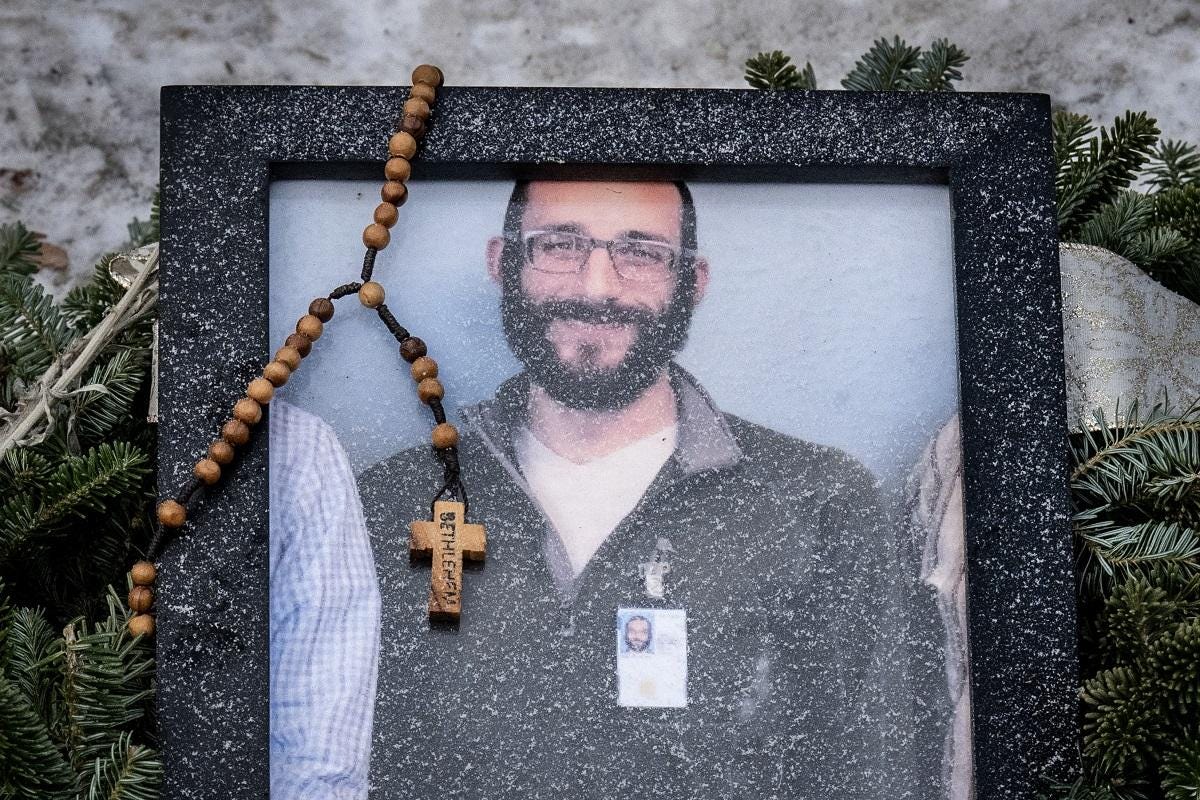
Pretti’s killing, the second death of a local U.S. citizen during President Trump’s Operation Metro Surge immigration crackdown, has shaken the Twin Cities.
Pope Leo XIV himself, in his Jan. 25 Angelus address, implored that “the Gospel must be proclaimed and lived in every setting” as a “leaven of fraternity and peace”, urging respect for human life amid the unrest.
Catholic leaders from Minnesota to the Vatican have echoed that call for justice and mercy.
Yet one voice remains conspicuously silent: Bishop Barron, the most prominent churchman in Minnesota, has not uttered a public word about the death of his own flock.
Barron’s silence is deafening, especially given his tepid response after the first killing. When ICE agents fatally shot 37-year-old Renee Good in Minneapolis on Jan. 7, Bishop Barron’s only commentary came in a Fox News op-ed two weeks later that faulted both sides for the tragedy.
In that essay, Barron wrote that “ego and poor decisions on both sides converged” to produce an “unbearable” situation.
Barron said he “strongly” defends the nation’s right to enforce its borders and even scolded Minnesota’s leaders for “stirring up resentment” against ICE, calling comparisons of agents to Nazis “morally heinous.”
He urged that “everyone on all sides of this issue must stop shouting at one another and demonizing their opponents”.
To be sure, calling for civility isn’t wrong — but where was the moral outrage at the fact that an unarmed woman was shot in her car by an immigration officer? Where was the clear condemnation of a federal crackdown that treats migrants as enemies?
Barron’s Fox News essay, coming two weeks after Good’s death, read as painfully equivocal.
A mother of three lay dead at the hands of federal agents, and the bishop’s takeaway was essentially to ask everyone to just get along. It was, at best, a both-sides balm applied to a moral crisis.
And now, after Alex Pretti’s killing, Barron hasn’t offered even that. He’s simply gone quiet, as if the systematic kidnapping and killing of people on our streets is just another political squabble to avoid.
Tweets, TV — and a Telling Void
Bishop Barron’s reluctance to confront the ICE killings is not for lack of things to say — he’s been busy opining elsewhere.
In recent days, Barron has found time to blast the new Muslim mayor of New York City for mentioning “the warmth of collectivism,” even comparing that phrase to the evils of Stalin.

He took to social media to amplify a sensational story of alleged Somali political corruption in Minnesota — a fraud narrative that had already been thoroughly debunked by authorities, but which right-wing media hyped over the holidays.
He’s weighed in on Iran, cheered on a crusade against “wokeism” in higher education, and even went on Dr. Phil to talk about Christian persecution and praises Donald Trump as “the greatest champion of religious liberty” in his lifetime.

When a mob of agitators disrupted a church service in St. Paul to protest ICE, Barron leapt to respond within hours, condemning the protesters as “unacceptable” violators of sacred space.
In short, the bishop has been anything but silent on culture-war flashpoints and pet partisan issues.
But on the life-and-death matters of justice and human dignity roiling his own state? Barron has been mute.
He has offered no public lament for Alex Pretti, a fellow Catholic Minnesotan killed in cold blood. Not a single word of comfort for Pretti’s grieving parents or the fearful immigrant families in his pews.
No denouncement of the machinery of death that is tearing families apart in Minnesota’s streets.
These silences stand in stark relief against the clear moral cry coming from Rome.
Remember: with the future Pope Leo XIV as his ghostwriter, the late Pope Francis wrote to the American bishops that a just society “welcomes, protects, promotes and integrates” the vulnerable. The message could not be clearer.
Yet on this urgent pro-life issue of immigrants’ lives and state violence, America’s most famous bishop is AWOL.
Why the reluctance? It’s hard to escape the conclusion that Bishop Barron is calibrating his silence to political convenience.
Bluntly put, condemning ICE’s brutality would mean criticizing the Trump administration — and Barron seems loath to do that.
His public persona in recent months has trended in the opposite direction: aligning with many of the MAGA-friendly narratives. He praises Trump’s record, parrots talking points about lawlessness and “open borders,” and saves his sharpest critiques for those protesting injustice rather than those inflicting it.
The result is a bishop who sounds more like a culture warrior or a cautious politician than a prophetic moral leader.
It’s a trend we’ve seen building for a while now, and it has not gone unnoticed.
In fact, Letters from Leo highlighted this disturbing shift in Barron’s priorities in an analysis earlier this month.
Barron’s social media presence even sparked a scandal recently.
Just before Christmas, eagle-eyed Catholics discovered that a private Facebook account linked to Bishop Barron had been following several explicit homoerotic pages — including one literally titled “Brazilian Male Feet” — along with a couple profiles of muscular young men posting provocative content.
The news, first reported by writer Chris Damian, quickly spread and raised eyebrows: Why was a bishop’s account (even a private one) engaging with such pages? Rather than directly address the matter, Barron’s team went into crisis mode.

Word on Fire put out a statement claiming Barron was the victim of online impersonators, insisting that a “bad actor” had somehow hacked the bishop’s account and “liked” those scandalous pages. That explanation was met with widespread skepticism.
Others Step Up as Barron Stays Quiet
Ironically, as Bishop Barron stays mute, other Catholic leaders are stepping into the breach.
They are showing what moral leadership looks like — and in the process, casting Barron’s abdication in an even harsher light. Consider Cardinal Joseph Tobin of Newark, one of Pope Leo’s top American allies.
On Sunday night, Tobin delivered a blistering rebuke of the administration’s immigration crackdown. Speaking at an online prayer vigil, he dared to say “no” to what he called state-sponsored cruelty.
Tobin didn’t mince words: he condemned ICE as a “lawless organization” and a “machinery of death,” and he urged Catholics to lobby Congress to defund the agency carrying out Trump’s deportation force.
This is extraordinarily strong language from a cardinal — unprecedented, in fact, for a U.S. Church leader to call for cutting off funds to a federal agency.
Cardinal Tobin framed his outcry explicitly in Christian terms, invoking the Gospel’s call to mercy and Dr. Martin Luther King Jr.’s plea that “hate cannot drive out hate”.
He even named the victims of this crackdown: “a 37-year-old nurse, Alex Pretti, shot dead… children as young as 5 legally kidnapped from their parents.”
Tobin’s message was clear: people of faith must not remain silent or numb in the face of such atrocities. We must name them, mourn them, and resist. That is what a successor of the apostles should sound like in this moment.
His voice joins a growing chorus of Catholic resistance inspired by Pope Leo’s own moral clarity.
Even in Minnesota, Bishop Barron’s own backyard, other church leaders are filling the void.
Archbishop Bernard Hebda of St. Paul–Minneapolis, Barron’s metropolitan, has been speaking out consistently in the past few weeks.
In a Wall Street Journal op-ed, Hebda pleaded for “comprehensive immigration reform now,” warning that each year of political inaction only makes the conflict “louder, angrier and less humane”.
“If recent events in Minnesota have clarified anything, it’s that we can no longer put off the hard work of immigration reform,” Hebda wrote, noting that years of inaction have turned a policy issue into a “cultural and political battleground.”
Crucially, Archbishop Hebda insisted that the status quo serves no one: communities are strained, millions live in fear, and this serves “neither justice nor the common good.”
In other words, we need both security and humanity. Hebda’s plea is far more than Bishop Barron has offered his own people.
While Barron went to Fox News to rally the rally the troops, effectively defend the federal crackdown, and chastise those who resisted it, Hebda went to a conservative newspaper to plead for empathy and bipartisan reform.
Which approach sounds more like the Gospel?
Even Archbishop José Gomez of Los Angeles — who lives thousands of miles from Minnesota — has spoken out more forcefully about the ICE killings than Barron has.
Gomez, the former USCCB president, used his platform to express solidarity with Minneapolis.

He lamented the “disturbing” use of lethal force on American streets and urged that the tragedy be met with prayer, peace, and dialogue, not more violence.
In a column from L.A., Archbishop Gomez noted the fear gripping immigrant communities after the shootings, and he called on Americans to “turn away from dehumanizing rhetoric” that treats any human being as less than a child of God.
Tellingly, Gomez explicitly echoed Pope Leo XIV’s recent words, reminding us that “Peace is built on respect for peoples!”
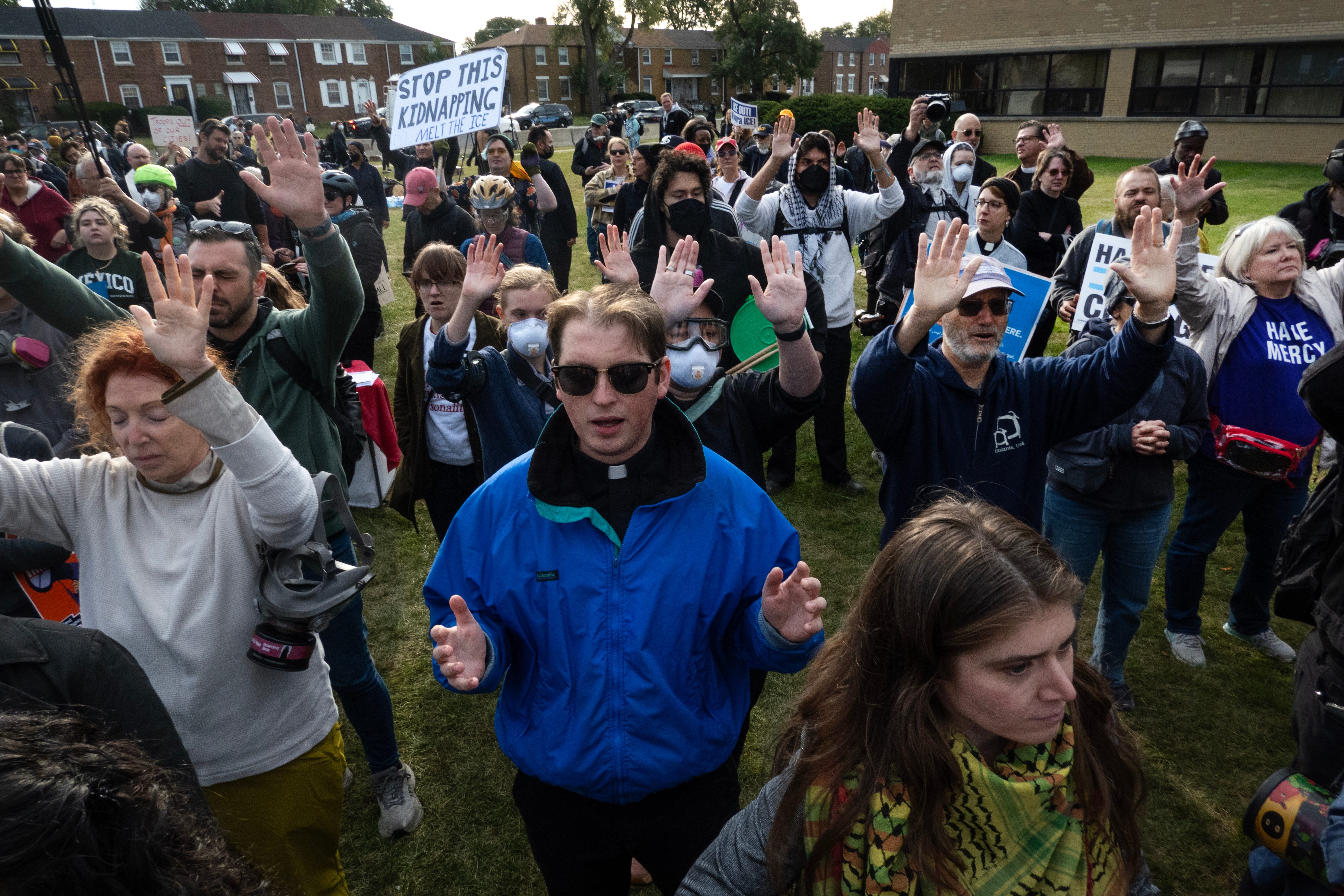
In fact, the very morning after Alex Pretti’s death, Pope Leo, in his Angelus address, implored the world to pray for peace in every place torn by conflict — from Ukraine and the Middle East to our own streets — and stressed that true peace can only stand upon a foundation of respect for human dignity.
Archbishop Gomez took that to heart.
He spoke about Minneapolis in the same breath as global war zones, insisting that what’s happening in Minnesota is a matter of fundamental human rights.
And yet, Bishop Barron, the man actually on the ground in Minnesota, stayed silent. Not a single public statement of grief, or a call for justice, or even a word of prayer for his own Catholic brother, Alex Pretti, who was killed in his state.
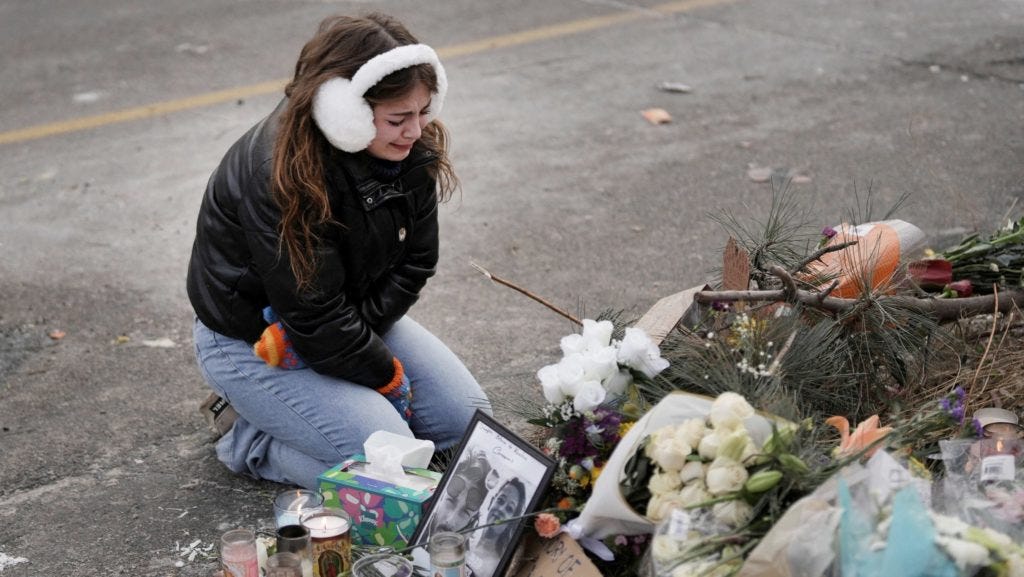
Archbishop Hebda, who presides next door, immediately issued a statement asking for prayers for Pretti and “for his loved ones” as well as for a restoration of peace. But from America and Minnesota’s most famous bishop: nothing.
Meanwhile, local Catholic priests in Minnesota have shown more courage than their bishop. At the Basilica of St. Mary in Minneapolis, the Rev. Harry Tasto — who worked alongside Alex Pretti at the VA hospital — rose to defend the slain man’s character against right-wing smears.
Federal officials like Vice President JD Vance had disgracefully labeled Pretti a “domestic terrorist” and “assassin” with no evidence.
Other Twin Cities pastors offered special Masses and preached with righteous anger.
“We cannot dismiss the murdering of Alex Pretti,” insisted one priest from the pulpit, lamenting the “darkness and fear” gripping their community. These clergy are channeling exactly what the faithful need right now: moral clarity, compassion for the victims, and an unflinching demand for justice.
And notably, none of them seemed afraid to name the evil at work or to call it what it is.
A Shepherd Missing in Action
All of which begs the question: Where is Bishop Barron? Here’s the answer.
