
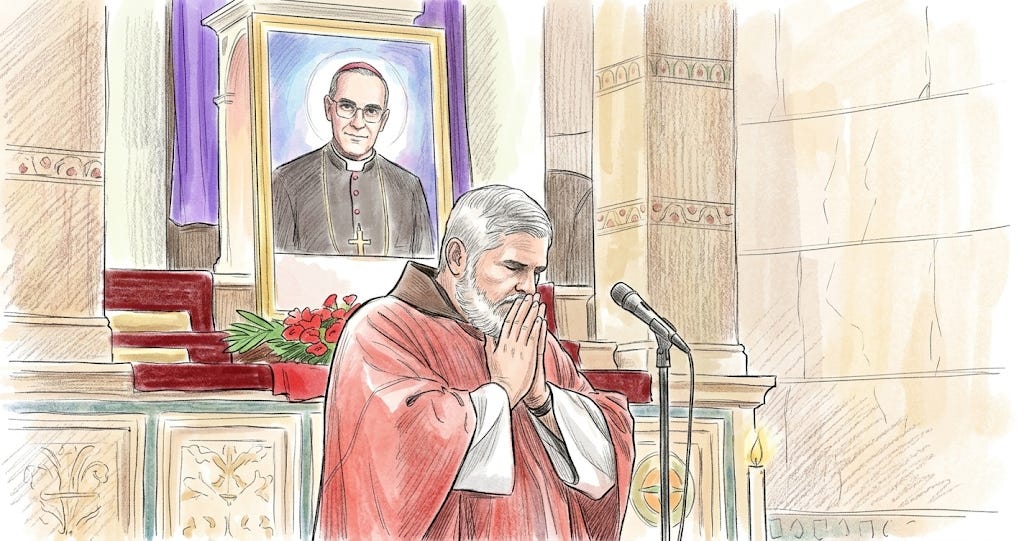
ICE Came for His Parishioners. Now Pope Leo XIV Is Sending Their Pastor to Lead a Diocese in Trump’s Florida.
Father Emilio Biosca’s heavily Salvadoran Mount Pleasant parish has lost more than forty members to ICE detention and deportation since August. Now Pope Leo XIV is sending him to lead a Florida diocese in the heart of Trump-DeSantis country.
Thank you for reading! Letters from Leo is a reader-supported publication. To receive new posts and support my work, consider becoming a free or paid subscriber.
For the better part of a year, Father Emilio Biosca Agüero has been watching his parishioners disappear.
The Shrine of the Sacred Heart, the Capuchin-run parish in D.C.’s Mount Pleasant neighborhood where Biosca has served as pastor since 2019, draws most of its 5,600 members from El Salvador.
Since federal immigration enforcement intensified in the District last August, more than forty of those parishioners have been detained or deported, according to reporting by the Associated Press. Six were arrested by ICE in a single recent stretch — among them an usher on his way to evening Mass, a man preparing for marriage, and a parishioner enrolled in confirmation class.
Mass attendance at Sacred Heart has dropped by roughly twenty percent. The pews under the basilica’s mosaic dome sit half empty most Sundays. Parishioners pray on Zoom from their living rooms because they are afraid to step outside.
The parish sits less than three miles from the White House.
This morning, Pope Leo XIV decided that the pastor of that parish — Father Emilio Biosca Agüero, OFM Cap. — is going to be the next bishop of the Diocese of Venice, Florida.
The announcement came from Monsignor Većeslav Tumir, chargé d’affaires of the Apostolic Nunciature in the United States. Bishop Frank Dewane, 76, who has led Venice since 2007, is retiring. Biosca will succeed him.
Biosca, 61, is a Capuchin Franciscan of the Province of Saint Augustine in Pittsburgh. He entered the order in 1987 and was ordained a priest in 1994. He spent twelve years as a missionary in Papua New Guinea and another twelve in Cuba, where he ministered in Havana, Santa Clara, and Manzanillo.
He speaks Spanish and Tok Pisin. He has been the pastor of an overwhelmingly Salvadoran-immigrant parish, and a steady public voice in Washington’s Latino Catholic community, since 2019.
The Diocese of Venice covers most of southwest Florida — Fort Myers, Naples, Sarasota, and the counties stretching along the Caloosahatchee. Donald Trump carried every one of those counties in 2024. It is reliably Republican Catholic territory. It is also home to a large and rapidly growing Hispanic Catholic community of Cuban, Mexican, and Central American descent.
Biosca’s appointment continues a pattern. In five months, Pope Leo XIV has named four bishops with deep ties to Latin America — Rodríguez (Dominican Republic), Gómez (Colombia), Menjivar-Ayala (El Salvador), and now Biosca — to lead U.S. dioceses. Three of those appointments have come in the last two weeks alone.
In December, Leo sent Manuel de Jesús Rodríguez, a Dominican-born priest who had ministered for years in a Hispanic parish in Queens, to lead the Diocese of Palm Beach — where Mar-a-Lago is located.
On May 1, Leo named John Jairo Gómez, a Colombian-born priest of the Diocese of Tyler, as the next bishop of Laredo on the Rio Grande border.
The same day, he named Evelio Menjivar-Ayala, a former undocumented Salvadoran refugee, as bishop of Wheeling-Charleston in deep-MAGA West Virginia.
Leo’s very first U.S. appointment, twelve months ago, went to Michael Pham, the Vietnamese-refugee bishop of San Diego, who has since publicly accompanied migrants to their immigration hearings.
According to a tally published by Aleteia on May 7, eleven of the twenty-six bishops Pope Leo XIV had named to U.S. dioceses through May 6 — forty-two percent — were born outside the United States.
Their origins span the Americas, Asia, and Africa. None of them come from Europe. Biosca’s appointment brings the total to twenty-seven.
Estimates put the foreign-born share of active U.S. clergy at roughly one in four. Pope Leo is selecting immigrant or immigrant-rooted bishops at almost twice the rate of the priest pool he is drawing from. He is doing so deliberately.
The geography is worth noting. Wheeling-Charleston covers a state Donald Trump carried by 42 points in 2024. The Mar-a-Lago estate sits inside the Diocese of Palm Beach; Laredo straddles the southern border.
Venice — Trump-DeSantis country, where federal deportation operations have been running at full intensity for nearly a year — now joins them. The American dioceses where Leo is choosing to place immigrant bishops keep turning out to be the same ones where the federal government’s immigration enforcement is fiercest.
Leo has not been subtle about the through-line.
Last November, the U.S. bishops at their Baltimore plenary pledged in a public letter to stand with migrants in the face of mass deportations. A week later, on November 18, Pope Leo XIV called the treatment of migrants in the United States “extremely disrespectful.” The episcopal appointments are the give flesh to that rhetoric.
There is a longer logic that matters much more than politics. Hispanic Catholics already account for thirty-six percent of all adult Catholics in the United States and a clear majority of Catholics under thirty.
The U.S. hierarchy has, until recently, looked almost nothing like the people in the pews. Of the roughly 200 active Latin Rite bishops in the country at the time of Leo’s election, fewer than 30 were Hispanic. Pope Francis began correcting that imbalance over the course of a decade. Leo has accelerated it in twelve months.
None of this represents a break with tradition. The Catholic Church has always rebuilt its leadership in the image of the people in front of it.
Irish immigration produced Irish bishops in the nineteenth century. The early twentieth saw Italian-Americans elevated to American sees as their parishes filled with newcomers from Naples and Palermo.
The fastest-growing population in American Catholicism in 2026 is Latino, and Pope Leo XIV — who spent two decades as a missionary in Peru and carries Peruvian citizenship to this day — understands those demographics more intimately than any pope in history.
Today, Biosca will return to the Shrine of the Sacred Heart in Mount Pleasant. The parishioners who still come to Mass will hear from the man who has been their pastor for seven years that he is being sent to lead a diocese in Florida. Some of them will not be able to come at all, because they remain afraid to leave home.
A pattern this dense is policy. Leo is not going to stop.
The question is whether other U.S. Catholic leaders whose coalition has spent a year trying to assimilate Leo into its preferred narrative about an “American pope,” will register that the man in the chair of Peter has been telling them, bishop after bishop, what kind of Church he intends to lead.
At Letters from Leo, we stand with Father Emilio Biosca, with the parishioners of the Shrine of the Sacred Heart, and with the millions of American Catholics — and countless others of goodwill — who refuse to accept that the people kneeling in the pews of an American parish are fair game for federal agents.
The fastest-growing Catholic community in the country exists because Catholics and many people who are not Catholic are hungry for a Church that means what it teaches about human dignity.
They are tired of watching their parishes emptied by fear. They are looking for courage, for truth, for a faith made visible in action — and right now, as immigration enforcement targets the most vulnerable people in our communities, that hunger has never been more urgent.
If you believe this movement matters — Catholics and people of goodwill standing for human dignity against an administration that has turned deportation into a sacrament of its own — I am asking you to join us.
If you’d like to invest in our mission, here are three ways you can help this Easter season:
Subscribe as a paid member to receive exclusive posts about the life and formation of Pope Leo and help sustain this newsletter.
Donate with a one-time gift to fuel this project’s mission.
Share this post (and Letters from Leo) with a friend who might enjoy it.
Paid members receive our full biographical series on the life and formation of Pope Leo XIV, our ongoing Epstein-Bannon Investigation, the Scripture Reflection Series, and the best of our full archive.
Whether you give $0, $5, $50, $500, $1,000, or more, your presence here matters — no matter your faith or your politics.
Thank you for reading. I’ll see you on the road.


The Pope is making good choices for Catholic leadership in America. Stepping up the diversity of its leadership will help minister to the needs of all parishioners and strengthen Catholic communities, as well as signal that Hispanic Catholics in America are important and valued members of the Church. Well done! I am not Catholic but so far think the Pope is representing the best of Christianity as a whole.
I was skeptical of a US born pope but Leo XIV has been phenomenal in these trying times. Hopefully he'll make Americans better Catholics