

“Man Can Kill the Body, But Not Love” — Pope Leo XIV’s First Easter Vigil Homily Confronts the Powers of Death
The pope stood in St. Peter’s Basilica on Holy Saturday night and declared that no tomb can imprison the God of love. His message to a world at war landed with the force of scripture itself.

Thank you for reading! Letters from Leo is a reader-supported publication. To receive new posts and support this mission, consider becoming a free or paid subscriber.
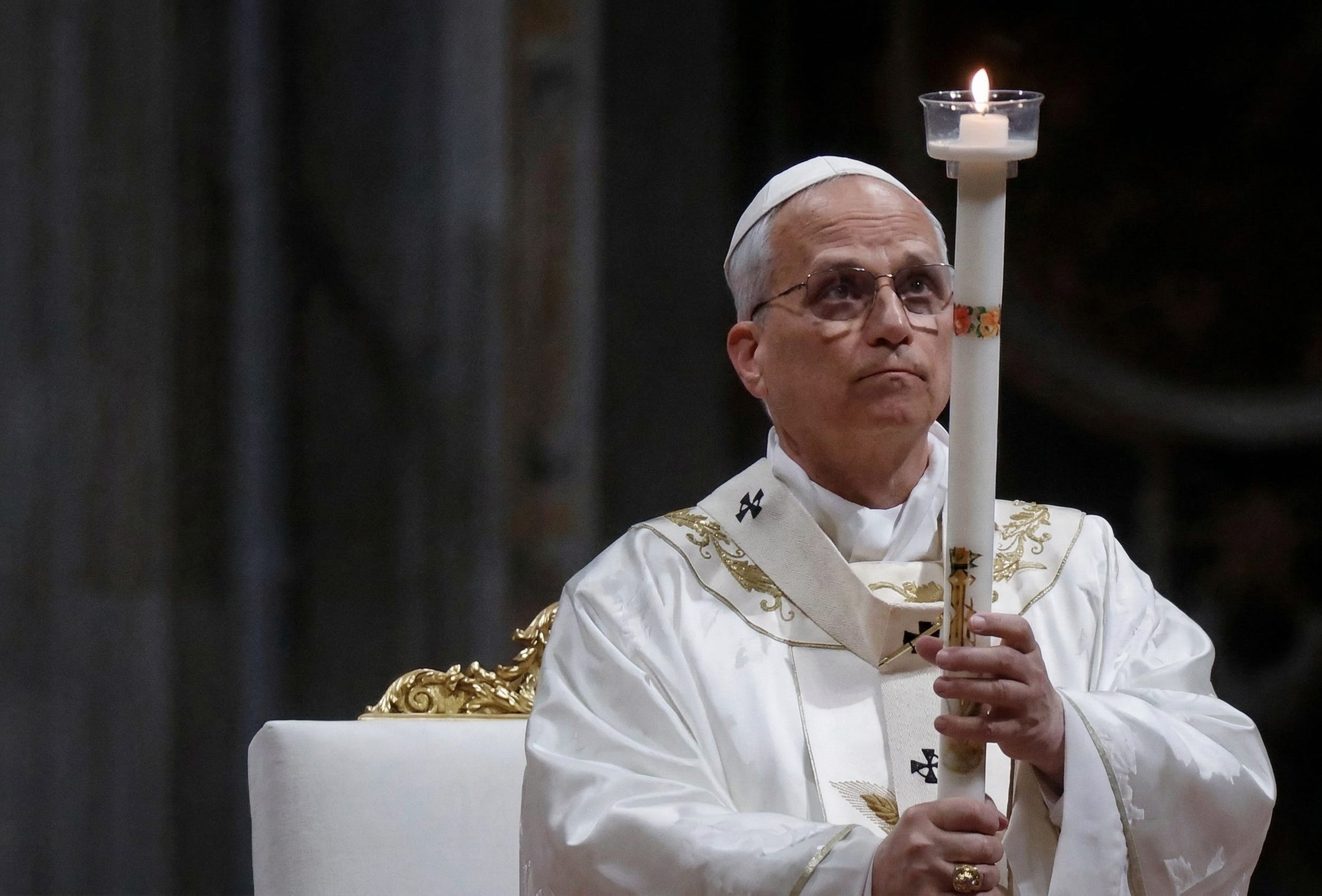
Pope Leo XIV delivered his first Easter Vigil homily on Saturday night in St. Peter’s Basilica, standing before thousands of candles lit from a single Paschal flame.
The occasion — the “mother of all vigils,” as the Church has called it since the earliest centuries of Christianity — carried particular weight this year. Leo has spent Holy Week publicly challenging warmakers and authoritarians, from his Palm Sunday rebuke to his Holy Thursday condemnation of what he called the “imperialist occupation of the world.”
The Vigil homily brought those threads to their theological conclusion.
Leo began where the liturgy begins: with creation. The same God who brought the cosmos from chaos and harmony from disorder, he said, is the God who gave his life on the cross.
The arc of salvation history — from Abraham’s stayed hand to the liberation of Israel from Egypt to the prophets’ promises of renewal — bends toward a single destination. God answers the harshness of sin that divides and kills with the power of love that unites and restores life.
The pope lingered on the Gospel of Matthew’s account of Easter morning. Mary Magdalene and the other Mary went to the tomb expecting to find it sealed, guarded by soldiers, blocked by a stone too heavy to move. Leo read this scene as a metaphor for sin itself — a barrier that closes us in, separates us from God, and seeks to kill his words of hope within us.
The women refused to be intimidated. Their faith and love made them the first witnesses to the resurrection, and in the earthquake and the angel sitting on the overturned boulder, they saw something no empire could contain.
“Man can kill the body,” Leo declared, “but the life of the God of love is eternal life, which transcends death and which no tomb can imprison.”
The claim is not abstract theology, even though Leo notably refrained from naming any specific conflict during the Vigil. He did not need to.
The pope was speaking to a world where bodies are being killed — in wars he has condemned by name throughout Lent, in deportation operations the Church has publicly opposed, in the quiet violence of poverty and abandonment that never makes the news.
The resurrection, in Leo’s reading, is God’s answer to all of it. The Crucified One reigned from the cross. The angel sat on the stone. Jesus presented himself alive and said, simply: “Greetings.”
Leo turned, in the homily’s final movement, to the stones that remain.
“Even in our day there is no shortage of tombs to be opened,” he told the congregation, and the stones that seal them — mistrust, fear, selfishness, resentment — can feel immovable.
Some oppress the heart from within; others, their consequence, “break the bonds between us, such as war, injustice, the isolation of peoples and nations.” The pope’s response was not despair but a command: “Let us not allow ourselves to be paralyzed by them!”
Leo grounded that command in history.
Men and women across the centuries have rolled these stones away, he said, “perhaps with great difficulty, sometimes at the cost of their lives, but with fruits of goodness from which we still benefit today.”
They were not saints from stained glass. They were “people like us” who, strengthened by the grace of the Risen One, found the courage to speak “with the words of God” and to act “with the energy received from God, so that in all things God may be glorified.”
He quoted St. Augustine’s charge to early Christians — “Proclaim Christ, sow, scatter everywhere what you have conceived in your heart” — and applied it directly to the ten adults he baptized that night and to every Christian watching from every corner of the world.
The homily closed with a prayer that “the Easter gifts of harmony and peace may grow and flourish” everywhere. Coming at the end of a Holy Week in which Leo has publicly challenged the architects of war and the machinery of cruelty, that prayer carried the weight of a commission.
Eleven months into his pontificate, Leo used his first Easter Vigil to weave the full sweep of salvation history into a direct confrontation with the forces that kill and divide — while maintaining the pastoral gentleness that has become his signature. The invitation to the world is as old as the faith itself: do not be afraid.
On this holiest of nights, the light of a single candle filled the darkness of St. Peter’s Basilica. That image — one flame becoming thousands — is the story of what we are building at Letters from Leo.
In a world where the powerful guard their tombs of war and injustice with soldiers and silence, we carry a different fire.
We believe that the God who rolled away the stone on Easter morning is still at work — through every Catholic and every person of goodwill who refuses to be paralyzed by fear.
Letters from Leo exists because this faith demands more than passive observance. The resurrection is a commission, and we are the ones sent. If you believe that commission matters — that the Gospel of human dignity has something urgent to say to a world at war — I am asking you to join us.
If you’d like to invest in our mission, here are three ways you can help on this sacred day:
Subscribe as a paid member to receive exclusive posts about the life and formation of Pope Leo and help sustain this community.
Donate with a one-time gift to fuel this project’s mission.
Share this post (and Letters from Leo) with a friend who might enjoy it.
Paid subscribers get access to the ongoing biographical series Pope Leo’s Life & Formation, exclusive investigations including The Epstein-Bannon Investigation, and the full archive of our essays.
Whether you give $0, $1, $100, $1,000 or more, your presence here matters — no matter your faith or your politics.
Thank you for reading. I’ll see you on the road.

Thank you for publishing Pope Leo’s first Easter Vigil message!✝️
Hope springs forth from the metaphor moving the stones of sin (arrogance, mythology meritocracy, greed, insatiable hunger for power, etc.) that contain a “tomb” of unlimited love and the possibilities of joy and peace. Thanks Mr. Hale for the lovely Lenten reflections and information about Pope Leo.