
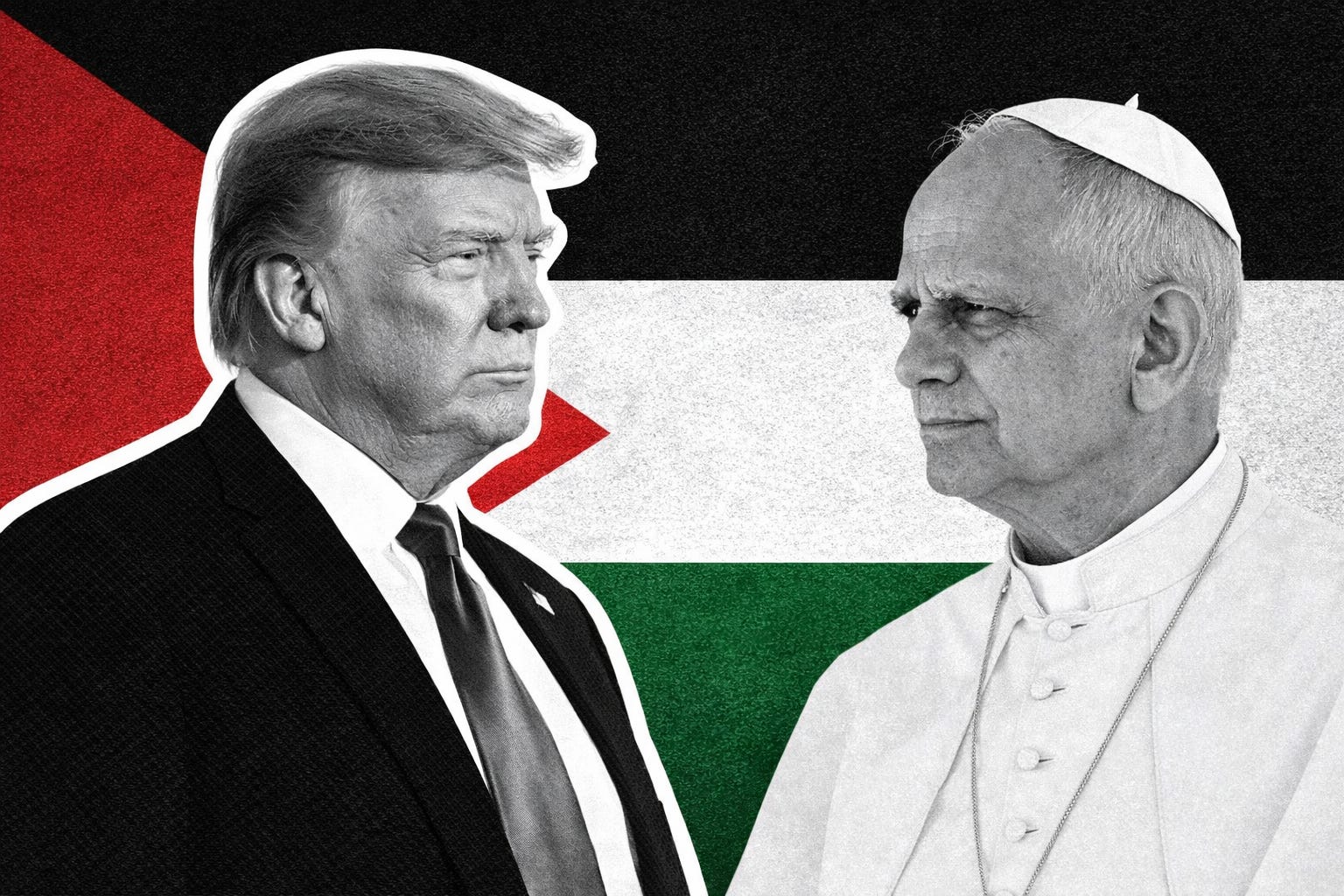
Pope Leo Rejects Trump’s Gaza “Peace Board” Invitation
After his top Middle East envoy denounced the plan as a “colonialist operation,” the Vatican formally declined to participate in Trump’s pay-to-play Gaza “Peace Board.”
Thank you for reading! Letters from Leo is a reader-supported publication. If you find value in my work, please consider becoming a paid subscriber or making a one-time donation.
On Tuesday in Rome, Cardinal Pietro Parolin confirmed what many had begun to suspect. Asked about President Donald Trump’s invitation for Pope Leo XIV to join the U.S.-led Gaza Peace Board, the Vatican Secretary of State gave a clear answer:
“The Vatican will not participate in the Board of Peace for Gaza.”
With that statement, Pope Leo formally declined Trump’s request for the Holy See to take part in the American-backed body overseeing Gaza’s future — marking another significant diplomatic and moral break between the Vatican and the White House.
The refusal came just days after Pope Leo’s top envoy to the Holy Land publicly blasted Trump’s Gaza plan.
On February 6, Cardinal Pierbattista Pizzaballa — the Latin Patriarch of Jerusalem and a trusted Leo confidant — denounced the U.S.-led “Board of Peace” as a “colonialist operation: others deciding for the Palestinians.”
In an open forum at a Roman parish, Pizzaballa warned that any so-called peace board imposed from above, with a $1 billion price tag for a seat at the table, was an affront to the very people it claimed to help.
“They asked us to enter. I’ve never had a billion dollars,” the cardinal quipped, “but above all, this is not the Church’s task: It is the sacraments, the dignity of the person.”
His words underscored the Vatican’s disgust at the notion of effectively buying influence in Gaza’s reconstruction. Pope Leo’s decision this week — siding with his envoy’s moral critique — made it official: the Catholic Church refuses to lend its credibility to what it sees as an imposed, morally suspect peace.
In truth, the Vatican’s misgivings were telegraphed well in advance. Last month, Cardinal Parolin had already hinted that if the Holy See engaged with Trump’s Gaza initiative at all, it would be strictly on moral and diplomatic terms, not as a bankroll.
The pope might consider offering prayers or mediation, Parolin suggested, but “the request will not be to participate financially” because “we are not in a position to do so.”
Rome wasn’t about to pay for a permanent seat on an American-crafted board, and Leo XIV was clearly loath to endorse any plan that lacked Palestinian voices.
Indeed, as Pizzaballa noted, “any initiative cannot fly without the engagement of the Palestinian people themselves.” The stage was set for Leo’s refusal long before the invitation ever landed on his desk.
This dramatic standoff over Gaza is only the latest flashpoint in a nine-month public clash between Pope Leo XIV and President Trump.
Since Leo’s election to the papacy, the two men have repeatedly sparred across a moral divide, their visions of leadership often in direct opposition.
When Leo spoke up for migrant families last fall — pointedly suggesting that those who support “inhuman” treatment of immigrants can’t call themselves truly pro-life — Trump’s White House bristled.
Press Secretary Karoline Leavitt, herself a Catholic, flatly rejected the pope’s insinuation of inhumanity and insisted the administration was enforcing immigration laws “in the most humane way possible.”
It was a telling exchange: a pope invoking the Gospel’s call to compassion, a president’s team defensive and dismissive.
Time and again, from Leo’s critiques of nationalism and border cruelty to Trump’s irritation with the pope’s moral outspokenness, the two leaders have clashed in tone and principle.
The invitation to join the Gaza board — and Leo’s public “no” — is a new chapter in this ongoing duel of visions.
Yet Vatican officials are careful to frame Leo’s refusal not as a political snub or personal animosity, but as a matter of conscience. This isn’t about East vs. West or a power struggle between a pope and a president.
It’s about right and wrong.
By declining Trump’s offer, Pope Leo is effectively saying that some lines won’t be crossed — even for the sake of photo-ops or diplomatic niceties. Catholic teaching reminds us that peace cannot be imposed by sheer force or fiat; it must be built on justice and the participation of those who seek it.
As the Second Vatican Council taught, “Peace is not the mere absence of war, nor can it be imposed at the dictate of absolute power. It is a work of justice.”
In other words, a “peace” dictated by the powerful — without justice for the vulnerable — isn’t true peace at all. The Church, true to this principle, would rather abstain than legitimize a plan that deciding for the Palestinians without their full voice.
For Pope Leo XIV, this stance is wholly consistent with the values he has championed since day one of his pontificate. He has spoken repeatedly about the dignity of every person in conflict zones and the necessity of including local communities in peace-making.
On Sunday, he warned of a growing global mentality that exalts “the supremacy of the strongest” and pursues victory at any cost, while remaining deaf to “the cry of those who suffer.”
Time and again, Leo has rejected the false allure of what some call imperial peace plans — deals hammered out by the mighty over the heads of the weak. In their place, he advocates what he calls a “culture of encounter,” a multilateral approach where even the smallest nations and afflicted communities have a say in their destiny.
The Vatican’s blunt refusal to join Trump’s Gaza board is the fruit of that conviction. Leo will not baptize a peace built on dominance. Instead, he invites the world to pursue peace built on justice, dialogue, and the inherent rights of peoples to shape their own future.
As the dust settles from this public rejection, there is a clear message for all of us.
True peace demands more than top-down solutions; it asks for solidarity with those on the ground and a willingness to forgo power for the sake of justice.
Pope Leo’s choice to say “no” is, in fact, a yes — a yes to the Gospel’s vision of peace that uplifts the oppressed rather than simply managing them.
It’s a call for each of us to reject the lure of false peace — the kind that is merely the silence of the weak in the shadow of the strong – and to work instead for a peace rooted in genuine justice and reconciliation.
In the spirit of the Beatitudes: Blessed are the peacemakers — not the deal-makers who ignore the poor, but those who hunger for a just peace where the voices of the hurting are finally heard.
In this charged moment, Letters from Leo stands with Pope Leo XIV in affirming that peace built on truth and justice must prevail over peace built on coercion.
We invite you to join in this prayerful stand for authentic peace — perhaps by taking a moment today to pray for the people of Gaza, for their freedom and dignity, and for the conversion of all leaders’ hearts to true justice.
Let this be our call to action: resist the temptation to settle for peace at any price. Raise your voice instead for a peace worthy of the name — one rooted in love of neighbor and steadfast in its defense of the least among us.
At Letters from Leo, we stand with the millions of American Catholics — and countless others of goodwill — who are shining light in dark times and working toward the day when peace is more than a slogan, when it is a lived reality grounded in justice, mercy, and the inviolable dignity of every human person.
In an era poisoned by cruelty and division, we remain rooted in a faith that refuses to flinch before injustice or bow to the idols of fear and authoritarianism.
We’re not just watching this moment. We’re part of it.
This is the fastest-growing Catholic community in the country because people are hungry for something deeper than rage and cynicism. They’re looking for courage, for truth, for love made visible in action.
If you’re ready to build a country — and a Church — that is more just, less cruel, and more alive with hope, then you’re already one of us. Let’s walk together.
If you’d like to invest in our mission, here are three ways you can help:
Subscribe as a paid member to receive exclusive posts about the life and formation of Pope Leo and help sustain this newsletter.
Donate with a one-time gift to fuel this project’s mission.
Share this post (and Letters from Leo) with a friend who might enjoy it.
Paid subscribers have access to the Sunday Scripture Reflection Series, the upcoming Lenten Reflection Series, and our new investigative series on Jeffrey Epstein and Steve Bannon’s attempt to take down Pope Francis.
You’ll also get access to the Q&A mailbag that opened last month, where you can ask me anything about American politics, Catholicism, Donald Trump, Pope Leo, JD Vance — or my own faith, biography, and life.
Whether you give $0, $1, or $1,000, your presence here matters — no matter your faith or your politics.
Thank you for reading. I’ll see you on the road.


As an American clergyman and Church historian, I stand firmly with Pope Leo's refusal to participate in this latest of Trump's fraudulent schemes to mask a grift as a "peace" initiative.
No person of Faith or Integrity should have any part in this fraudulent scheme. Pope Leo has both.
How could he possibly accept participation in a corrupt deal between profoundly corrupt people?