
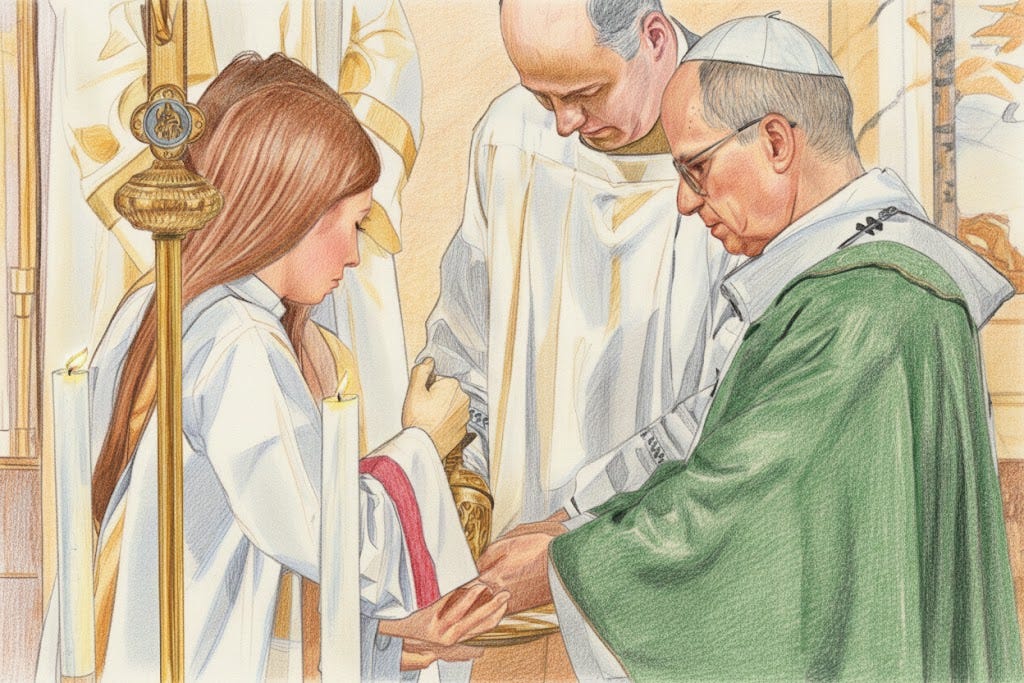
Flanked by Altar Girls, Pope Leo XIV Preaches Preach in Ostia Parish
In one of Rome’s most crime-ridden neighborhoods, Pope Leo says peace begins by disarming our words.
Thank you for reading! Letters from Leo is a reader-supported publication. If you find value in my work, please consider becoming a paid subscriber or making a one-time donation.
Pope Leo XIV’s first visit to a Roman parish as pontiff produced a quietly striking image.
As he celebrated Mass at the seaside church of Santa Maria Regina Pacis in Ostia on Sunday, the Pope found himself flanked by altar girls in Adidas sneakers — the first time he had female altar servers by his side.
It was a subtle change but a powerful one, perfectly normal in parishes worldwide yet a welcome sight at a papal liturgy.
There was no fanfare, just the pope praying alongside local children. Even the setting foreshadowed his message: Regina Pacis means “Queen of Peace,” a fitting name as Pope Leo would soon speak about how to build peace.
In his homily, Pope Leo issued an urgent appeal: true peace must begin with the conversion of our hearts and even with our choice of words.
He acknowledged that violence and exploitation “are felt also here, in Ostia,” warning that “the evil we see in the world has its roots” in hearts grown cold.
Yet Leo quickly turned from diagnosis to challenge. “Do not resign yourselves to the culture of abuse and injustice.
“On the contrary, spread respect and harmony, beginning by disarming language,” he urged the community. In a neighborhood scarred by crime, this call to spread harmony was as practical as it was spiritual — and it starts, the pope stressed, with words that heal instead of harm.
This theme of disarming one’s language is fast becoming a cornerstone of Leo’s papacy. Just days earlier, the Vatican released his first Lenten message, in which Pope Leo invites Catholics to fast not only from food, but also from hurtful words.
He urged the faithful to “begin by disarming our language, avoiding harsh words and rash judgment,” promising that if we measure our speech with kindness, “words of hatred will give way to words of hope and peace.”
In other words, peace isn’t just a geopolitical agenda — it starts in the everyday choices of gentleness and restraint in how we speak.
During the noon Angelus before Mass, Pope Leo struck a similar note of compassionate challenge.
Reflecting on the day’s Gospel, he reminded the crowd that “true righteousness consists in love” and that mere rule-following is not enough — “great love is needed” to fulfill God’s law.
The Angelus message dovetailed with his Ostia homily: both insisted that without love, religious devotion rings hollow — and without gentle language, peace remains out of reach.
In Gaudium et Spes, the Second Vatican Council taught that “the joys and hopes, the griefs and anxieties of the men of this age, especially those who are poor or in any way afflicted, these are the joys and hopes, the griefs and anxieties of the followers of Christ.”
Pope Leo echoed that vision on the ground in Ostia, insisting that the Church must not withdraw from the world’s pain but show up in its broken places with love and humility. He noted that “many clouds still darken the world,” including a mentality that exalts “the supremacy of the strongest” and pursues victory at any cost, deaf to “the cry of those who suffer.”
The only antidote, he suggested, is found in what he called “the disarming strength of meekness.”
“Let us oppose this drift with the disarming strength of meekness,” the pope said, urging Christians to “welcome and cultivate” peace as a gift “with tenacity and humility.” Disarmament, for Pope Leo, begins in the heart and on the tongue — indeed, he is making the disarmament of language a foundation of his pontificate.
His call is morally urgent yet pastorally warm: a challenge to replace the weapons of harsh rhetoric with the tools of listening, respect, and tender truth. On that Sunday in Ostia, Leo’s message rang out in both word and gesture.
He stood at the altar surrounded by girls bearing candles and cruets — a quiet sign of openness — and from the pulpit made a gentle but firm plea: if we desire peace in our homes, our city, and our world, we must first learn to speak the language of peace, disarming our words so that love can prevail.
At Letters from Leo, we stand with the millions of American Catholics—and countless others of goodwill — who rise each day to defend the dignity of every person, regardless of race, religion, background, or belief.
In an era poisoned by cruelty and division, we remain rooted in a faith that refuses to flinch before injustice or bow to the idols of fear and authoritarianism.
We’re not just watching this moment. We’re part of it.
This is the fastest-growing Catholic community in the country because people are hungry for something deeper than rage and cynicism. They’re looking for courage, for truth, for love made visible in action.
If you’re ready to build a country — and a Church — that is more just, less cruel, and more alive with hope, then you’re already one of us. Let’s walk together.
If you’d like to invest in our mission, here are three ways you can help:
Subscribe as a paid member to receive exclusive posts about the life and formation of Pope Leo and help sustain this newsletter.
Donate with a one-time gift to fuel this project’s mission.
Share this post (and Letters from Leo) with a friend who might enjoy it.
Paid subscribers have access to the Sunday Scripture Reflection Series, the upcoming Lenten Reflection Series, and our new investigative series on Jeffrey Epstein and Steve Bannon’s attempt to take down Pope Francis.
You’ll also get access to the Q&A mailbag that opened last month, where you can ask me anything about American politics, Catholicism, Donald Trump, Pope Leo, JD Vance — or my own faith, biography, and life.
Whether you give $0, $1, or $1,000, your presence here matters — no matter your faith or your politics.
Thank you for reading. I’ll see you on the road.


Inspiring. The Pope we all needed now.
I follow a Franciscan priest on YouTube, Fr Casey Cole. He talked about the evil that is going on in our country. Because we have to forgive even Trump, Bannon and the others. Between what he said and Pope Leo saying we should fast from hurtful words I know what I will be working on during Lent.