


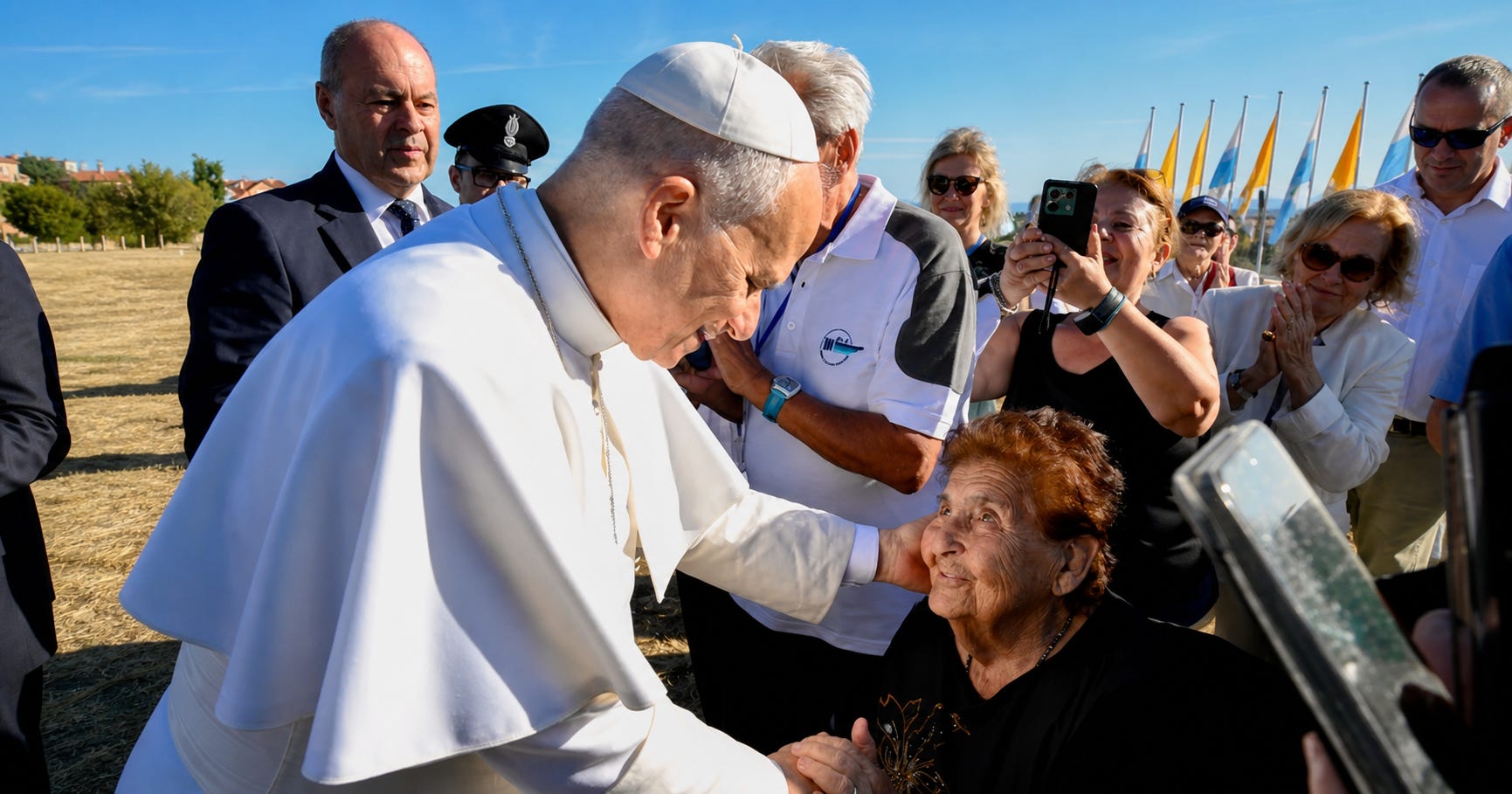
San Marino is one of the smallest countries in the world. It is also a Catholic republic, governed by two captains regent who serve together for six months at a time.
When Leo went to Monaco earlier this year, postliberals hoped he would hold up Catholic theocracy. He didn’t. Now he has come to another tiny Catholic country and done the same thing. Both times, Leo has stood firm for democratic rule inspired by Christian principles.
That is what made Libertas the right word.
Libertas is stamped on the republic’s coat of arms, and Leo went to the trouble of explaining where the word comes from. Tradition holds that Saint Marinus, the Dalmatian stonemason who founded the community in 301, left it with this line: Relinquo vos liberos ab utroque homine. I leave you free from both men.
The Sanmarinese have always read those two men as the emperor and the pope. Their founding charter releases them from temporal and ecclesiastical authority at once, and they held that independence for seventeen centuries.
“A single word,” Leo said, “but of what density.”
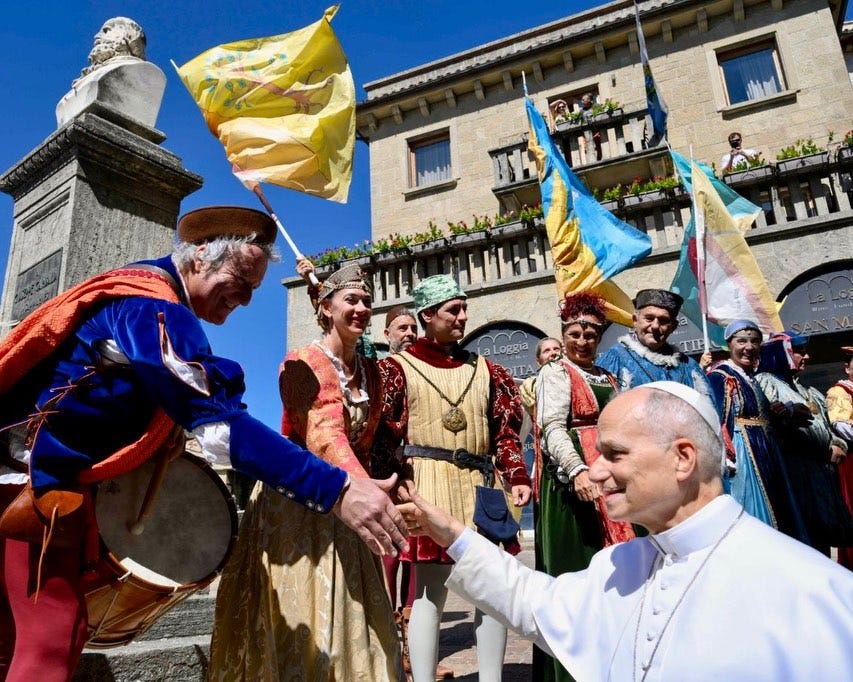
He granted that it means self-determination, the aspiration “not to depend on other political authorities,” and then told the council that Libertas means a great deal more than that.
“Promoting freedom entails defending the spaces of conscience,” he told the council, and then he named the cost of doing so.
And here my thoughts turn to the many men and women who, in every age and every place, are martyrs of freedom because they bear witness precisely to the primacy of conscience. Firmly formed by the search for truth, they are fully responsible for their own decisions and therefore free from every bond except the one proper to the creature, which binds them to God.
His example was Thomas More, whom he called the patron of governors and politicians, and whose claim to that patronage rests on refusing to sign what his king told him to sign.
Shifting into the present tense, he asked the council to hold in mind “those who, at this moment, are paying personally for not having betrayed their own conscience.”
The pope was not describing a thirteenth-century problem.
Thomas More’s last words feel ripe for American Catholics in 2026: “I die the King’s good servant, but God’s first.” How many of us need to realize that the highest values of our faith outrank any president we will ever have?
We cannot be patriots without being shrewd observers of the times and responding accordingly. Theodore Roosevelt put it plainly in a 1918 essay for Metropolitan Magazine: “Patriotism means to stand by the country. It does not mean to stand by the President or any other public official save exactly to the degree in which he himself stands by the country.”
“It is unpatriotic not to oppose him to the exact extent that by inefficiency or otherwise he fails in his duty to stand by the country,” Roosevelt wrote. “In either event it is unpatriotic not to tell the truth — whether about the President or about anyone else.”
The idols of freedom
Minutes later, Leo warned the assembly that the word he had just praised is constantly counterfeited.
This theological reference may perhaps seem excessive, but I believe that today it is necessary, in the face of the idolatry that corrupts at their root those political and economic projects that present themselves in the name of freedom, but in reality are slaves of idols and of power.
Leo is describing a false freedom. A political project can fly the banner of liberty and serve power underneath it, and the word outlives the thing it once named. “In the Christian vision,” he added, “freedom and communion stand or fall together.” A politics that promises liberation while demanding submission is idolatry wearing a rosary.
Economic freedom often disguises a world in which human beings are cogs in the wheel of an idolatry of money. Francis talked about this at length in Evangelii Gaudium, especially in his critique of trickle-down economics.
Describing San Marino as a possible “laboratory of good politics,” he said the republic could draw on the principles of Catholic social doctrine, among them the common good, the universal destination of goods, and the harmony of subsidiarity with solidarity — “without derogating from the secularity of the State.”
Senza derogare alla laicità dello Stato. In a Catholic country, Leo chose a word rightly associated with secular rule. It reminded me of the three words that define the French Republic: liberty, equality, fraternity. That republic was born amid a horrific rupture with the Catholic Church, but the relationship has evolved over time. Leo will visit France next month.
For a decade, a school of American Catholic intellectuals has argued that the secular state is precisely the problem.
What postliberalism actually wants
Postliberalism argues that the weakness of liberalism is its belief that the state can remain neutral about the good life and leave that question to you.
Patrick Deneen says that neutrality was always a fiction. Liberalism claimed to be impartial while advancing agendas that hollowed out the family. Adrian Vermeule wants judges and lawmakers to construe the law toward a substantive moral order — the common good as authority defines it, rather than as citizens argue it out.
But it is dangerous to believe that the state can be the arbiter of a good life. James Madison put the problem in Federalist 51: “If men were angels, no government would be necessary.” No government we build will be staffed by angels, least of all one handed the moral and temporal power the postliberals want.
JD Vance is the odds-on favorite to become the Republican nominee for president of the United States. If he does, he will be the first Catholic to lead the Republican ticket.
We must hold him to account. His political use of Catholic teaching has now been challenged by Francis and Leo in the same year. That matters even if Leo never says his name.
At Letters from Leo, we have reported that formation — from the Dominican friars and postliberal brain trust to Peter Thiel.
Rome has been answering for a year
On September 13, 2025, Cardinal Christophe Pierre, then apostolic nuncio in Washington, delivered a lesson titled “Woke Culture and Post-Liberalism.” We surfaced the text last November.
Pierre has seen in the flesh authoritarian movements disguised as religious projects. He knows what our founders knew: men aren’t angels.
That is the irony here. Pierre understands that reality better than the Americans he is correcting. When a politician turns ordo amoris into “first me, then my family, and then my country,” that is not fidelity to Catholic teaching. It is integrismo — an abuse of the faith in service of power.
Postliberalism creates a world where a politician’s misapplication or misappropriation of Catholic teaching can be falsely presented as fidelity to our faith. But it is an abuse in service of power. Look to Franco’s regime for the historical example. As I wrote in November after Tucker Carlson’s interview with Nick Fuentes, Franco is one of the Groypers’ heroes.
Conscience is not a permission slip
Through this papal throughline, there is a defense of democratic rule and a strong suspicion toward states acting as if they are vessels of the Church. Far too often, they aren’t.
John Paul II, standing in this same republic in 1982, tied freedom to respect for the freedom of others. Benedict warned the young against settling for partial answers when he came in 2011. Francis rejected the political misuse of ordo amoris, and Leo now locates freedom in Jesus Christ and puts its hearing in the conscience of every human being.
None of them is arguing for a state that speaks for the Church. The warning runs the other direction, toward what happens when a state claims that power for itself.
There can be no true civil freedom without personal freedom, that is, without respect for and the promotion of the dignity of the human person, of which freedom is an essential component. This freedom is given and guaranteed, in the final analysis, by God, whose voice resounds in the conscience of every human being.
The primacy of conscience has a history of overturning the abuses of government. That is the story of the American experiment — the continual formation of a “more perfect Union” through a people using their individual consciences, given by God, to advance the nation past its sins.
Time and again, individual conscience has overcome collective and structural sin. Abolition ran on it, and so did the civil rights movement. That same conscience drove the fight for women’s equality and the long argument over LGBT inclusion.
That is why the primacy of conscience is so dangerous to an integralist government. A state that wants the power to define the good life cannot tolerate a person standing before it and saying: You do not own my conscience.
A Catholicism that puts freedom of conscience at the center of its project is a Catholicism that threatens MAGA authoritarianism and exposes the folly of Catholic postliberalism.
Thomas More is the patron of politicians for a reason, and it has nothing to do with serving a Catholic prince well. He went to the scaffold because he would not let a government tell him what his conscience contained. Leo carried that story into the world’s oldest republic on Saturday morning, and whatever the postmark says, it was addressed to Washington.
This is the first half of the pope’s day. Later I will have a second dispatch from Rimini, where Leo addresses the Meeting for Friendship among Peoples and celebrates Mass at the port, a few miles and one border from where he spoke this morning.
Writing Letters from Leo has been one of the great honors of my life.
I write because I think there is a sacred moment in the United States, where, under an American pope, Catholics and all people of goodwill can use the power of the Gospel to overcome the threat of MAGA authoritarianism at home and abroad.
Writing is only half of it. What we are building here is a community that acts on hope. Hope has feet. It compels us to move. We must be a people of hope in an era of darkness.
If you’d like to invest in our mission, here are three ways you can help:
Subscribe as a paid member to receive exclusive posts about the life and formation of Pope Leo and help sustain this newsletter.
Donate with a one-time gift to fuel this project’s mission.
Share this post (and Letters from Leo) with a friend who might enjoy it.
Paid members get the full biographical series on Pope Leo’s life and formation, our continuing investigation into how this pope took on Silicon Valley, and the Sunday Scripture Reflection Series. The reporting that surfaced Cardinal Pierre’s lesson last November exists because readers paid for it.
Whether you give $0, $5, $50, $500, $1,000, or more, your presence here matters — no matter your faith or your politics.
Thank you for reading. I’ll see you on the road.

I Trust Pope Leo XIV!!
We ALL need to find the places where we listen to, learn from, support, and respect each other.
I find that here
Thank You!
Thank you for the newsletter, Chris. The Vice President has been doing a lot of back peddling because of Trump’s slurring of his speech. I will continue to pray for Pope Leo and this nation of ours.