Pope Leo XIV Puts the ‘Economy That Kills’ on Trial Before the Young People of Barcelona
From Elon Musk’s trillion-dollar trajectory to the “cult of self-image,” the pope traced a single sickness. At the Lluís Companys Stadium, he prescribed silence, the Gospel, and a restless heart.

Thank you for reading! Letters from Leo is a reader-supported movement of Catholics and people of goodwill standing for human dignity. To invest in this mission, please consider becoming a free or paid subscriber.
Pope Leo XIV stood in Barcelona’s Lluís Companys Olympic Stadium on Tuesday night and told the young people of Spain that “the idolatry of profit and performance” and “the cult of self-image” are “anesthetics designed to numb our conscience and mold it to a certain vision of society.”
The evening prayer vigil closed the fourth day of his apostolic journey through Spain — a trip that has already produced a rebuke of the politics of “weapons and walls” in Madrid and an address to the Spanish parliament on a world “in profound crisis.”
Leo opened the Barcelona leg at midday in the Cathedral of the Holy Cross and Saint Eulalia, where he preached on two images: the Church as beloved spouse and the Church as a single body.
“We are strong because we are united, and we are united because we are animated by the same Spirit,” he told the assembly, calling the people of Barcelona and Catalonia to “a special vocation and a responsibility to become, with God’s help, builders of unity.”
In a world torn apart by wars and divisions, he said, Christians must become martyrs in the original sense of the word — “witnesses and prophets of unity, of welcome, of harmony and of peace, even at the cost of sacrifice and renunciation.”
Like the city’s martyr Eulalia, they should be ready “to renounce the superfluous in order to build upon what is essential and lasts forever.”
By nightfall, the renunciation he had in mind acquired names and faces.
Three Testimonies
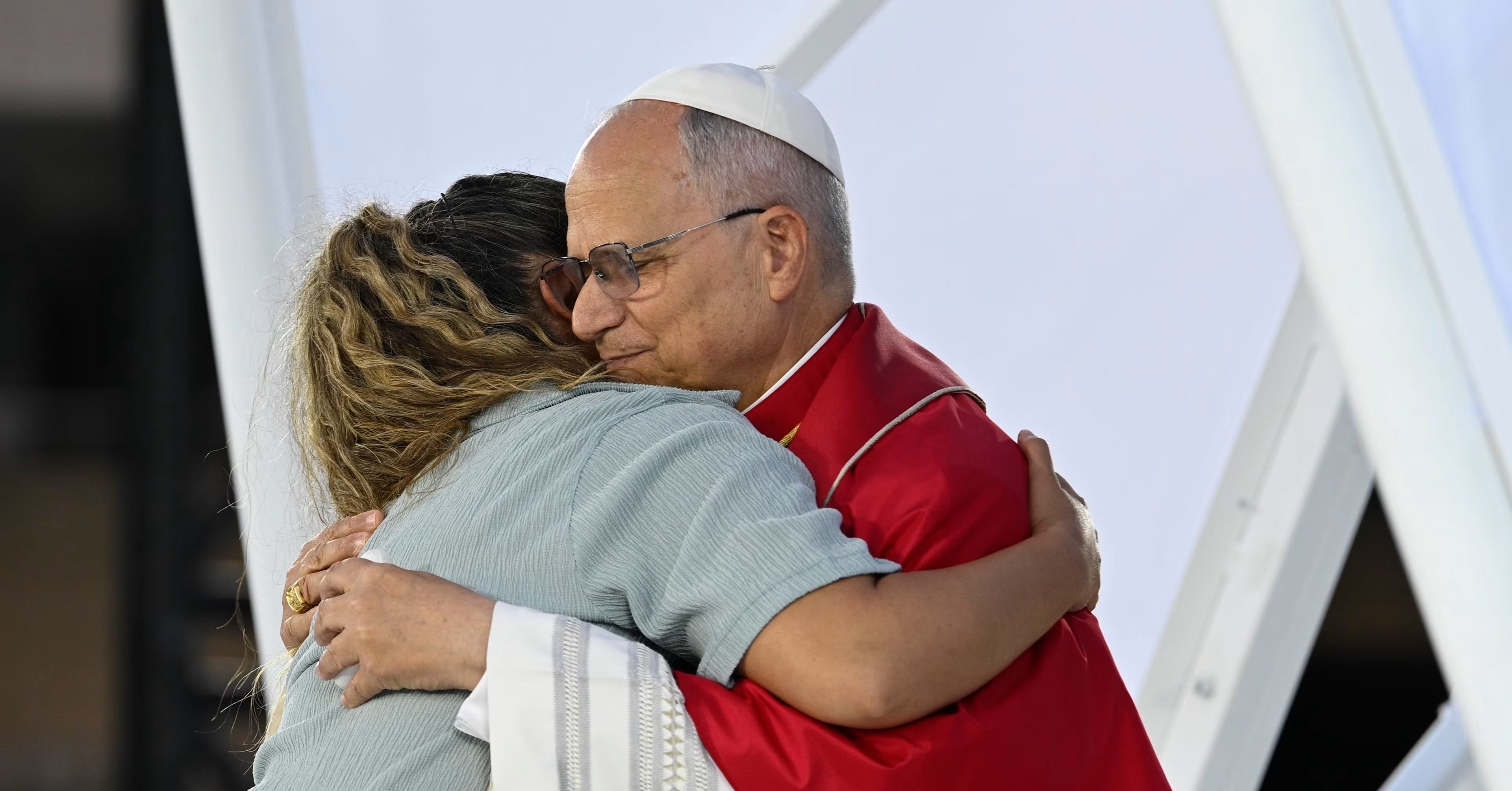
Three young people stood before the pope in the Olympic Stadium and told their stories: Ferran, baptized this past Easter after years of chasing success that left him empty; Carmina, who survived a suicide attempt after years of silent depression; and Desirée, who grew up in the shadow of her father’s attempt to kill her mother. Leo answered each of them at length.
Ferran told the pope he had grown up hearing that the only goal in life is to produce, to succeed, and to manage his own image. He asked how to keep his eyes on what matters when society pushes him to look down or only at himself.

Leo told him the restlessness he felt was a gift from God. “We are made for the infinite,” the pope said. “That is why every finite horizon, every step, every achievement — while satisfying us — also propels us forward and invites us to keep searching.”
A person who learns to stop, Leo continued in remarks the Vatican has so far published only in Italian and Spanish (translations here are mine), develops “a critical mind toward a social system that does not place the person at the center and that produces injustice and existential poverty at many levels.”
He drew the conclusion himself: “That is why restlessness is frightening — and so is the discovery of interiority, of spirituality, and even more of the Gospel.”
He told the young people what to do about it: “Cultivate moments of silence, perhaps pausing for a few minutes each day to read the Gospel and speak with God.”
Carmina spoke next. She had fought depression in silence for years, and one Friday night, she tried to take her own life. God gave her a second chance, she told the pope, but many others still face that darkness alone. Where can they see God when the darkness is total?
Leo thanked her for the courage it took to speak. Mental health, he said, is increasingly under threat in societies that consider themselves advanced — “a sign that there is something deeply wrong with a certain notion of progress that subjects people to pressures, expectations and tensions that compromise healthy balances.”
Then he pointed her to the cross.
“The cross of Jesus tells us that God does not abandon us, that he is at our side, crucified with us in moments of pain and extreme loneliness.” He also warned believers against tidying up the mystery of suffering: “We must not spiritualize pain, superficially attributing it to ‘God’s will’ or to some mysterious plan of his. God does not want suffering. He carries it with us.”
Desirée grew up in a poor neighborhood of Barcelona. Her father went to prison for trying to kill her mother, social services placed her in a Catholic children’s home at age ten, and there she encountered the love of a family for the first time — and, eventually, baptism. She asked the pope how she could forgive her father, and where God was when she was a child.

“We cannot attribute to God what has been entrusted to our responsibility,” Leo answered. “If violence exists, if selfishness prevails, if even love among family members turns into hatred, we must question the dynamics of our society, the culture of individualism and the temptation of violence — but not God.” Forgiveness, he told her, is a journey rather than a single act, one that begins by asking God to widen the space of love precisely where we have been wounded. “We move forward in small steps toward forgiveness.”
The Economy on Trial
Leo has been making Ferran’s case since the first months of his papacy. In his first formal interview, released last September, he cited projections that Elon Musk would become the world’s first trillionaire and asked what such a milestone reveals: “If that is the only thing that has value anymore, then we’re in big trouble.” CEOs who earned four to six times a worker’s wage sixty years ago, he noted, now earn 600 times as much.
His first encyclical, Magnifica Humanitas, carried that argument into the age of algorithms. Behind all of it stands the judgment Pope Francis rendered in Evangelii Gaudium: “such an economy kills.”
In Barcelona, Leo showed where the casualties fall: in the interior lives of the young, whose restlessness gets anesthetized before it can become a question about God.
American readers will recognize the catechism Ferran described. It is the house religion of hustle culture, preached through productivity metrics and engagement counts, and it forms souls on this side of the Atlantic with particular efficiency.
Pilgrims in the Night
When the testimonies ended, Leo preached on Nicodemus, the Pharisee who came to Jesus under cover of darkness. Every person, the pope said, is a pilgrim in the night: “We are beggars for love; we are truly hungry and thirsty.” The nights of our lives, of the Church, and of society are not signs of failure but “a time of blessing, a place for rebirth, a womb that always gives birth to new life.”
He asked Spain to look honestly at its own nights — its old and new poverties, its social divisions — and to decide what kind of society it wants to build, so that the country “may then be a welcoming space for all, where each person’s dignity is respected and everyone loved for who they are.”
“God does not want anything to be lost,” he concluded. “Even now he desires to give us eternal life and lead us to a happiness that has no end.”
A church that tells a newly baptized young man his restlessness is sacred, a suicide survivor that God hangs on the cross beside her, and a wounded daughter that forgiveness arrives in small steps is offering something no market can price. Leo spent one day in Barcelona insisting that the human person sits at the center of the world’s story, whatever Silicon Valley and Wall Street might say.
At Letters from Leo, we stand with the young people of Barcelona — and with everyone who has felt the emptiness of an economy that measures human beings by what they produce. The Gospel insists that every person carries a dignity no balance sheet can capture, and Pope Leo XIV is staking his papacy on that claim.
This is the fastest-growing Catholic community in the country because people are hungry for something deeper than rage and propaganda.
They are looking for courage, for truth, for love made visible in action — and at a moment when profit and performance pose as the meaning of life itself, that hunger has never been more urgent.
If you believe this movement matters — Catholics and people of goodwill standing for human dignity against the idols of profit and power — I am asking you to join us.
If you’d like to invest in our mission, here are three ways you can help during this critical time:
Subscribe as a paid member to receive exclusive posts about the life and formation of Pope Leo and help sustain this movement.
Donate with a one-time gift to fuel this project’s mission.
Share this post (and Letters from Leo) with a friend who might need it.
Paid subscribers make this work possible, and they receive the full archive: the biographical series on Pope Leo’s Life & Formation, the exclusive investigations, his ongoing confrontation with the tech titans in Pope Leo Takes On AI, and the Sunday Scripture Reflection Series.
Whether you give $0, $5, $50, $500, $1,000, or more, your presence here matters — no matter your faith or your politics.
Thank you for reading. I’ll see you on the road.


I'm not Catholic but I do appreciate Pope Leo
As a school teacher/college student who struggled with depression for many years, lost several friends and colleagues to it, and also found healing through Christ's wounds... Oof. This one was a hard read. But worth it! I feel like the Holy Father just gave me (and my fallen friends) this loving embrace 🫂❤️🔥