
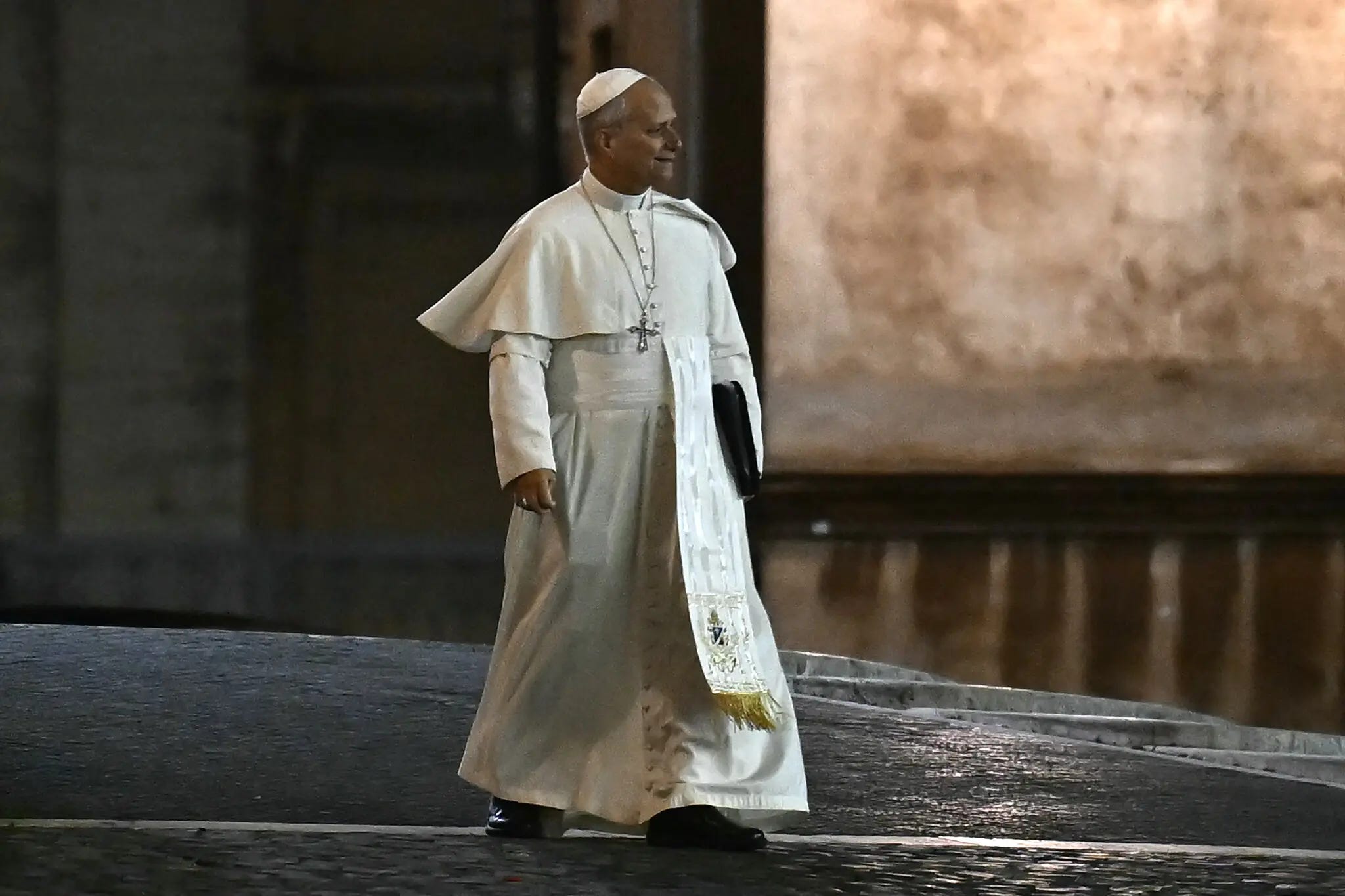
“Disarm AI” — Pope Leo XIV Drops His First Encyclical on Slavery, Algorithms, and War
The pope’s first encyclical takes on autonomous weapons, the layoff cycle behind generative AI, and the algorithmic capture of democracy — and asks whether the dignity of the human person can survive.
Thank you for reading! Letters from Leo is a reader-supported publication. To receive new posts and support my work, consider becoming a free or paid subscriber.
I’m exhausted. Today is going to be mostly television hits, and last night I read Pope Leo XIV’s first encyclical, Magnifica Humanitas, in full — so I could write this letter for those of you who cannot read 200 paragraphs of papal prose in short order. I hope I articulate myself well, nevertheless. If you’re able, you should read the encyclical too.
No summary will do this document justice. I previewed it last week and wrote a reader’s guide. What follows is what stood out to me on the first full read.
Here is the shape of what Pope Leo has done.
The encyclical opens with a choice. In its first paragraph, Leo writes that “the magnificent humanity created by God stands today before a decisive choice: to erect a new Tower of Babel or to build the holy city, where God and humanity dwell together” (§1).
The Tower of Babel is the Genesis story in which a unified humanity tries to build a tower to heaven on its own terms, without reference to God, and ends in confusion and dispersion.
Leo uses it as the image for a civilization that lets technology dominate the person, against the alternative of a city built around the dignity of every human being.
Chapter One traces the development of Catholic social doctrine from Leo XIII’s Rerum Novarum in 1891 through Francis’s Laudato Si’ and Fratelli Tutti, presenting the magisterium as a living tradition rather than a static rulebook.
The second chapter restates the foundational principles — the dignity of the person, the common good, the universal destination of goods, subsidiarity, solidarity, social justice. In the third, Leo names what Pope Francis first called the technocratic paradigm and identifies its newest expression in artificial intelligence.
The fourth applies those principles to truth, work, and freedom in the digital transition. Chapter Five moves from the algorithm to the battlefield, identifying the use of AI in war as a sin against what Pope Paul VI called the civilization of love.
Inside that structure, Leo has tucked a moment of historic moral reckoning. For the first time in the history of the papacy, a pope has formally apologized for the role the Holy See itself played in legitimizing the slave trade.
Earlier popes have apologized for Christians who participated in slavery. None has acknowledged, until now, that the fifteenth-century bulls of Nicholas V and his successors gave Portuguese and Spanish sovereigns explicit authority to “invade, conquer, fight and subjugate” non-Christians.
Leo names that record a “wound in Christian memory.” The pope, whose own family tree includes both enslaved people and slaveholders, issued the apology inside an encyclical on artificial intelligence for a reason.
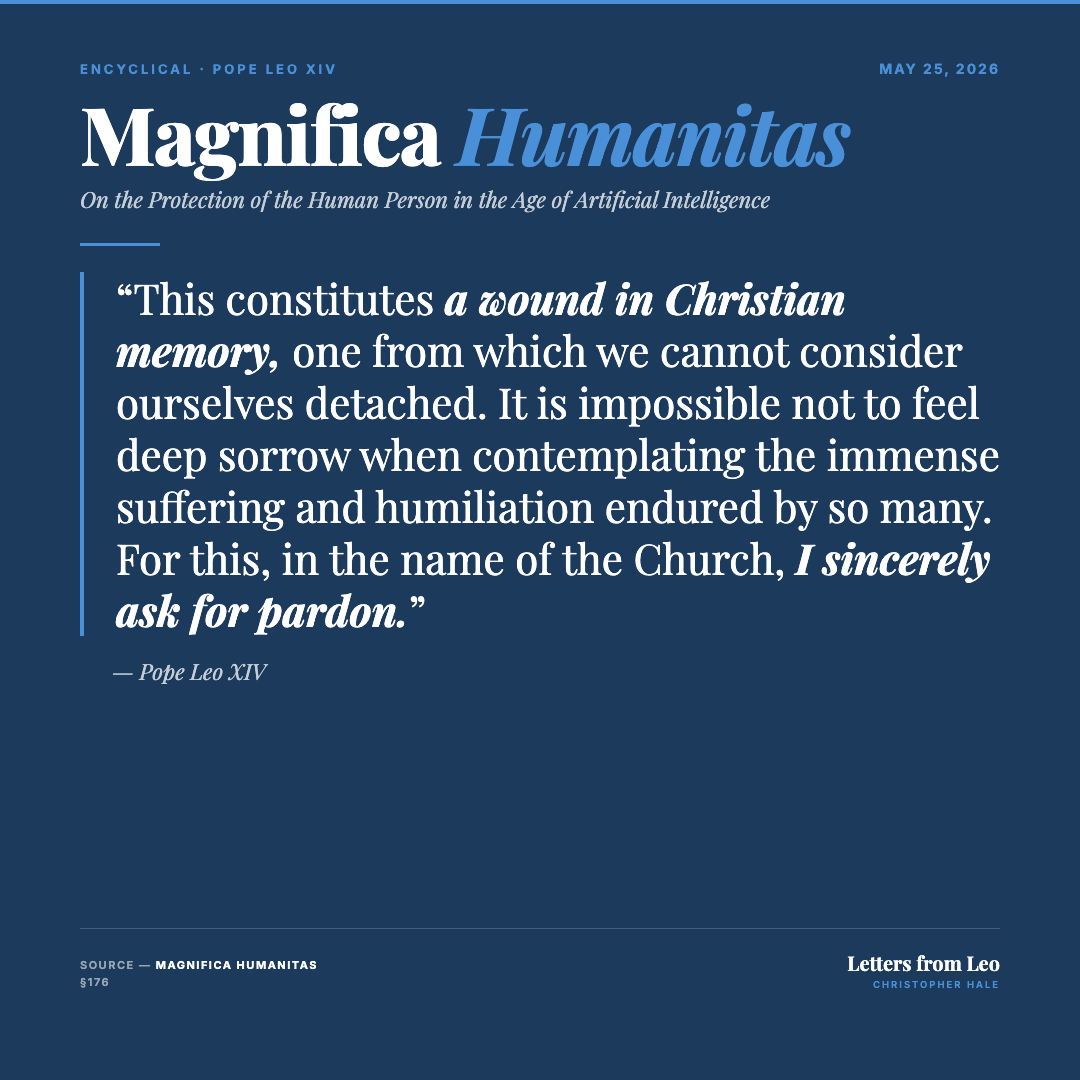
He is asking whether we are repeating the pattern in the unregulated labor that supplies the rare minerals for AI chips and the new digital trafficking enabled by the platforms.
This is the heart of what the encyclical does — it refuses to let artificial intelligence be treated as a theoretical question. Leo is direct on this point.
AI is already deciding who gets hired and who gets fired, whether you receive credit or are denied a loan, what your face means to a surveillance camera, what counts as truth on the public square, and increasingly, who lives and who dies in a war zone. The Church, Leo says, has a duty to weigh in precisely because the stakes are this concrete.
Chapter Four contains the encyclical’s defense of democracy, and American Catholics should pay close attention to it. Leo writes that truth is “a common good essential to democratic life,” and that the digital ecosystem — manipulated images, polarizing narratives, the algorithmic amplification of falsehood — places that good in peril.
He insists that the quality of public communication “depends directly on social trust,” and that trust cannot be manufactured by code. It is built only by human beings who care more about the truth than about the engagement metric.
Leo is teaching a country that has spent the better part of a decade learning to lie to itself that no democracy survives the death of regard for the truth. He has done this teaching before. During his African journey in April, Leo told the Pontifical Academy of Social Sciences that democracy “remains healthy only when rooted in the moral law and a true vision of the human person.” Magnifica Humanitas is the long-form version of that argument.
The chapter on work is where Leo gets concrete about the economics of AI. He writes that the present model of digital transformation has inverted the proper order of tools and persons. “Workers are often forced to adapt to the speed of machines, rather than machines being designed to assist workers.”
That is a single sentence, but it is also a verdict on the entire layoff cycle that has swept American newsrooms, customer-service centers, paralegal departments, and design studios over the last few years. The pope is saying the labor model behind generative AI is backwards.
The chapter on war is sharper still. Leo writes that the use of artificial intelligence in weapons systems represents a betrayal of just-war doctrine, dressed up as a refinement of it. Automated killing accelerates the decision to use force, blurs moral responsibility, and lowers the ethical threshold at which a society is willing to take a human life.
“No algorithm can make war morally acceptable,” the pope writes. He revives Pius XII’s wartime line — “with peace nothing is lost, with war everything is lost” — and applies it to the present moment, when Silicon Valley contractors and the Pentagon are racing to build autonomous targeting systems.
That same just-war doctrine has already been applied in real time by senior American churchmen to the war the Trump administration is currently waging. Cardinal Robert McElroy of Washington has declared the U.S. war on Iran “not morally legitimate,” ruling that the campaign fails the threshold tests of just cause and right intention.
He is not alone. American bishops from Chicago to Arkansas have echoed him. Magnifica Humanitas gives that judgment a magisterial frame and a Vatican voice.
Then Leo did something at the launch that nobody expected. Standing in the Synod Hall, the pope called for a “disarmed AI.” His exact words, as the Vatican released them, are these: “Artificial intelligence now demands to be ‘disarmed,’ freed from logics that turn it into an instrument of domination, exclusion or death.”
He clarified what he meant. “Disarming does not mean renouncing technology, but preventing it from dominating humanity.” And then he extended the meaning past the literal battlefield: “Disarming AI means freeing it from the mentality of ‘armed’ competition, which today is not limited simply to the military context, but is also an economic and cognitive phenomenon.”
The call for a disarmed AI is the line to remember from this papacy. Vatican News led its coverage with it. The pope is asking the industry, and the global political order, to give up the framing under which AI has been built so far — arms races, market dominance, cognitive capture — and rebuild the technology around the dignity of the human person.
From the same dais, Leo offered a quieter line that may matter just as much: “We need faces and voices to speak for people again. We need to cherish the gift of communication as the deepest truth of humanity.” The pope is warning that AI’s deepest threat is mimicry. An imitation of friendship is a slow theft of friendship itself.
The only AI industry figure on the stage with Leo was Christopher Olah, the co-founder of Anthropic and head of the company’s interpretability research. Olah used the platform to say something no leader of a major AI lab has ever said from a Vatican rostrum.
The development of frontier artificial intelligence, he argued, cannot be entrusted to frontier AI labs alone. Every lab, including his own, operates inside a set of incentives that can sometimes conflict with doing the right thing. Outside scrutiny — from religious leaders, governments, civil society — is essential, not optional.
Anthropic knows the cost of that position.
As I wrote earlier this week, the company has spent the last three months in open conflict with the Trump administration over precisely the question Pope Leo just answered from the Vatican stage.
In February, Defense Secretary Pete Hegseth designated Anthropic a “supply chain risk” and President Trump ordered every federal agency to cease using Claude after Anthropic refused to drop the clauses in its acceptable-use policy that prohibit Claude from being deployed in fully autonomous weapons or mass surveillance of Americans.
Anthropic is in federal court this month fighting to overturn the Pentagon’s blacklist. A federal judge has already found that the government retaliated against Anthropic for raising the issue publicly. Bloomberg has reported that the Pentagon is already testing OpenAI and Google models as replacements.
For Pope Leo to invite the co-founder of that company onto a Vatican stage during the same week the case is being argued in Washington was a choice with a meaning. The pope has taken a side. He stands with the lab whose acceptable-use policy refused the Pentagon’s demand for unrestricted access to autonomous weapons capability, and against the political and corporate forces that treat the human person as a target.
Beneath the news, Magnifica Humanitas is also a careful act of doctrinal development. Pope Leo broke with recent precedent by personally presenting the encyclical at the Vatican rather than handing the introduction to a cardinal, and he wrote a letter to the bishops of the world asking them to receive the document as part of his magisterium and to teach it.
Inside the text, Leo quotes Pope Francis again and again. Laudato Si’, Fratelli Tutti, Evangelii Gaudium, Dilexit Nos, and Dignitas Infinita are all woven through the citations.
The principle that anchors the doctrinal continuity is one Francis made his own — “time is greater than space” — Francis’s way of saying the Church’s mission is to initiate processes that mature over time rather than to seize positions of power in the present. Leo reups that principle directly and uses it to argue that the Church’s social doctrine grows organically with each pontificate without breaking from what came before.
Magnifica Humanitas extends Francis rather than rupturing with him, adding the next stitch to a garment that runs from Rerum Novarum through Laudato Si’ through this moment. The continuity itself is the message. To anyone who hoped Leo would distance himself from Francis, this encyclical is a quiet, unmistakable correction.
One of the more charming details of Magnifica Humanitas, and a habit Leo borrowed from Francis — who delighted in citing non-Catholic literary voices like Dostoevsky, Borges, and Manzoni in his own encyclicals — comes at §213, where Leo turns to J.R.R. Tolkien.
Quoting a line from The Lord of the Rings, the pope writes that “it is not our part to master all the tides of the world, but to do what is in us for the succour of those years wherein we are set, uprooting the evil in the fields that we know, so that those who live after may have clean earth to till.” The first AI encyclical in history is, among other things, a hobbit document.
The encyclical also contains an unflinching critique of what Leo calls the transhumanist and posthumanist narratives — the Silicon Valley faith that human limitation is a flaw to be engineered out of existence. Leo says no.
The human person, he writes, “does not flourish in spite of limitation, but often through limitation.” Weakness is where we learn love, care, and dependence on one another. A civilization that promises to abolish weakness will end by abolishing the people it considers weak.
Leo closes the encyclical with the same image he opened it with. The choice before us, he writes, is to be “builders of communion, not architects of Babel.” I would write that sentence on every wall of every server farm in Silicon Valley if I could. It is the standard by which a Catholic conscience must now evaluate every product, every contract, every Pentagon demand, every algorithm, every shareholder meeting that touches the dignity of the human person.
If you’re able, I encourage you to sit with the encyclical and read the whole text. The first American pope has chosen our moment to remind the Church and the world that the dignity of the human person is not a feature that can be patched in later.
At Letters from Leo, we stand with Pope Leo XIV and the millions of Catholics — and countless others of goodwill — who believe that the dignity of the human person is not a setting on a control panel, that democracy cannot survive on engagement metrics, and that no algorithm should ever be entrusted with the decision to take a human life.
In an era poisoned by cruelty and cynicism, we remain rooted in a faith that refuses to flinch before the new idols of power — whether they wear the suit of a defense contractor, the seal of a federal agency, or the logo of a Silicon Valley platform.
This is the fastest-growing Catholic community in the country because people are hungry for something deeper than rage and propaganda. They are looking for courage, for truth, for love made visible in action — and right now, as the Vatican itself calls for a disarmed AI, that hunger has never been more urgent.
If you believe this movement matters — Catholics and people of goodwill standing for human dignity against a culture of power that increasingly treats people as targets — I am asking you to join us.
If you’d like to invest in our mission, here are three ways you can help on this critical day:
Subscribe as a paid member to receive exclusive posts about the life and formation of Pope Leo and help sustain this newsletter.
Donate with a one-time gift to fuel this project’s mission.
Share this post (and Letters from Leo) with a friend who might enjoy it.
Paid subscriptions unlock our ongoing series on Pope Leo and AI, the multi-part biographical series on the life and formation of Pope Leo, the ongoing Epstein-Bannon Investigation, and the Sunday Scripture Reflection Series.
Whether you give $0, $8, $80, $800, or more, your presence here matters — no matter your faith or your politics.
Thank you for reading. I’ll see you on the road.


Thank you. Profoundly thank you.
Thank you for this overview of “Magnifica Humanitas”! Your writing has distilled and amplified Leo’s message.
My favorite nugget from your observations: “A civilization that promises to abolish weakness will end up by abolishing the people it considers weak.”