
“An Eclipse of What It Means to Be Human” — Pope Leo XIV Previews AI Encyclical
At the Vatican on Friday, the American pope previewed Magnifica Humanitas — the encyclical Cardinal Michael Czerny tells CBS News will confront “control that is exercised now by a few.”
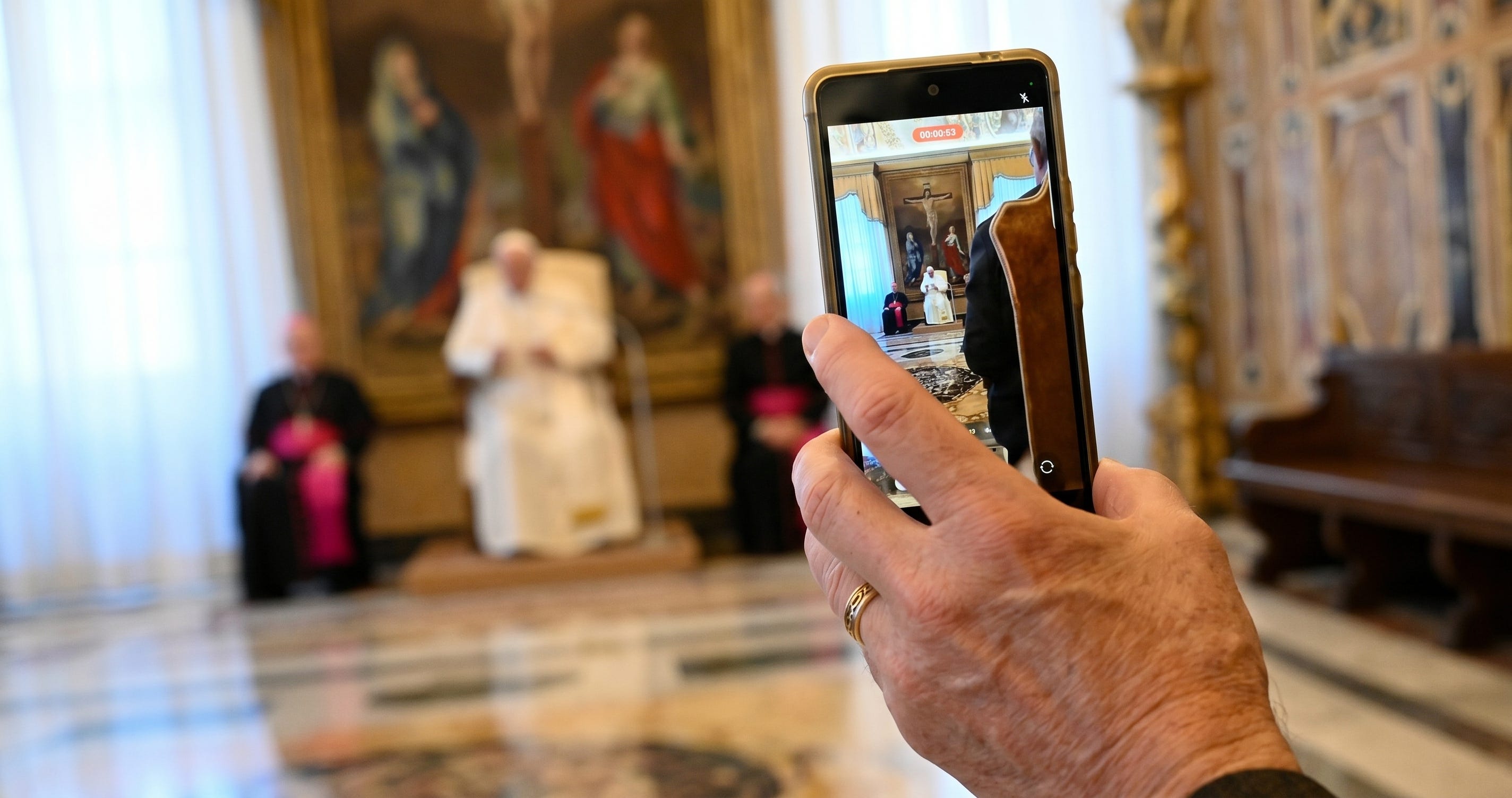
Pope Leo XIV stepped into the Consistory Hall of the Apostolic Palace on Friday morning and told scholars gathered at the Vatican for “Preserving Human Voices and Faces,” an international conference on artificial intelligence, that the technology has produced “an eclipse of the sense of what it means to be human.”
The line was the centerpiece of Friday’s address, which the Vatican posted on social media within hours of delivery. The pope spent the rest of the speech sketching the argument readers will see in full on Monday.
“The challenge we currently face,” Leo told the conference, “is not technological, but anthropological.”
That sentence is likely the thesis of the document — the first papal encyclical on artificial intelligence in the history of the Church.
The pope will unveil it personally in the Vatican’s Synod Hall on Memorial Day, sharing the stage with Anthropic co-founder Christopher Olah.
He signed the text on May 15, the 135th anniversary of Rerum Novarum, Leo XIII’s foundational document on labor and capital at the dawn of the first industrial revolution.
Friday’s address introduced the populist moral argument that defines the encyclical.

The pope told the conference that chatbots exploit our need for human relationships and that the “unbridled promotion and implementation of technology at the expense of human dignity” has put humanity in genuine danger. Silicon Valley wasn’t named, but every executive watching from Menlo Park and San Francisco understood the address was aimed at them.
Cardinal Michael Czerny — a member of the pope’s inner circle — appeared in a CBS News interview with Norah O’Donnell that aired Friday morning. The cardinal previewed the document in language that should make every CEO in Palo Alto sit up straight.
“What we’re going to hear is a message of both challenge and reassurance,” Czerny told O’Donnell. “The challenge is that we need to take responsibility — we, not just a few — but we need to take responsibility for artificial intelligence.”
He continued: “We have to struggle against certain control that is exercised now by a few in order to take human responsibility for this.” Just like previous revolutions, the cardinal said, the benefits “can and should and must reach all of us, not just a few.”
This is Catholic social teaching pointed at the architecture of the modern economy. Francis pressed it on the climate crisis in Laudato Si’. The 1891 encyclical Rerum Novarum applied the same instinct to industrial barons who treated workers as machines. Leo is now training that pressure on a Silicon Valley that treats human attention as raw material.
Pope Francis spent the last decade of his life trying to wake the Church up to the AI question. He became the first pope to address the G7 leaders in Apulia in June 2024. The Rome Call for AI Ethics, convened with Silicon Valley signatories in 2020, was his.
So was Antiqua et Nova, the January 2025 joint statement from the Dicastery for the Doctrine of the Faith and the Dicastery for Culture and Education that did much of the philosophical groundwork Magnifica Humanitas now builds on.
Bishop Antonio Staglianò, the head of the Pontifical Academy of Theology, told Catholic News Service this week that Magnifica Humanitas will go further than an ethics framework.
A code of ethics by itself is “a cold code of regulations” that profit-driven tech giants “would manipulate, bypass and exploit as they please,” the bishop said. The encyclical, he added, will demand “a true great political and social revolution” — a change of the human heart.
The encyclical drops at a moment when American policy is going the other way. On Thursday, President Trump scrapped a planned executive order on AI safety after eleventh-hour phone calls from David Sacks — Trump’s former AI and crypto czar — and Silicon Valley executives, including Elon Musk and Mark Zuckerberg.
The order would have invited AI companies to voluntarily give the federal government early access to test new releases before they ship. Magnifica Humanitas will read as a direct rebuke of that retreat and a call to lawmakers to hold the line on the few moral guardrails left standing.
Television networks have been calling me all day. I haven’t seen this kind of secular hunger for a papal text since June 2015 and the release of Laudato Si’. People want a moral champion in a season of upheaval, and Leo is providing one.
This is what the American pope was elected to do. The encyclical that drops on Monday will be read in seminaries and chanceries, in the executive suites of Anthropic, OpenAI, Google DeepMind, and Meta, and in every congressional office trying to figure out what to do about a technology already reshaping work, education, and childhood.
For Silicon Valley, the message will be unmistakable: the era of moving fast and breaking things without regard to human consequence is over. The Church will insist, in the populist register of a working-class American pope, that the architecture of the next century be built around the dignity of every human being — not the profit margins of a few.
This is the hour, and Leo is meeting it.
At Letters from Leo, we stand with the millions of American Catholics — and the countless people of goodwill — who believe the architecture of the next century cannot be designed by a handful of men in Palo Alto.
Pope Leo XIV is offering the world a moral framework that places the dignity of every human being above the profit margins of the firms building this technology. Monday’s encyclical is a document for our time.
This is the fastest-growing Catholic community in the country because readers like you are hungry for clarity in a season of upheaval. People want a Church that refuses to be complicit, a pope who speaks plainly, and reporting that translates the Vatican’s signals into something they can use.
If you believe this work matters — people of goodwill standing for human dignity against a Silicon Valley that has been allowed to operate without accountability — I’m asking you to join us.
If you’d like to invest in our mission, here are three ways you can help this Easter season:
Subscribe as a paid member to receive exclusive posts about the life and formation of Pope Leo and help sustain this newsletter.
Donate with a one-time gift to fuel this project’s mission.
Share this post (and Letters from Leo) with a friend who might enjoy it.
Paid subscribers get full access to my biographical series on Pope Leo’s life and formation, the Pope Leo’s campaign confronting AI and what comes next, and the Sunday Scripture Reflection Series.
Whether you give $0, $1, $50, $1,000, or more, your presence here matters — no matter your faith or your politics.
Thank you for reading. I’ll see you on the road.


