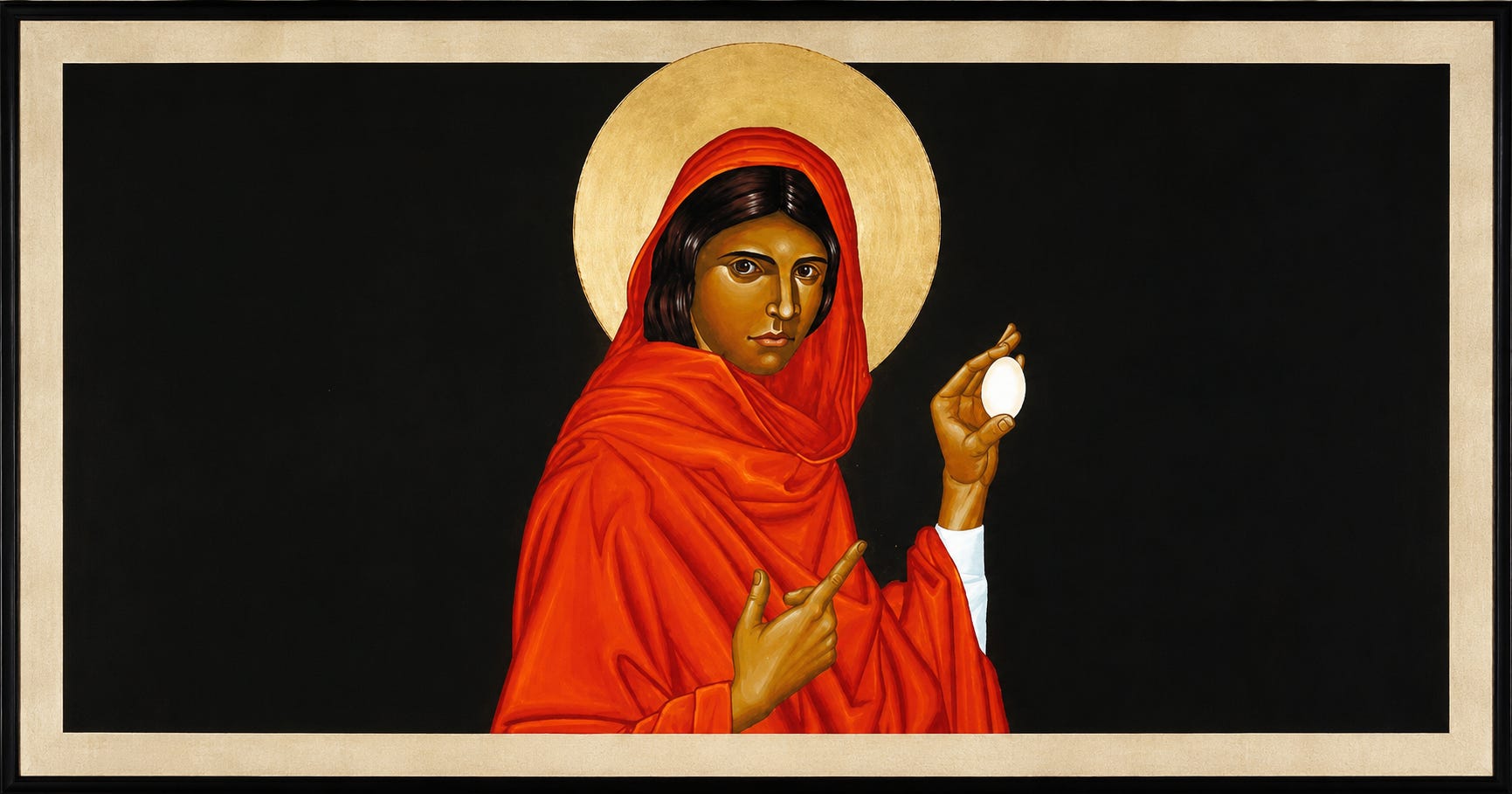
“Run Like Mary Magdalene” — Pope Leo XIV’s Vision for Women in the Church
Gregory the Great turned her into a prostitute with one sermon. Fourteen centuries later, Pope Francis handed her an apostle’s feast — and from what I heard in Rome, Leo is only getting started.

Dear friends,
Today is the Feast of Saint Mary Magdalene, and in her honor, this one is free for everybody.
Paid subscribers get a scripture reflection every Sunday. If today’s means something to you, the upgrade button is right below.
“Mary Magdalene went and announced to the disciples, ‘I have seen the Lord.’” — John 20:18
Somewhere along the way I absorbed the idea that Mary Magdalene was a prostitute. So did most Catholics I know. She is the most fascinating woman in the New Testament, and we got her wrong for fourteen hundred years.
None of us got the prostitute story from the Bible, because it is not in there.
Luke says Jesus healed her of “seven demons,” and that she then traveled with him and the twelve disciples and paid the bills — a woman of means providing for the ministry out of her own resources. She kept vigil near the cross after all the other men had fled.
And on Easter morning she got up in the dark and walked to the grave to discover Christ risen from the dead.
The prostitute legend comes from elsewhere.
In 591, Pope Gregory the Great preached a sermon that mashed three different Gospel women into one — the sinful woman of Luke 7, Mary of Bethany, and Mary of Magdala — and the Western church ran with his mistake for centuries.

Rome only untangled the three women in Paul VI’s 1969 liturgical calendar reform.
Pope Francis finished the job. In 2016, he raised her day, July 22, from a memorial to a feast, which sets her liturgically on the same footing as the apostles, and the Vatican’s liturgy office called her “a true and authentic evangeliser.”
Thomas Aquinas had coined the better title back in the thirteenth century: apostolorum apostola.
The apostle of the apostles.
The East never needed the correction. Orthodoxy and the Eastern Catholic churches never bought Gregory’s composite in the first place, and their calendars venerate her as isapóstolos, “equal to the apostles” — the honor they give Helena, and Cyril and Methodius, and the handful of saints whose witness did what the Twelve’s did.
I love that title. Nothing the West came up with fits her half as well.
Read John 20 this week if you have a few minutes.
She reaches the tomb before sunrise and finds the stone moved. She runs for Peter. She comes back, stands outside crying, looks in, sees two angels, turns around, and starts questioning a man she assumes is the gardener — she wants to know where they took the body, she will go get it herself — until he says her name. Then he gives her a job: go to my brothers and tell them.
For however long it took her to get from that garden to the upper room — ten minutes, maybe twenty — every syllable of the Christian faith on earth was in the custody of one woman. Nobody else had it yet, not even Peter.
A church in mission, running to frightened people with news too good to believe, begins right there, in her stride. She was the church at its birth.
Preaching on her witness at a general audience in 2017, Francis put her testimony in layman’s terms: “I have changed my life because I have seen the Lord!”
Francis had a lifelong weakness for strong women, and my favorite proof is a painting.
In 1986 he was in Germany — lonely, far from Argentina, working on a doctorate he never finished — when he came across a Bavarian devotion called Mary, Untier of Knots. He took it home. The devotion caught fire in Buenos Aires, above all in the poorest neighborhoods of the city.
The original painting hangs in Augsburg. Mary stands on a crescent moon, working a knot out of a long white ribbon while her heel rests on a serpent, her face completely unbothered. Whoever that woman is, she is nobody’s porcelain figurine on a shelf. She is a woman who gets things done.

Between the Magdalene of the empty tomb and the Mary of the knots, the church’s two most recent popes inherited a vision of Christian womanhood built on strength. Which brings me to Pope Leo XIV.
Robert Prevost learned his Old Testament from a woman — Sister Dianne Bergant, who taught him at Catholic Theological Union in Chicago, a graduate school where seminarians studied beside laywomen and women religious.
His undergraduate years at Villanova were coeducational too. Commonweal put it plainly: Leo is “a man who studied under and alongside women at Catholic Theological Union.” No modern pope was formed for the priesthood in classrooms quite like those.

As bishop of Chiclayo, he governed that way. Elise Ann Allen’s biography of Leo — read it on Kindle if you haven’t — documents a bishop who invited laywomen to offer reflections at Mass, put a laywoman in charge of the diocesan Caritas, and met constantly with the women religious serving trafficking victims on Peru’s northern coast.

One Peruvian parishioner remembers him asking her to preach, then clarifying that what she would give was “a reflection” rather than a homily in the formal sense. He was ahead of his church, and he knew precisely how far ahead he could afford to be.
The pattern has continued from the Chair of Peter. Pope Francis broke the seal in January 2025 when he named Sister Simona Brambilla the first woman ever to lead a Vatican dicastery.
Leo has kept going. In his first fourteen months he named Sister Tiziana Merletti secretary of that same dicastery, appointed the laywoman Montserrat Alvarado to lead the Dicastery for Communication, and made Sister Alessandra Smerilli prefect of the Dicastery for Promoting Integral Human Development.

Three women have now been named to run major offices of the Roman Curia. Two of them were hired by Leo in the past few weeks.
When he met roughly two thousand synod leaders in the Paul VI Hall last October, the pope told them the obstacles facing women are cultural before they are doctrinal. “Not all bishops or priests want to allow women to exercise what could very well be their role,” he said, praising the sisters he knew in Peru who “baptize, assist at marriages, and carry out a wonderful missionary work that is a testimony even for many priests.”
He likes to tell the story of asking his mother whether men and women were equal. Her answer: “No, because we’re already better.” The Synod’s study group on women reached a similar conclusion in its final report this spring, writing that the church needs “a change of mentality” even before it speaks of roles.
That is Leo’s own language too. He told his biographer Elise Ann Allen, in the long interview they recorded in the summer of 2025, that “we have to change attitudes before we even think about changing what the Church says about any given question.”
I have spent much of the past several weeks in Rome, and I can tell you from my conversations within the Roman Curia that Leo intends to advance the role of women in the church further than any pontiff before him.
He will not do it recklessly.
Everything about this pope — the canon lawyer, the missionary, the Augustinian trained to prize unity — suggests he will move deliberately, bringing the whole church with him rather than leaving half of it behind.
Which returns us, on her feast, to the woman in the garden.
Mary Magdalene is the role model the modern church offers its daughters: a woman of means who funded the mission, a witness at the cross when staying was dangerous, and the lone carrier of the resurrection before anyone else believed it. I write this as a man who has needed, more than once in my life, a woman to tell me the truth about God before I could hear it.
So here is the question this feast asks of all of us: when a woman comes running with the good news, do we believe her?
This past Easter, in his first Easter Sunday homily as pope, Leo handed the whole church her example as a command: “Let us then run like Mary Magdalene, announcing him to everyone, living out the joy of the resurrection, so that wherever the specter of death still lingers, the light of life may shine.”
She is still ahead of us. Twenty centuries of head start, and nobody has caught her yet. I figure the best any of us can do on her feast is run.
One more word before you go.
Most of us received the faith from a woman. Trace yours back far enough, and you will probably find a grandmother, a catechist, a religious sister who scared you a little — somebody who handed you the Gospel long before any priest did.
Letters from Leo stands with those women, with the sisters in Peru whom Leo praised in Rome last fall, and with the laywomen about to take charge of two Vatican dicasteries.
This has become the fastest-growing Catholic community in the country, and I think the reason is fairly simple: people are hungry for a faith that tells the truth about its own story, including the embarrassing chapters — maybe especially those.
If that sounds like a movement worth belonging to — the whole church, women and men together, running with the good news — then I am asking you to join us.
If you’d like to invest in our mission, here are three ways you can help during this critical time:
Subscribe as a paid member to receive exclusive posts about the life and formation of Pope Leo and help sustain this newsletter.
Donate with a one-time gift to fuel this project’s mission.
Share this post (and Letters from Leo) with a friend who might enjoy it.
Paid subscribers get the full biographical series on Pope Leo’s life and formation — his Chiclayo years alongside the women of northern Peru are some of my favorite chapters — plus every Sunday scripture reflection, the Pope Leo Takes On AI series, and the Epstein-Bannon investigation.
Whether you give $0, $5, $50, $500, $1,000, or more, your presence here matters — no matter your faith or your politics.
Thank you for reading. I’ll see you on the road.


Wow I never saw her as the messenger but what a role model she is! I have always cringed when I heard people call her a prostitute. It’s what I was taught but it is nowhere in scripture. So many amazing ideas in this piece Chris. Keep them coming!
Beautiful!
