Thank you for reading! Letters from Leo is a reader-supported publication. If you find value in my work, please consider becoming a paid subscriber or making a one-time donation.
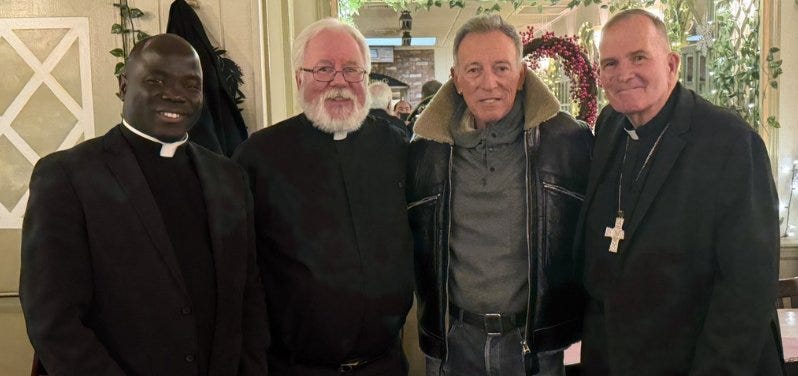
In a Freehold, New Jersey pizzeria on Monday, two Jersey legends shared a table and a message. Rock icon Bruce Springsteen met with Bishop David M. O’Connell of Trenton for an impromptu lunch Feb. 2, arranged by a mutual priest friend.
The bishop — a longtime Springsteen fan — described the get-together as “delightful,” marveling that “given his worldwide fame, [Springsteen] was so humble and low-key. It felt as though we’d known each other for years!”
Their warm conversation about family, faith and Jersey roots was ordinary in tone, but the timing was extraordinary: just days earlier, Springsteen’s searing new protest song Streets of Minneapolis had become the top-selling track in America.
Springsteen’s latest single is an anthem of moral outrage against aggressive immigration raids. He wrote it after federal agents killed two Minneapolis residents — including a Catholic ICU nurse — during Trump-ordered ICE operations.
Backed by a gospel chorus, Streets of Minneapolis pointedly shouts “ICE out now!” and condemns a “state of terror” in immigrant neighborhoods.
The National Catholic Reporter praised the song as a “soundtrack to the liturgy of protest,” noting how Springsteen’s lyrics evoke “bloody footprints where mercy should have stood” and a call to “stand for the stranger in our midst.”
In other words, the rock star has given Americans a kind of hymn for justice in the streets. Fittingly, Streets of Minneapolis hit No. 1 on the charts within a week of its Jan. 28 release, a cultural moment Catholic media hailed as “exactly what it needs to be” in this dark hour.
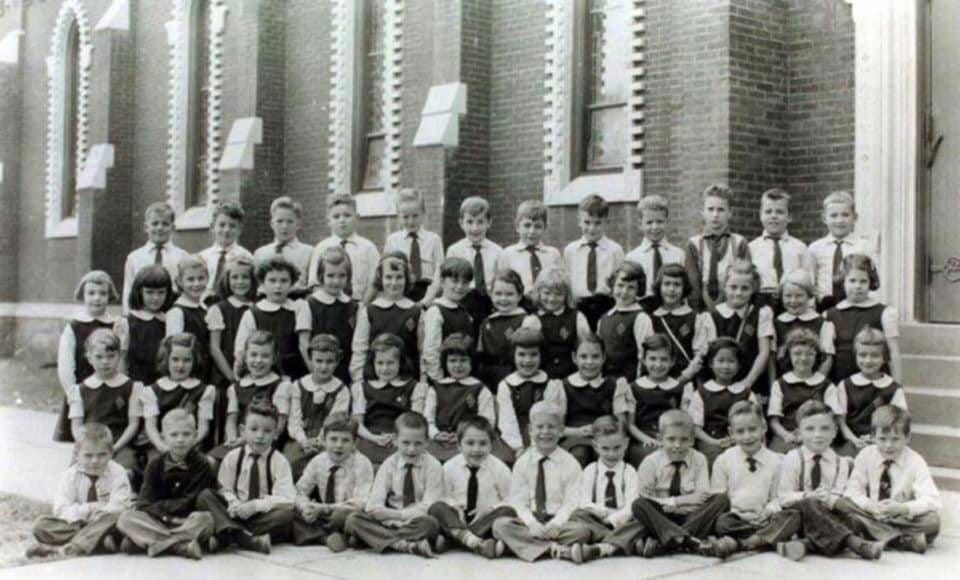
For Springsteen, this public stand is also a homecoming of faith. The 76-year-old rocker was raised Catholic — attending St. Rose of Lima School in Freehold — and though he drifted from active practice, he insists “once a Catholic, always a Catholic.”
His music has long reflected Gospel values of mercy, hope and solidarity with the marginalized. “Springsteen without the Catholic faith is simply not Springsteen,” one commentator has observed.
In his own memoir, Springsteen admitted that the Church “has walked alongside me as a waking dream my whole life.” Indeed, even many nonreligious fans experience Springsteen’s concerts as quasi-spiritual events.
“For many listeners, Springsteen’s music is a spiritual experience — an invitation to meet the Divine through image and song,” NCR’s review noted, adding that Bruce’s faith still quietly informs his art.
Springsteen himself often nods to that heritage — at the 2018 Tony Awards he recalled growing up “surrounded by God and all my relatives… when the church bells rang, the whole clan would hustle up the street” for every wedding and funeral.
Those Catholic roots run deep in “The Boss.” Here’s some background on it.