‘The Grand Humbling’ — Silicon Valley Responds to Pope Leo XIV
Dean Ball, Doug Burgum, David Sacks, and Raymond Arroyo all came for Magnifica Humanitas this week. JD Vance praised it. The men who actually own AI said nothing. A field report from a busy week on television.
Thank you for reading! Letters from Leo is a reader-supported publication. If you find this work valuable, please consider becoming a paid subscriber or making a one-time gift.
I intended to send this yesterday. Media chaos intervened.
Since Pope Leo XIV released his first encyclical, Magnifica Humanitas, on Monday — the first papal document of the modern era to take artificial intelligence as its central concern — I have been on cable, on streaming, and on tech podcasts almost continuously.
I will have more to say about the substance of those appearances in another letter. For now, every clip from this week is gathered below, along with my April conversation with Pod Save America’s Jon Favreau on the same technological terrain.
Forgive me, again, for the late dispatch. I’m still new at this venture, and I promise as we go along this journey together, I will improve.
A word on the document itself before I turn to the response. I wrote about it before it dropped. I have spoken about it nonstop since. I believe it is a masterpiece.
The rollout helped. I was skeptical of releasing such a consequential text on Memorial Day weekend, when American attention scatters toward grills, beaches, and parades. The forecast intervened. Rain washed out much of the country; people stayed indoors, and the encyclical landed in millions of feeds with the kind of penetration most Vatican documents never achieve.
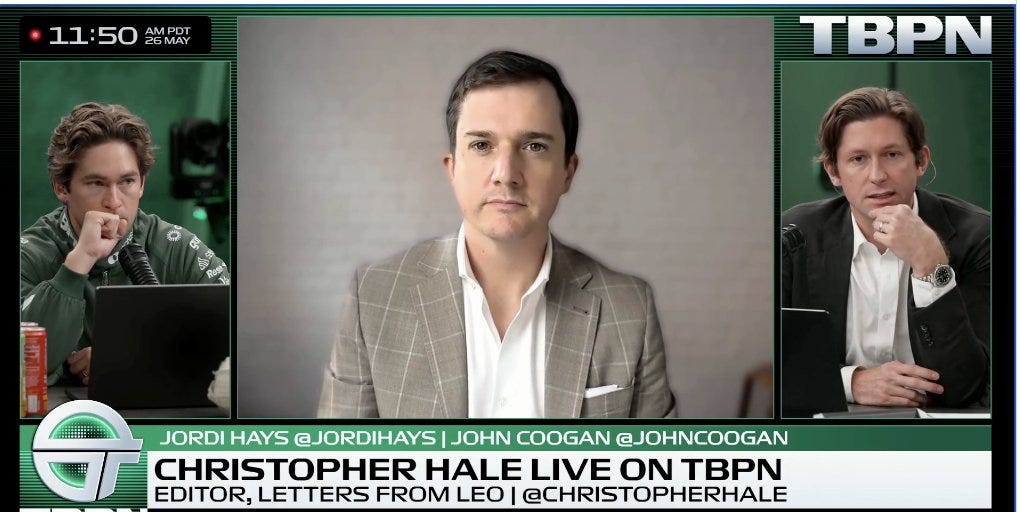
Silicon Valley noticed. Perhaps my biggest surprise of my week was twofold: Jack Dorsey — the founder of Twitter — shared the full Vatican text of Magnifica Humanitas with his followers and responded to an excerpt with a single word, “yes”; and TBPN, the flagship Silicon Valley business show, invited me on for a full thirty minutes to discuss a papal encyclical that had dropped on a Monday morning.
Now to the response — which has been more muted on the right than some expected, but a handful of voices have spoken out, and they are worth naming.
Dean Ball got there first. The former senior White House AI policy advisor — who served as the organizing author of the Trump administration’s AI Action Plan, departed the administration in August, and now writes from the Foundation for American Innovation as a critic of the same White House he served — laid out a serious religious critique of the encyclical.
Reading Magnifica Humanitas, Ball wrote on X that humanity is building machines smarter than we are at the things we care most about — at the domains of thought we ourselves originally invented.
No honest person, Ball argued, can deny that this will be “a kind of grand humbling for humanity,” and that there is “at least some melancholy in contemplating it all, some change to the centrality we have ascribed to our own minds in the order of the world.” Ball was sincere in this. He was not being arch.
His disappointment with the encyclical was that, in his telling, Pope Leo XIV fundamentally denies the grand humbling — that Magnifica Humanitas sidesteps it by “saying that AI cannot ‘really’ this and that.”
The encyclical, Ball wrote, puts the Church into the “awkward role of the European technocratic regulatory advocate,” when what the world actually needs from her is leadership on harder questions: “What is the genuine and unique source of human meaning? What is the human touch in the era of thinking machines?” Those, Ball said, are the questions the encyclical dodges.
Ball is right that those are the right questions. He is wrong that Leo dodges them. The encyclical spends most of its 42,000 words on precisely those questions — and then refuses to stop there, adding a moral and political demand on top of the spiritual diagnosis. That demand gets read in libertarian and engineer-class circles as European technocracy because it asks something of the powerful the libertarian framework cannot ask: restraint.
Pope Leo XIV, drawing on the Book of Genesis and the Book of Nehemiah, asks the builders of our age to choose between Babel and Jerusalem. He calls the resignation to inevitable humbling by what name fits it: idolatry. Ball intends his line as a verdict on the encyclical. The encyclical absorbs it as a thesis statement.
Raymond Arroyo, the Fox News contributor and longtime EWTN host, made the next move. On The Papal Posse — his EWTN segment with Robert Royal and Father Gerald Murray — Arroyo complained about how rarely the encyclical references sin, implying that a document that does not count its sins by the page has somehow lost its theological footing.
The complaint betrays a misreading of the genre. Rerum Novarum and Laudato Si’ are not concordances of fallenness. Arroyo offered a culture-war reflex, and very little else.
Doug Burgum, the Secretary of the Interior and an emerging administration voice on AI policy, took his turn on Fox Business with Maria Bartiromo on Tuesday morning. “I didn’t know that tech editorializing was part of the role of being Pope,” he said. He defended AI data centers as “positive for humanity,” in pointed contrast to the encyclical’s call for AI to be “disarmed.”
That Burgum picked this hill the morning after Pope Leo XIV shared a Vatican stage with Anthropic co-founder Christopher Olah — whose company is in open conflict with the Pentagon over unrestricted military access to its models — is its own admission. The administration sees what is happening. It does not like it.
Vice President JD Vance has been more careful. In a Tuesday evening NBC News interview, Vance called the encyclical “very profound” and “the sort of thing that you would expect and hope from a leader of the Church.” On just-war doctrine — the encyclical’s sharpest intervention into U.S. foreign policy — Vance offered this: “You have new technologies and warfare, so you have to update ‘just war’ doctrine.”
At a press conference last week, before the document dropped, Vance had told reporters he expected the encyclical to contain “a lot of insights, some of which I’ll probably agree with, some of which I may not.” The portions he might struggle to embrace are not hard to identify.
The encyclical itself dedicates a section to accelerationist rhetoric and the framing of AI safety as a brake on national greatness — a fair summary of the speech the Vice President himself gave at the Paris AI Action Summit in February 2025, where he warned “excessive regulation” could kill the industry and told European leaders to abandon their guardrails.
Pope Leo XIV, of course, did not name him. Politicians are never named in encyclicals. That Vance has nonetheless emerged as the senior Trump official publicly aligned with the document is a story almost no one is writing this week.
David Sacks went a different direction. The former White House AI and Crypto Czar — now co-chair of the President’s Council of Advisors on Science and Technology — warned on X that the encyclical’s prescription for government oversight of AI is the real Orwellian danger.
Hand governments sweeping power over AI development in the name of safety, Sacks argued, and that power will eventually be turned to surveillance and control — “the real alignment problem,” in his phrase. It is a serious-sounding objection that, conveniently, argues for less regulation of the firms Sacks invests in.
Sam Altman broke the silence of the largest AI firms in the only way he could. On Monday — the day the encyclical dropped — the OpenAI chief executive told an audience he sees “a future where intelligence is a utility, like electricity or water, and people buy it from us on a meter.” The pushback this morning has been substantial. The encyclical Altman did not respond to spends pages warning against precisely that future. He answered the U.S.-born pontiff without meaning to.
A pattern emerges. None of the four — Ball, Arroyo, Burgum, Sacks — engaged Leo’s central moral argument: that intelligence severed from wisdom, scaled at planetary velocity, and concentrated in the hands of a small clerisy of engineers, poses a profound danger to human dignity. Each fought on adjacent ground. The serious challenge to Leo from the right has not yet arrived from any of them.
It did arrive from a Jewish reader on the right.
In The New Atlantis, Yuval Levin — who writes from the American Enterprise Institute — published a generous and frustrated essay titled “Idols of the Valley,” accepting Magnifica Humanitas as a powerful Christian intervention but objecting that Leo defined AI mostly in the negative, never quite engaged the linguistic breakthrough at the heart of the technology, and produced a document gesturing toward idolatry without naming the particular idol the moment is forging.
This is the critique Dean Ball was reaching for and could not articulate. Pope Leo XIV himself anticipates a version of it inside the text, conceding that even the people who build these systems possess “only a limited understanding of their actual functioning.” Levin wants Leo to dive deeper. So do I — and so, I suspect, does Leo.
The other serious critique came from the opposite direction. In The New York Times, Matthew Walther — editor of The Lamp and one of America’s more uncompromising Catholic writers on technology — argued that Magnifica Humanitas treats AI as a technology to be ethically managed when it should be resisted outright.
For Walther, AI is “unambiguously evil,” the encyclical is naive, and Leo’s Tower of Babel is a project that should not have been built at all. He also questioned the optics of putting Olah onstage.
I think Walther is wrong, but only at the edges. Pope Leo XIV shares his diagnosis. Where they differ is on tactics. Walther would have the Church withdraw from the field. The first American pope has chosen to enter it.
A Times news story from the technology desk, paired with a report from NBC News, documented what nobody following the industry can miss. Outside of Altman’s utility line, the tech titans have said nothing at all. Sundar Pichai, Mark Zuckerberg, Elon Musk — silent. The architects of these systems are not arguing with Leo. They are perhaps calculating that he can be outlasted.
That is the deeper story. Catholic commentators on the right have been loud because amplification is the only lever they still hold. Inside the firms that actually build these systems, the response has been near-total silence — a wager that the U.S.-born pontiff is a story to be waited out rather than a question to be answered.
That wager has, I think, already been lost. Magnifica Humanitas has done what few Vatican documents have accomplished in my lifetime: it has forced the question of conscience into the boardrooms of the firms that will shape the next century. The pushback you see this week is the sound of that pressure registering.
Dean Ball called it the grand humbling and meant it as a verdict against the encyclical. The encyclical, properly read, returns the favor. The grand humbling Ball wants us to accept is itself the idolatry Pope Leo XIV has spent the document warning us against.
At Letters from Leo, we stand with Pope Leo XIV and the millions of American Catholics — and countless others of goodwill — who believe that the moral question of this century cannot be answered by the men who own the model weights.
Pope Leo XIV has spent the first year of his pontificate insisting on the irreducible dignity of the human person in every corner of Catholic life, and Magnifica Humanitas is the most concentrated form of that insistence yet.
This is the fastest-growing Catholic community in the country because people are hungry for something deeper than rage and propaganda.
They are looking for a faith that takes the moral stakes of artificial intelligence as seriously as the men building it take their valuations — courage, truth, love made visible in action.
Right now, as Silicon Valley and its political enablers attempt to wait the U.S.-born pontiff out, that hunger has never been more urgent.
If you believe this movement matters — Catholics and people of goodwill standing for human dignity against the idolatries Pope Leo XIV has named — I am asking you to join us.
If you would like to invest in our mission, here are three ways you can help at this critical moment in the life of the Church, the nation, and, indeed, the entire world:
Subscribe as a paid member to receive exclusive posts about the life and formation of Pope Leo and help sustain this newsletter.
Donate with a one-time gift to fuel this project’s mission.
Share this post (and Letters from Leo) with a friend who might enjoy it.
Thanks to your support, Letters from Leo can keep building out our deep biographical work on the life and formation of Pope Leo XIV, our running coverage of how he is taking on the AI industry, and our weekly Sunday scripture reflections.
Whether you give $0, $5, $50, $500, $1,000, or more, your presence here matters — no matter your faith or your politics.
Thank you for reading. I’ll see you on the road.
The Clips
Every appearance from the week, in chronological order. I will write more about what I said in each in another letter soon.


I stand with Pope Leo
Classic example of "There's no such thing as bad PR." The more high visibility push-back, the better: it keeps the conversation going with more people reached, badly needed in a country where way too few non-religious talk openly about morality and ethics...certainly words apparently unknown in DC. There's a reason the encyclical resonated so strongly and well with Gen Z. Leo can and will hold his own. Onward.