

“Weapons Must Fall Silent” — Pope Leo XIV Again Demands Peace in Iran
Altar girls, a young woman's embrace, and a fourth call for peace in Iran — how Pope Leo XIV marked International Women's Day.


Thank you for reading! Letters from Leo is a reader-supported publication. If you find value in my work, please consider becoming a paid subscriber or making a one-time donation.
On Sunday morning, Pope Leo XIV appeared at the window of the Apostolic Palace and begged the world to stop bombing Iran. It was his fourth appeal in seven days. Roughly fifteen thousand pilgrims stood in St. Peter’s Square below him, the Third Sunday of Lent’s Gospel still hanging in the air — the story of Jesus and the Samaritan woman at Jacob’s well.
The pope’s words were blunt: “Deeply disturbing news continues to arrive from Iran and the entire Middle East.” He warned that the violence risks pulling other nations — “including beloved Lebanon” — back into instability.
Then he offered this poetic prayer that cuts through every talking point coming out of Washington and Tel Aviv right now:
“Let us raise our humble prayer to the Lord, so that the thunderous sound of bombs may cease, weapons may fall silent, and a space for dialogue may open up in which the voice of the people can be heard.”
While Donald Trump calls for “unconditional surrender” and Iran vows it will “never surrender,” the first American pope is making a different demand entirely.
He wants the focus shifted to ordinary people — families living under the bombs, refugees fleeing across borders into Lebanon, names that will never appear in a Pentagon briefing.
Pope Leo XIV’s Sustained Moral Offensive Against the Iran War
Since the war began on February 28, when the United States and Israel launched strikes that killed Ayatollah Ali Khamenei and dozens of senior Iranian officials, at least 1,230 people in Iran have been killed, along with about a dozen Israelis and six American service members.
The United States has hit more than 3,000 targets. Israel has struck 2,500 more. Lebanon’s social affairs ministry reports approximately 454,000 displaced people.
The Vatican has responded with what may be the most significant diplomatic intervention of this papacy so far.
On March 1 — the day after the strikes began — Pope Leo warned of a “tragedy of enormous proportions” and urged all parties to “assume the moral responsibility of stopping the spiral of violence before it becomes an irreparable abyss.”
Then, on March 4, came the Vatican’s sharpest salvo. Cardinal Pietro Parolin, the Secretary of State — Pope Leo’s top deputy and the most powerful diplomat in the Catholic Church — delivered a strong indictment: “Justice has given way to force. The force of law has been replaced by the law of force, with the conviction that peace can arise only after the enemy has been annihilated.”
Parolin went further, striking at the philosophical foundation of the war itself: “If states were to be recognized as having a right to preventive war, the whole world would risk being set ablaze.”
This was the Vatican telling Washington, in the clearest possible terms, that the moral order has been violated.
The diplomatic choreography here deserves close attention. Veteran Vatican correspondent Gerard O’Connell noted that Leo’s own language has been “relatively restrained” compared to what John Paul II said at the outset of the Iraq War.
That restraint seems strategic to me. By giving Parolin room to speak in the harshest terms, Leo has activated the full machinery of the Holy See’s traditional diplomacy — the Secretariat of State, which has maintained quiet channels with Iran for decades. The effect is a coordinated moral pressure campaign aimed squarely at Washington.
And on Saturday, Leo added another piece to the board. As I wrote yesterday, the pope named Archbishop Gabriele Caccia — the Vatican’s veteran envoy to Duterte’s Philippines and the United Nations — as the new apostolic nuncio to the United States.
Caccia spent years in the Secretariat of State alongside Parolin himself and has been one of the Holy See’s most forceful advocates for multilateralism and negotiation over military force.
Sending him to Washington at the most turbulent moment in modern Vatican-U.S. relations is a signal that Pope Leo is deploying his diplomatic A-team — not to smooth things over with the Trump administration, but to press the moral case directly.
Cardinal Parolin Indicts the Logic of Annihilation
Parolin’s intervention deserves more weight than it has received. This is the man who negotiated the Vatican’s secret deal to restore diplomatic relations with China. When he says “the law of force has replaced the force of law,” he is speaking with the authority of the institution that essentially invented modern diplomacy during the Thirty Years’ War.
And he is telling the United States that its conduct in Iran has crossed a line that Catholic moral theology will not bless.
The language of “annihilation” is deliberate. Catholic just war doctrine has always rejected the idea that military victory requires the destruction of an enemy. The tradition demands proportionality, protection of civilians, and a reasonable prospect of peace. Parolin is saying, in terms that any moral theologian would recognize, that this war fails all three tests.
Meanwhile, Trump’s demand for “unconditional surrender” echoes a phrase the Vatican has historically treated with deep suspicion — going back to Pius XII’s concerns about Allied demands in World War II. The moral framework here could not be clearer.
Washington demands annihilation while the Vatican insists on dialogue — and Catholic teaching has never had any doubt about which of those impulses deserves the backing of the Gospel.
A Pope in a Normal Parish — and an Embrace No One Expected
After the Angelus, Pope Leo traveled to the parish of Santa Maria della Presentazione in Torrevecchia — one of Rome’s more marginalized neighborhoods, where drug trafficking and poverty press against the parish walls. No pope had visited this church in more than forty years; the last was John Paul II, in 1982.
As we’ve seen throughout this Lenten season, there is something genuinely pleasant about watching a pope settle into the rhythms of an ordinary parish.
Altar girls served beside him at the altar. He met with about sixty people living with disabilities. He spoke to young people preparing for their First Communion, telling them simply: “Jesus will come to your heart, into your life.”
On International Women’s Day, for the third time in four weeks, the first American pope celebrated Mass flanked by female altar servers — a quiet detail worth noting.
Then, during the presentation of the gifts, a young woman broke from her entourage and ran up to embrace the pope. Nobody planned it, and nobody stopped it. The video is already spreading across the world because it captured something that cannot be staged — a moment where the distance between a pope and the people he serves simply collapsed.
In his homily, Pope Leo urged parish communities to become “a sign of a Church that — like a mother — cares for her children, without condemning them, but rather welcoming them, listening to them, and supporting them in the face of danger.”
What Today Revealed About Leo XIV
The Gospel reading for this Sunday was the encounter at Jacob’s well — Jesus breaking every social convention to sit with the Samaritan woman. Pope Leo XIV reflected on how Jesus “spoke with her, listened to her, showed her respect without a hidden agenda, and without disdain.”
He called the Samaritan woman “the first of many female evangelizers” and renewed the Church’s commitment to recognizing “the equal dignity of men and women,” lamenting that too many women, from childhood onwards, are still discriminated against and suffer various forms of violence.”
Once again, it was International Women’s Day. God’s providential timing was precise.
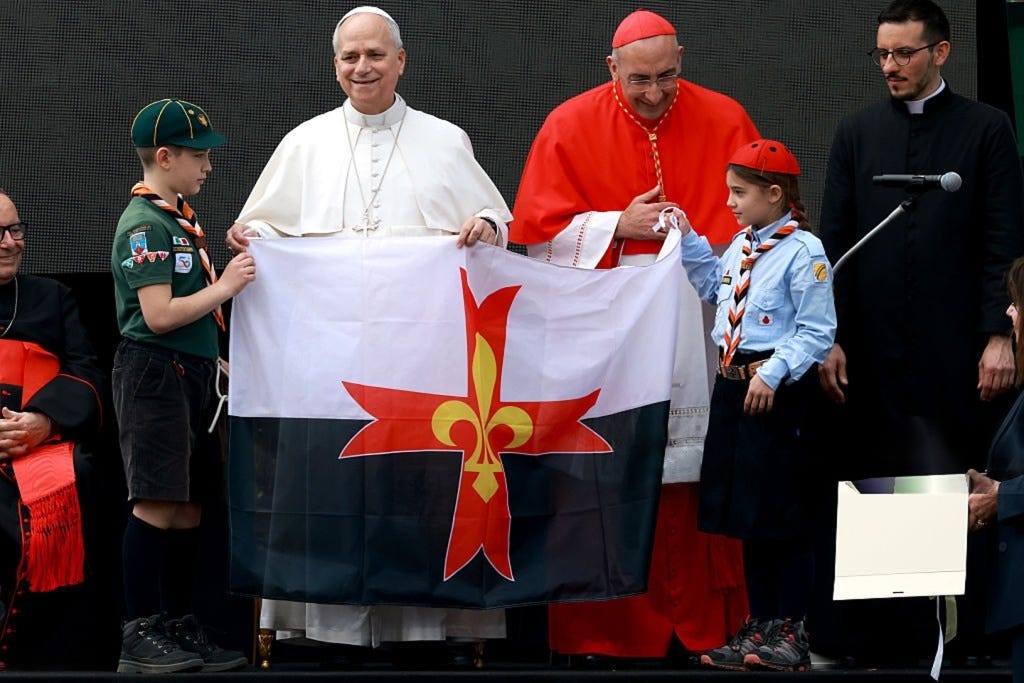
The encounter at the well seems to give us an organizing principle to this pontificate: Jesus chose to see a woman the world told him to ignore. Pope Leo XIV is choosing to see a war that Washington would rather not reckon with, a neighborhood abandoned for decades, and a young woman whose embrace was worth more than any diplomatic communiqué issued that day.
The question that Catholic doctrine poses to Washington right now has a devastating simplicity: if 1,230 dead Iranians and 454,000 displaced Lebanese are not enough to open a space for dialogue, what number would be?
The first American pope is asking that question from the window of the Apostolic Palace, and no one in the White House has offered an answer.
At Letters from Leo, we stand with the millions of American Catholics — and countless others of goodwill — who believe that the encounter at the well demands something of us right now, today, as American bombs fall on Iran and a pope pleads for the voice of ordinary people to be heard.
In an era poisoned by cruelty and division, we remain rooted in a faith that refuses to flinch before injustice or bow to the idols of fear and authoritarianism.
We’re not just marking time. We’re making history.
This is the fastest-growing Catholic community in the country because people are hungry for something deeper than rage and cynicism.
They’re looking for courage, for truth, for love made visible in action — and right now, as the Vatican mounts its most sustained moral offensive against an American war since Iraq, that hunger has never been more urgent.
If you’re ready to build a country — and a Church — that chooses attention over indifference, dialogue over destruction, and the dignity of every person over the logic of annihilation, then I’m asking you to join us.
If you’d like to invest in our mission, here are three ways you can help this Lenten season:
Subscribe as a paid member to receive exclusive posts about the life and formation of Pope Leo and help sustain this newsletter.
Donate with a one-time gift to fuel this project’s mission.
Share this post (and Letters from Leo) with a friend who might enjoy it.
Paid subscribers have access to our Lenten Reflection Series, the biographical deep-dives into Pope Leo’s life, and the Q&A mailbag, where you can ask me anything about American politics, Catholicism, Donald Trump, Pope Leo, JD Vance — or my own faith, biography, and life.
Whether you give $0, $1, or $1,000, your presence here matters — no matter your faith or your politics.
Thank you for reading. I’ll see you on the road.
I read about Archbishop Caccia and was very impressed. Trump won’t pay attention to him but maybe Rubio who supposedly is Catholic will. Another American soldier died from a military base in Saudi Arabia being attacked. I am very concerned about our nation. We’re no longer the super power who helped others. Now we’re a rogue nation that wants to take over everything. Trump has explicitly said he wants Cuba. For what? I pray daily that this war stops. It reminds me of Vietnam where we learned the government lied to us.
Your transmission of the words of Pope Leo inspires me. Do you know how I can find a group of lik-minded Catholics in San Francisco? Rumor has it this is a very conservative, kinda Opus Dei, archdiocese at the top.