
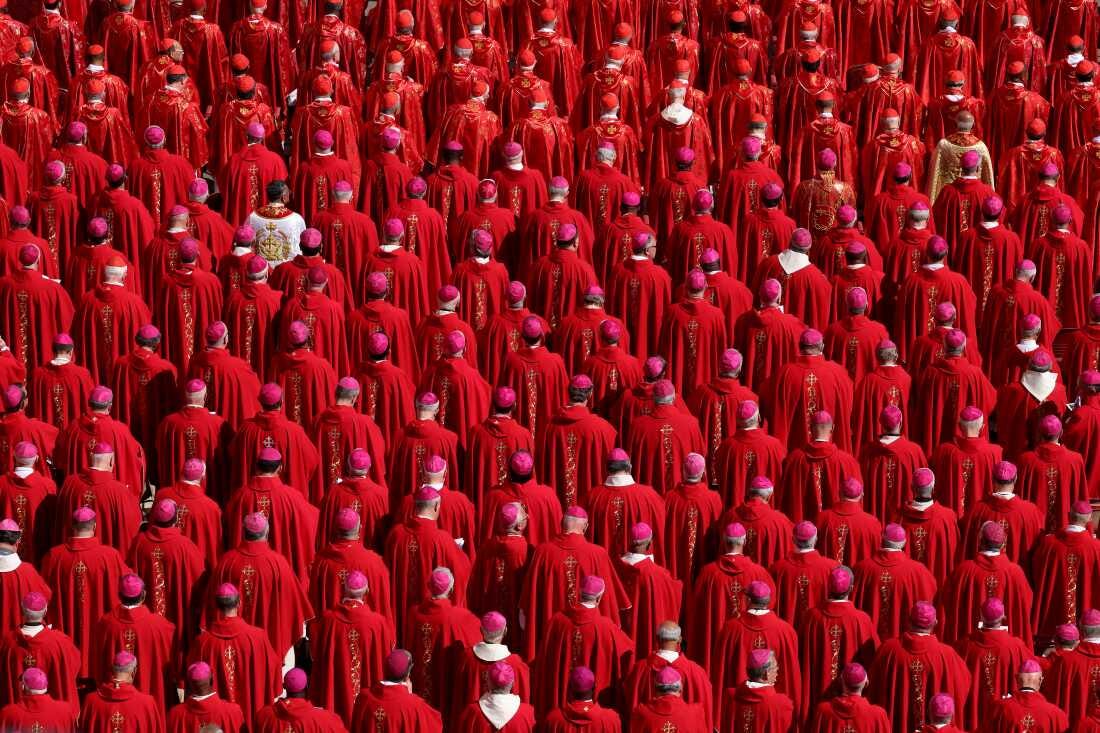
What I Saw — And Felt — At Pope Francis’s Funeral
One year ago today, I stood on the colonnades of St. Peter's Basilica as the Church laid Francis to rest. I'm republishing my Newsweek essay from that morning.
Letters from Leo is a reader-supported community chronicling the first American pope and the moral collision between Rome and Washington. If you believe in this work, please consider subscribing or making a one-time gift below.
Dear friends —
One year ago today, I stood on the colonnades of St. Peter’s Basilica as the Church laid Pope Francis to rest.
I wrote the essay below for Newsweek that morning, in the hours after watching his wooden casket carried back into the basilica where Peter’s bones still lie.
I’m republishing it here on the anniversary of his funeral because the question Francis left us — whether we will live the Gospel he preached — has only grown more urgent in the twelve months since.
Pope Leo XIV now carries Peter’s ring. The mission he inherited from Francis is the same one Francis entrusted to every one of us.
Standing atop the colonnades of St. Peter’s Basilica this morning, I looked out over the hundreds of thousands gathered below and realized something astonishing: I was standing on the same hill where Peter himself — crucified upside down by Nero Caesar — died 2,000 years ago.
Today, Caesar’s empire is long gone. Peter’s Church remains. And today we were celebrating the remarkable life of his 265th successor.
For me — and for countless Catholics who have navigated the messy terrain of early adulthood into middle age — Francis was not just the Bishop of Rome. He was the pastor who showed us how to have an adult faith. How to follow Jesus even when life gets complicated. How to embrace our doubts rather than fear them.
I still remember his words from the first Sunday of Francis’s papacy in 2013: “God never tires of forgiving us.”
That line became a refrain for me, resurfacing during moments of failure, confusion, and distance from God. In an age where mercy often feels in short supply, Francis insisted there was no bottom to God’s well of forgiveness.
He did everything he could to keep us in the faith. And he made it clear: bad Catholics were welcome. Strugglers were welcome. Sinners were welcome.
The Eucharist, Francis taught, was not a prize for the perfect but “medicine for the sick.” For a generation raised to believe that holiness was synonymous with flawlessness, Francis offered something radically different and deeply freeing: a Christianity rooted in the grace of mercy.
In his every move and gesture, Francis embodied the heart of the Gospel. His famous pectoral cross, a simple image of the Good Shepherd carrying a lost sheep on his shoulders, wasn’t just a personal emblem. It was his mission statement. He was the pope who left the ninety-nine to go after the one.
For those of us who have ever felt like the one — the doubtful, the sinful, and the disillusioned — he was our pope.
The funeral itself was simple, almost jarringly so for a global figure of Francis’s magnitude. That was fitting. Francis lived by the idea that greatness is found in humility, not spectacle. His wooden casket was adorned only with the symbols of faith, hope, and love. His legacy was not built on grandiosity but on the small, stubborn acts of love and tenderness he encouraged in each of us.
From the start, Francis the Troublemaker unsettled both the world and the Church — not by chasing controversy, but by daring to act as if the Gospel were true. He stripped himself of his office’s trappings. He carried his own bags. He paid his own hotel bill. These simple actions weren’t about public relations; they were about reminding us who we are called to be: servants, not princes.
Over the years — through moments of faith and virtue, and stretches of doubt and vice — Francis reminded me that the Christian life isn’t a straight line. It’s a path walked by sinners who dare to believe they are loved anyway, and who keep walking because of it.
He showed us that hope has feet. It moves, even if haltingly, even if imperfectly. One inch forward, he said, is more pleasing to God than standing still. Francis taught us that stumbling forward in hope is itself an act of faith.
He made clear that the Church isn’t a museum for the virtuous but a field hospital for the wounded. In a polarized, often brutalized age, that vision has been both scandalous and salvific.
As his casket disappeared into the Basilica, I noticed something striking: the usual chants of “santo subito” — “sainthood immediately” — never rose up.
It made sense. Francis never sought canonization. He didn’t want a pedestal; he wanted us to get closer to Jesus.
There’s a quiet providence in the fact that he came from the only major Catholic religious order named not for its founder, but for Christ himself. Like his Jesuit brothers, Francis wasn’t building a movement around his own life. He was leading us back to the source of the faith itself.
In a Church that tends to obsess over its very self, I find it striking just how often Francis would utter the name of Jesus. It echoes what he said in his short “Gettysburg Address” before the 2013 conclave: the Church had become too self-referential, too caught up in itself, and needed to rediscover its true mission — to spread the joy of the Gospel.
Beneath the marble of St. Peter’s Basilica, Peter’s bones still rest. His spirit still moves through the Church he founded. Francis — the 265th since Peter to carry his office — tended that spirit with a fierce and stubborn hope.
On that ancient hill where a tyrannical empire once tried to crush the faith, we gathered not to bury a failed project, but to celebrate a victory that keeps echoing through the centuries.
If the Francis revolution has begun, it is not a matter of monuments. It is a matter of memory, mercy, and movement — and it is ours now to carry forward.
At Letters from Leo, we stand with Pope Francis and his successor, Pope Leo XIV.
One year after the Church carried Francis’s casket back into St. Peter’s, the world the new pope has inherited is crueler than the one his predecessor left him, and the Gospel he is called to preach is more urgent for it.
This community exists because readers like you believe Catholic witness in the public square must still be rooted in mercy for the wounded, a preferential love for the poor, and a Church that walks with its people rather than lording over them.
In an era poisoned by authoritarianism and cruelty, we remain rooted in the faith Francis embodied — a Gospel that refuses to flinch before injustice, rejects every idol of fear and power, and holds to the conviction Francis voiced in Spanish to the very end: todos, todos, todos.
This is the fastest-growing Catholic community in the country because people are hungry for something deeper than rage and propaganda.
They’re looking for the kind of leadership Francis lived and Pope Leo XIV is now extending into a darker hour — proximity, tenderness, courage — and on the anniversary of the day we laid Francis to rest, that hunger has never been more urgent.
If you believe this movement matters — Catholics and people of goodwill standing for human dignity against a rising authoritarianism that would crush the very people Francis spent his papacy defending — I am asking you to join us.
If you’d like to invest in our mission, here are three ways you can help this Easter season:
Subscribe as a paid member to receive my full biographical series on the life and formation of Pope Leo XIV, my ongoing investigations, and the full archive of my writing on Pope Francis’s papacy and legacy.
Donate with a one-time gift to fuel this project’s mission.
Share this post (and Letters from Leo) with a friend who is carrying Francis’s memory with them today.
Paid members receive my full biographical series on the life and formation of Pope Leo XIV, the American pope who now carries Francis’s mission into a new era. You’ll also get access to exclusive investigations, including my ongoing Epstein-Bannon Investigation, and the best of our full archive.
Whether you give $0, $5, $50, $500, or more, your presence here matters — no matter your faith or your politics.
Thank you for reading. I’ll see you on the road.


I love the humility and generosity he always showed. I remember the photo of his shoes, the black well-worn shoes, in the casket. Not fancy or well-polished. He spoke lovingly of Jesus, as a person who truly KNEW Jesus. Mercy and compassion were his way of being like Jesus.
Thank you for writing this. Because of Pope Francis I came back to the church. I was encouraged by his love for all, like Jesus. Perfection wasn't required. 🙏🏽✨️