


Thank you for reading! Letters from Leo is a reader-supported publication and the fastest-growing Catholic community in the country. To receive new posts and support this movement, consider becoming a free or paid subscriber.
Pope Leo XIV’s first full day in Argentina ran from a home for people with disabilities at dawn to Pope Francis’s old cathedral after dark, so we’re covering it in two parts. This is Part One: the morning in Claypole and the Mass in Palermo. Part Two follows the afternoon and evening, from the Catholic University to Vespers.
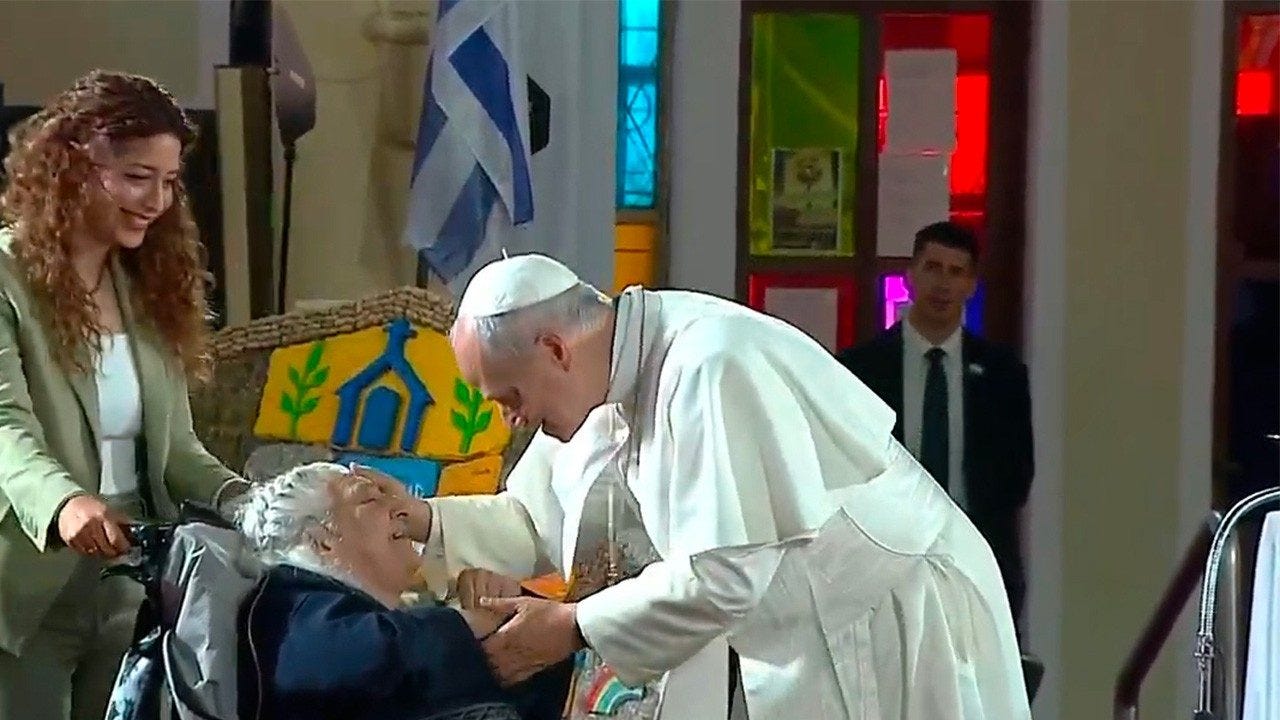
Marta Griselda Torres was born with cerebral palsy and, by her own account, abandoned before her first birthday. On Monday morning, from her wheelchair in the chapel of the Pequeño Cottolengo Don Orione in Claypole, she handed Pope Leo XIV the book she wrote about her life.
“I give it to you in thanksgiving to God for giving me so many things,” she told him. “Many crosses, but many gifts.”
Leo listened with his hand pressed over his eyes. When she finished, he bent down, took both of her hands, and wiped away tears.
The Cottolengo was the first stop of Leo’s first full day in Argentina, and the choice was deliberate. Opened by the Italian priest St. Luigi Orione in 1936, it is home to about 410 adults with intellectual and physical disabilities on the southern edge of Greater Buenos Aires. Milei’s government has kept it waiting. The home is owed about a year of public funding, and authorities have paid roughly $535,000, enough to cover four months.
Argentina’s Congress overrode Javier Milei’s veto last year to raise funding for disability care, a law the president still opposes. Before the visit, the home’s religious director, Jorge Silanes, told Reuters the pope’s stop carried added weight because spending cuts had reduced disability benefits while poverty remained widespread.
Leo said nothing about the budget. He spoke to the residents instead, and what he said read like a rebuttal anyway: “Your lives are not a burden on society. They are a blessing, because you can help us to remember the foundation of the dignity of every human being.”
A nation’s progress, he went on, “is also measured by how it welcomes all people with disabilities and particular needs.” He warned that modern societies are “often driven solely by the pursuit of economic success or the cult of outward appearance.” Then he told Argentina what he hoped it would become.
That wish (“where the love of Christ triumphs over individualism and exclusion”) is the best key I know to this entire trip. Leo’s itinerary reads like a map of the Argentines the economy has left behind, and he is visiting them in person, one group at a time.
On Tuesday in Córdoba, after a Mass for an expected 700,000 people, he will meet privately with 20 people chosen by the archdiocese, among them men and women living on the street, women who run community soup kitchens, and people fighting gambling addiction. Wednesday begins at 8 a.m. inside the Federal Penitentiary Complex, with the prisoners, before his farewell Mass at the Basilica of Our Lady of Luján.
Two and a half million in Palermo
By late morning, Leo was back in the capital for the largest crowd of his pontificate. The Vatican put it at 2.5 million people, stretched for miles down the Avenida del Libertador around the Monumento de los Españoles, the same ground where St. John Paul II drew about 2 million people in 1982. Families had camped there since midnight, and the government declared a national holiday.
Milei sat in the front row beside his sister, Karina Milei, the secretary-general of the presidency. Some in the crowd booed when he arrived. His estranged vice president, Victoria Villarruel, never made it inside; she said her office “never received the QR” code needed to pass security (the government insists she was invited).
Leo preached on the families sitting in front of him. Their homes, he said, often face “instability, social hardship, precarious employment, domestic violence, painful separations and addictions that destroy young people’s futures and damage family relationships.” He listed every one of them with the president of the republic in the front row.
He also asked the crowd to hold on to what they have. “Do not give in to those who dismiss the Christian family as outdated,” he said. “On the contrary, today more than ever, it remains a pillar amid the many insecurities of our time.”
Then he reached Francis. “Our beloved Pope Francis, who was Bishop of this city,” Leo began, and the avenue erupted. He stopped, visibly moved, and waited out roughly ten seconds of applause before he could finish the sentence. Francis never came home in twelve years as pope, and Leo spent Sunday night quoting him to Milei’s face. On Monday, Francis’s people answered for him.
Not everyone was welcome near the altar. Ahead of the Mass, security forces cleared more than 100 homeless people out of the Palermo parks where they sleep, a local outlet found. On Tuesday, the pope will sit down with homeless men and women in Córdoba anyway.
A different measure of progress
Americans have a stake in this argument. Milei is Donald Trump’s closest ally in Latin America, and last year Washington arranged a $20 billion currency swap to prop up his peso. Trump made the terms plain when Milei visited the White House in October 2025. “If he loses,” Trump said, “we are not going to be generous with Argentina.”
The first American pope has brought Argentina a different scale for judging a country, one that starts with a woman in a wheelchair holding out a book. Catholics back home seem to be weighing it too: they swung 21 points away from Trump’s party in last week’s midterms.
In his homily, Leo read from Ezekiel’s vision of the river that flows out of the temple and down into the Dead Sea, where nothing grows. Wherever that water reaches, the prophet says, life comes back. Monday was the pope carrying that water to the edges of Buenos Aires, beginning with the people a government budget had marked as a cost.
At Letters from Leo, we stand with Pope Leo XIV, with Marta Griselda Torres and the 410 residents of the Cottolengo, and with every Argentine family carrying the weight the pope named out loud in Palermo.
The Gospel measures a nation by how it welcomes the weakest among us. A disability home waiting eight months for its money fails that test, whatever the budget surplus says.
This is the fastest-growing Catholic community in the country because people are hungry for a Church that walks into the places power forgets, the way Leo did on Monday, and calls the people there a blessing.
If you believe this movement matters — Catholics and people of goodwill standing for human dignity against an economy that treats the vulnerable as a burden — I am asking you to join us.
If you’d like to invest in our mission, here are three ways you can help:
Subscribe as a paid member to receive exclusive posts about the life and formation of Pope Leo and help sustain this newsletter.
Donate with a one-time gift to fuel this project’s mission.
Share this post (and Letters from Leo) with a friend who might enjoy it.
Paid subscribers sustain our series on Pope Leo’s life and formation, including his two decades in Peru, where this trip ends next week, along with our Sunday Scripture Reflection Series.
Whether you give $0, $5, $50, $500, $1,000, or more, your presence here matters — no matter your faith or your politics.
Thank you for reading. I’ll see you on the road.

Indeed, the disabled are not a burden. God bless Marta and all human beings with disabilities. We are so fortunate to have Pope Leo shining his light upon the darkness around us. The greed of those who have the power, authority, and resources to provide the necessary supports for disabled people is beyond reprehensible.