


Thank you for reading! Letters from Leo is a reader-supported publication and the fastest-growing Catholic community in the country. To receive new posts and support this movement, consider becoming a free or paid subscriber.
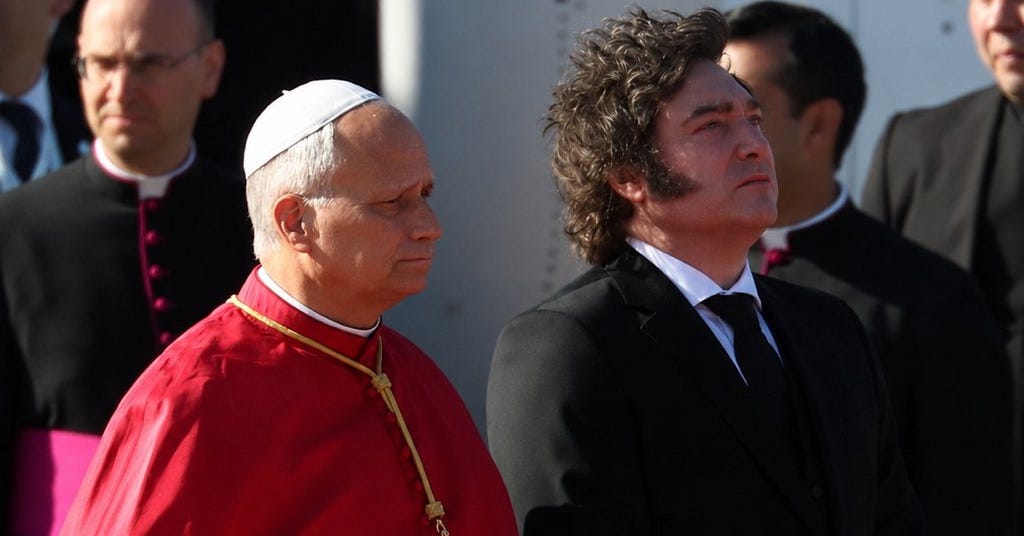
Pope Leo XIV stood across a stage from Javier Milei inside the Palacio Libertad in Buenos Aires on Sunday evening and told Argentina’s president what an economy is for. “The economy must serve the person, not the person the economy,” he said.
Milei applauded, and so did the lawmakers and diplomats packed into the hall. On national television the ovation grew loud enough that Leo had to repeat the line that came next: “Those who exercise authority have a duty to act with prudence, to acknowledge the limits of the power entrusted to them.”
It was the first speech by a pope on Argentine soil since St. John Paul II came in 1987, and Leo used it to name the people Argentina’s government has been asking to wait.
He began the day in Uruguay, celebrating Mass in the city of Florida before the small cedar image of Our Lady of the Thirty-Three. There he asked the faithful to pray for those who govern, “that they may seek with integrity the good of all.” It closed a three-day visit in which he told Uruguay that everyone deserves health care and then blessed Montevideo’s poorest families in Casavalle without a script.
By sundown he was in Milei’s capital, and “the good of all” had names. Leo said he was thinking of families carrying the weight of uncertainty, of people looking for work, and of the elderly who spent years helping to build Argentine society. Then he added a group that rarely gets mentioned out loud in Argentine politics: “all those who, despite hard work, nonetheless struggle to meet their household’s needs.”
Every one of those groups is easy to find in Milei’s Argentina. His austerity produced a budget surplus and brought annual inflation down from more than 200% to about 32%, but real wages are still lower than when he took office in late 2023, and roughly 300,000 formal jobs have disappeared. Retirees living on pensions that average about $510 a month have protested outside Congress every Wednesday for more than two years. University funding has fallen by about 40%.
Milei’s answer to people in that position has been contempt. He has called social justice “a moral aberration” and “theft,” dismissed complaints that families can’t make it to the end of the month as “huge stupidity,” and branded his critics “human trash.”
Argentina’s bishops have not stayed quiet. Of 44 public documents their conference released between January 2024 and September 2026, 42 criticized the Milei government. The loudest voice belongs to Archbishop Jorge García Cuerva of Buenos Aires, a former slum priest from La Cava whom Francis chose for his old see in 2023.
At the May 25 Te Deum, with Milei and most of his cabinet in attendance, García Cuerva told the country’s leaders to stop whipping up polarization. Alberto Benegas Lynch, one of Milei’s closest allies in Congress, answered that “some are campaigning in cassocks” for the return of Peronism. On July 9 the archbishop stood in the same cathedral and asked the government to end the insults and the cruelty.
Then, on Oct. 4, he closed the youth pilgrimage to the Basilica of Luján with a homily that quoted Pope Leo and spoke to a divided country. “The wounds of disqualification, of intolerance, of physical and verbal violence are festering,” he said. He named the grandparents, people with disabilities and their families, the unemployed, and those who think differently. “If the Virgin of Luján embraces all of us,” he said, “it is impossible to look at the other with contempt, because the other is my brother.”
Leo will celebrate Mass outside that same basilica on Wednesday morning, a few hours before he flies to Peru.
Milei’s own history with the Church has a strange shape. Before he took office, he called Pope Francis an “imbecile” and “the representative of evil on Earth.” Once in office, he flew to Rome, embraced Francis, and apologized. On Sunday, with Leo listening a few feet away, he called Francis “without a doubt, the most important Argentine in history” and said Francis “is not only immortal in heaven, but on earth as well.”
It is hard to say whether Leo was moved by the tribute. He answered it with Catholic social teaching, delivered calmly (and in Spanish) inside the president’s own house, and I found his words prophetic.
Francis never came home in twelve years as pope. Those who knew him said he feared being turned into a political football in a country split by la grieta, the bitter divide that has shaped Argentine politics for more than a decade. Leo walked into that divide on his first day. He gave the government credit where it was due, encouraging private initiative and anything that creates opportunity, and then he named the poor in front of the powerful.
That has been the pattern of this trip, and of his pontificate. He has pressed Donald Trump on migrants and the war in Iran; on Sunday he reminded a libertarian president that authority “is most authentic when it is exercised as service.” The man who took his name from the author of Rerum Novarum keeps returning to the worker whose wages don’t stretch and to the retiree standing outside Congress on a Wednesday. He saved his sharpest line for the young Argentines buying one-way tickets abroad.
“A nation must seriously ask itself where it has failed,” Leo said, “when its young people have to leave their homeland in order to make their dreams come true.”
On Monday morning he visits the residents of the Pequeño Cottolengo Don Orione in Claypole, a home for people with disabilities on the edge of Buenos Aires, before celebrating his first public Mass in the country.
At Letters from Leo, we stand with Pope Leo XIV and Archbishop García Cuerva, and with every Argentine retiree and young worker a pope named out loud on Sunday in front of the most powerful man in their country.
The Gospel never asks the poor to wait for an economy to finish its work. It asks the economy to serve them now, because every person carries a dignity no budget can measure.
This is the fastest-growing Catholic community in the country because people are hungry for a Church that speaks to power the way Leo did in Buenos Aires, calmly and in plain words, on behalf of families struggling to get to the end of the month.
If you believe this movement matters — Catholics and people of goodwill standing for human dignity against an economy that forgets the person — I am asking you to join us.
If you’d like to invest in our mission, here are three ways you can help:
Subscribe as a paid member to receive exclusive posts about the life and formation of Pope Leo and help sustain this newsletter.
Donate with a one-time gift to fuel this project’s mission.
Share this post (and Letters from Leo) with a friend who might enjoy it.
Paid subscribers sustain our series on Pope Leo’s life and formation, including his two decades in Peru, where this trip ends next week, along with our Sunday Scripture Reflection Series.
Whether you give $0, $5, $50, $500, $1,000, or more, your presence here matters — no matter your faith or your politics.
Thank you for reading. I’ll see you on the road.

Fearlessly, Leo keeps going from strength to strength, lovingly caressing the children with outstretched arms and then speaking truth to power. May God keep him safe and healthy as he continues his journey.
Amén! 🙏🏼