


Thank you for reading! Letters from Leo is a reader-supported publication and the fastest-growing Catholic community in the country. To receive new posts and support this movement, consider becoming a free or paid subscriber.
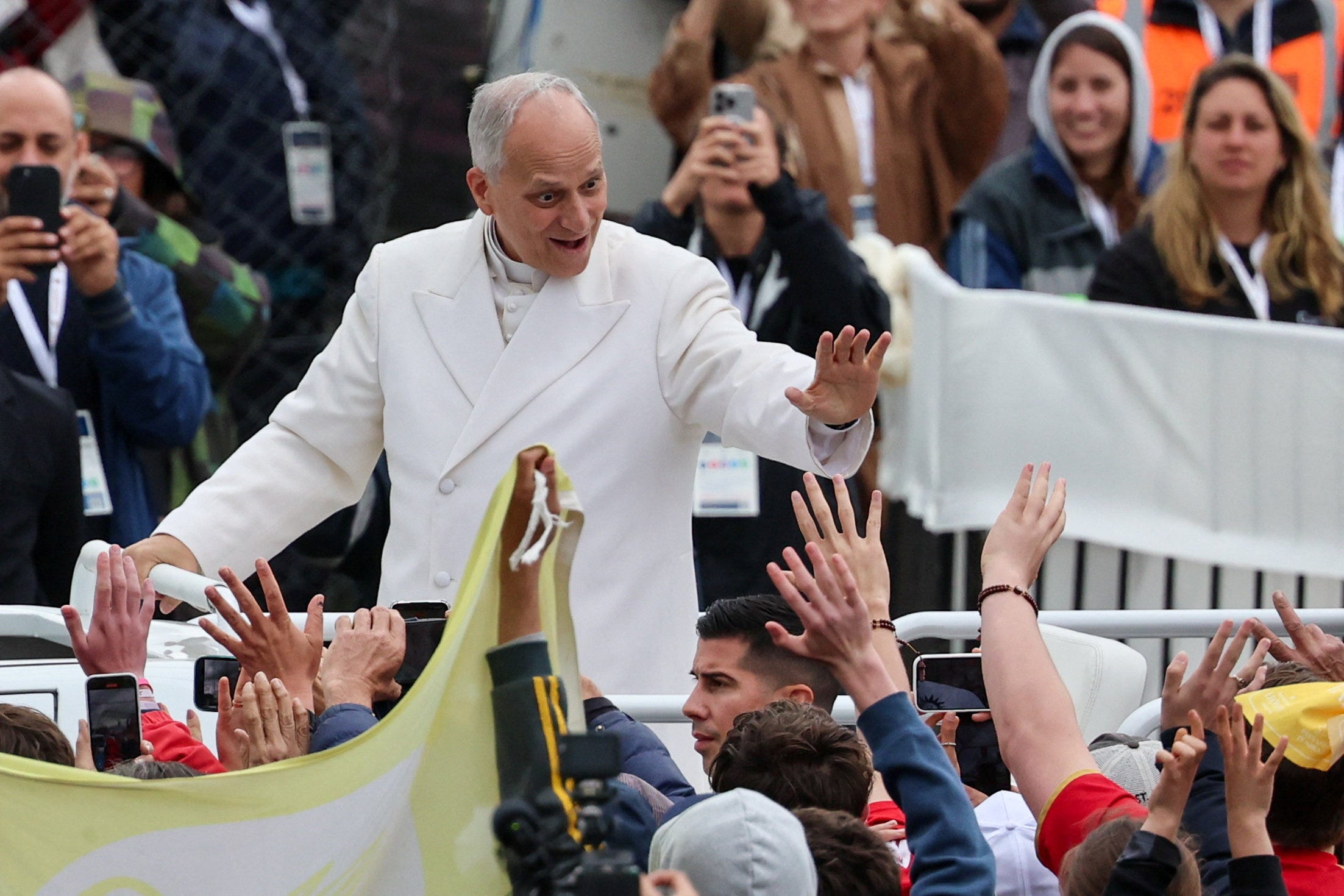
Pope Leo XIV told some 40,000 people in Paysandú on Saturday to be “builders of bridges,” then spent the rest of his first full day in Uruguay crossing a few of his own. He sat with elderly priests and walked through Casavalle, one of the poorest neighborhoods in Montevideo, before ending the night with young people at the Estadio Centenario.
The American pope, 25 days removed from lung cancer surgery, kept setting his script aside to talk to the people he met. Uruguay, a country of 3.5 million that the AP calls South America’s most secular, had not welcomed a pope since John Paul II came in 1988.
A bridge, and a gourd of mate
The day began in rain at Parque París Londres in Paysandú, a river city facing Argentina, where about 40,000 people (many had crossed the border to get there) attended his first Mass in South America as pope. Leo built his homily around the symbols of the place. He pointed to the General Artigas International Bridge over the Uruguay River and told the crowd, “That is why it is so important to be builders of bridges!”
Then he turned to mate, the bitter tea Uruguayans pass from hand to hand in a single gourd.
“Mate is a sign of familiarity, friendship and encounter,” he said. “It teaches us to share and to be together, strengthening the bonds that unite us as brothers and sisters.” When he added that mate “has even made its way to Rome,” the park laughed.
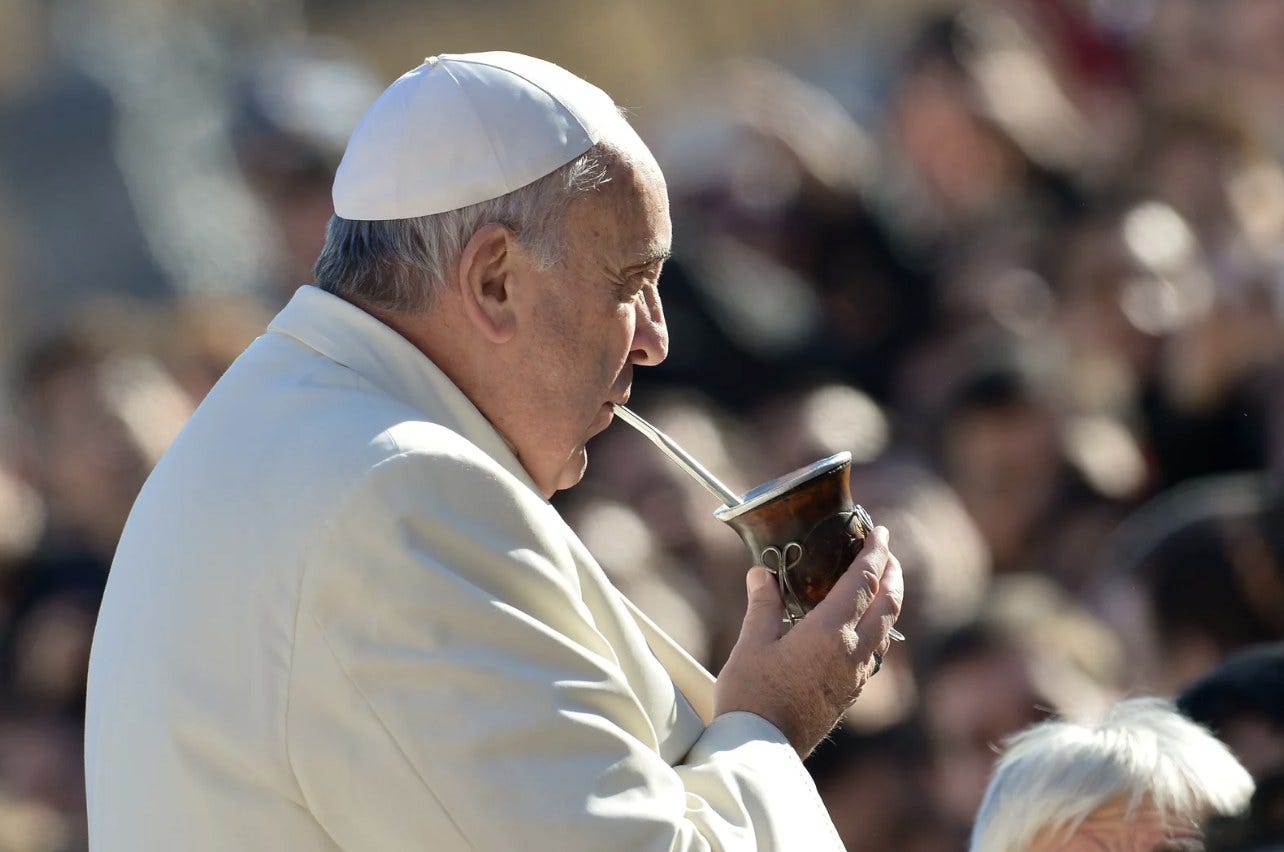
It was a nod to Pope Francis, the Argentine pontiff who loved mate and sipped from gourds that pilgrims handed him in St. Peter’s Square. He was, I suspect, looking down from heaven with a smile.
Jorge Monzón, a 64-year-old Paysandú resident who told the AP he is not religious, said the homily won him over anyway. “I personally felt a sense of communion,” he said.
Leaving the city, Leo stopped to pray in the Basilica of Our Lady of the Rosary and spoke off the cuff to the crowd outside. “We are united because we believe in one God,” he said, “and we believe that peace is possible, and we want to build peace.”
Twenty old priests
Back in Montevideo, on his way to Casavalle, the pope made a brief stop at the Hogar Sacerdotal Monseñor Jacinto Vera, a home for about 20 elderly and ailing diocesan priests. He greeted each man individually, and together they prayed the Our Father before he gave his blessing.
According to the Vatican, he spoke to them about “the absolute value of life, even when it is weakened by age or illness.”
From there he drove to Casavalle, a neighborhood on the city’s northern edge where, according to America, 46 percent of Montevideo’s 98 homicides this year have taken place.
He walked past houses roofed in corrugated metal and blessed 12 new homes the parish built for poor families. Before he even reached the stage, he stopped to bless the families of Casavalle in his own words.
In his prepared remarks, after a mother wept describing the years she raised a child while homeless, he named what the neighborhood lives with.
“We cannot turn a blind eye to the fact that there are children in Uruguay who do not go to school for fear of never returning home,” Leo said.
A child in a land so rich in resources, he added, “should not have to go to sleep hungry.”
The Casavalle blessing fit a pattern. On Friday night, after Vespers at the cathedral, he came out onto the balcony of the apostolic nunciature to greet the crowd below and told them, “I see that Uruguay is a country of young people with faith.”
Eighteen months into his pontificate, Leo has grown increasingly comfortable setting the page aside, as he did in July when he told 200 of Rome’s poor that he had come without a speech.
The person before the algorithm
At the Jesuit-run Catholic University of Uruguay, which John Paul II visited 38 years ago, Leo asked educators to use technology wisely, “placing the person before the algorithm.”
He warned that a culture which attributes “intelligence” to computational systems can struggle to see the dignity of people whose productivity has faded, an argument he pressed on Silicon Valley four days earlier when he insisted that machines are tools, not persons.
“Those who listen,” he told the room, “recognize others as a blessing, not as a threat.”
Afterward he leaned out of an upper window above the courtyard, where students had gathered, and spoke without notes. “I have a great desire in my heart,” he told them. He hoped the enthusiasm they felt that afternoon would stay with them every day, and that they would become “the voice Uruguay needs.”
A night at the Centenario
The vigil filled the stadium where Uruguay won the first World Cup in 1930. Local authorities, as reported by EWTN, counted about 100,000 people, roughly 70,000 inside and 30,000 more outside.
Anyone who watched the 15,000 young Lebanese who cheered him in the rain at Bkerké, or the 600,000 who filled Madrid’s Castellana to pray with him in June, would have recognized the scene, and the same goes for the young Catholics of secular France who greeted him like a rock star in September.
Leo spoke to them as the minority they are. “God chose Bethlehem,” he said, “and that choice is enough for us not to confuse smallness with insignificance.” He urged them to marry and raise families. “Do not be afraid of ‘forever’!” he told them.
Then the stadium sang the Salve Regina, and the pope, standing before a white statue of the Virgin Mary, was visibly moved.
Leo stepped onto the loggia of St. Peter’s in May 2025 asking the world to build bridges, and Americans still fighting over a border wall could hear in Paysandú a homily meant for us, too. On Saturday he carried that message, with a scar on his lung, to old priests and frightened children before ending the night with the young. Hours earlier, beside the river, he had told Uruguay what he expects of it: “Christ is counting on all of you!”
At Letters from Leo, we stand with Pope Leo XIV and the Church he is calling out of its comfort, into the streets of Casavalle and the rooms where old priests wait out their final years.
We believe a child who goes to bed hungry is a wound on the whole body of Christ, and that a society measured by productivity will always find a way to discard the old and the sick.
People of faith and countless others of goodwill are hungry for a Church that crosses the bridge first. They want shepherds who make time for a home of retired priests and who bless a poor neighborhood without needing a script. That hunger is why this community keeps growing.
If you believe this movement matters — Catholics and people of goodwill standing for the dignity of every person against a culture that discards them — I am asking you to join us.
If you’d like to invest in our mission, here are three ways you can help:
Subscribe as a paid member to receive exclusive posts about the life and formation of Pope Leo and help sustain this newsletter.
Donate with a one-time gift to fuel this project’s mission.
Share this post (and Letters from Leo) with a friend who might enjoy it.
Paid members receive our ongoing series on Pope Leo’s Life & Formation, which traces the missionary years in Peru that shaped the man now walking through Montevideo, along with our reporting on Pope Leo Takes On AI.
Whether you give $0, $5, $50, $500, $1,000, or more, your presence here matters — no matter your faith or your politics.
Thank you for reading. I’ll see you on the road.

Your writing is inspiring to be the hands and feet of Jesus. Maybe not as grand as Pope Leo XIV but at our local level. 🙏🏼🙏🏼🙏🏼
Thank you for wonderful newsletter, Chris. Pope Leo is a very inspiring person, to spend time with the poor. I will continue to pray that his health improves. I will also pray that this nation will receive a new healing in itself. I will pray for this.