


Thank you for reading! Letters from Leo is a reader-supported publication and the fastest-growing Catholic community in the country. To receive new posts and support this movement, consider becoming a free or paid subscriber.
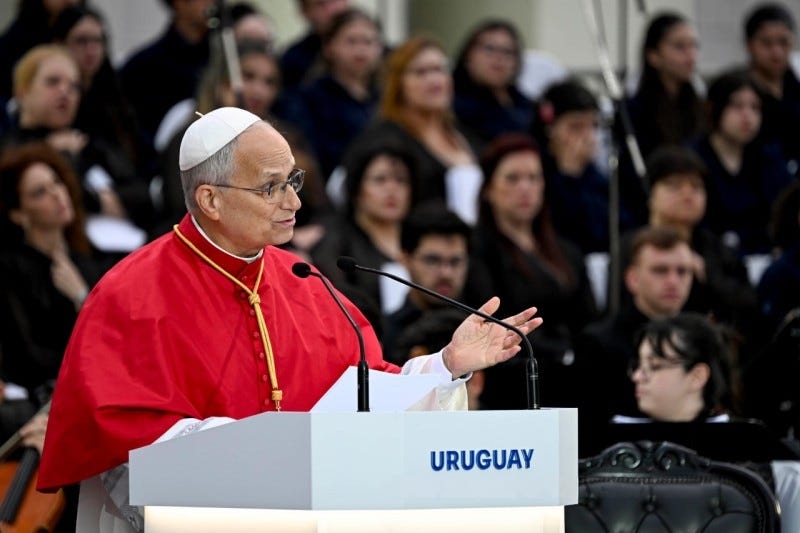
Pope Leo XIV stood before Uruguay’s leaders in Montevideo on Friday, 24 days after surgeons in Rome removed the lower lobe of his right lung, and told them what cancer had taught him.
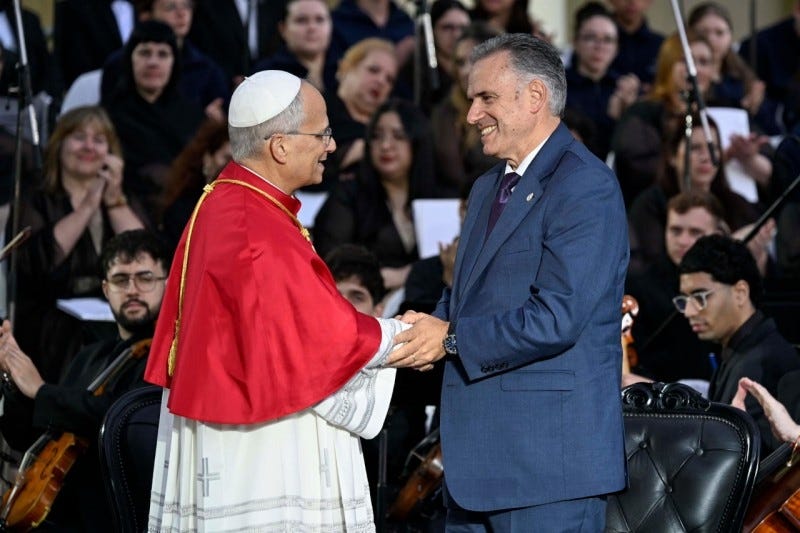
“Recently I experienced firsthand the limitations imposed by illness and I received care for which I am deeply grateful,” the pope said at Plaza Independencia, speaking in Spanish to President Yamandú Orsi, government officials, civil society leaders, and the diplomatic corps.
Then he turned that gratitude into a demand. “Ensuring that healthcare is accessible to everyone, regardless of their resources, is a duty that confronts every society,” Leo said.
It was the first papal visit to Uruguay since John Paul II came in 1988. The Vatican estimated 30,000 people turned out for the welcome, and crowds along the motorcade route chanted “Pope Leo, Uruguay is with you!” as the 71-year-old rode past in an open-sided popemobile.
A month ago, few people would have bet on that scene. When the Vatican confirmed his adenocarcinoma diagnosis on Oct. 13, the 12-day journey through Uruguay, Argentina, and Peru looked doubtful, and Cardinal Pietro Parolin said the pope might have to “adjust his pontificate.”
“Maybe better”
Leo addressed the doubters himself on the 13½-hour flight from Rome. Walking to the back of the plane to greet the 80 journalists traveling with him, he told them, “I confess that from the first day, I had no doubt and was convinced that this trip had to go forward.”
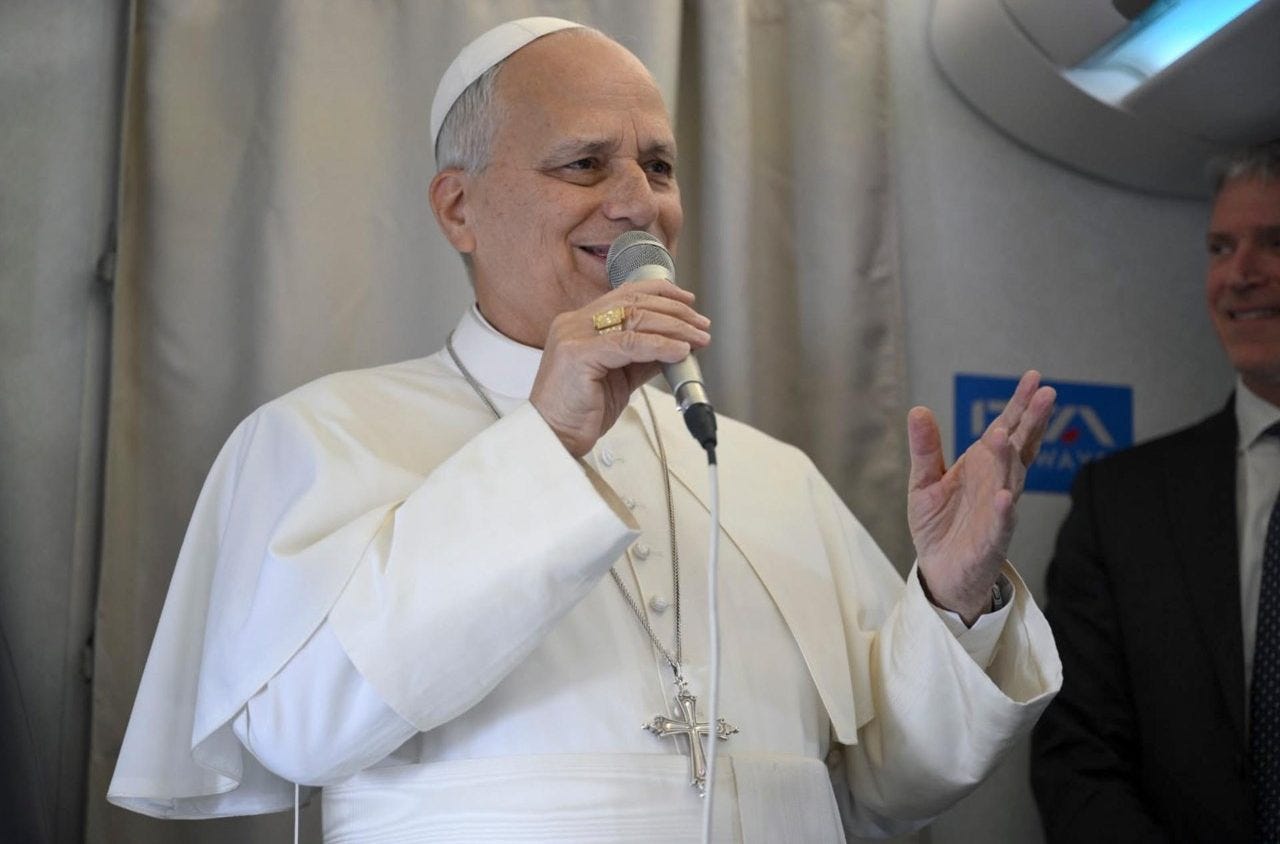
A reporter asked whether he felt as good as he looked. “Maybe better,” the pope answered, and the reporters laughed. He credited his recovery to “trusting God, good doctors, good surgeons, and overall I think a healthy lifestyle.”
The doctors at Rome’s Gemelli Hospital have their own way of describing him. Professor Stefano Margaritora, the thoracic surgeon who operated on Leo, told a story about the second day after the operation, when the staff turned around and found the pope arranging the chairs in the hospital chapel himself.
When the staff offered to take over, Leo told them, “It doesn’t matter. I can do it, so I will.” As Margaritora put it, “He really was an absolutely ideal patient.”
That patient was back at his Angelus window five days after surgery, and on Oct. 21 his doctors confirmed the tumor had been localized and that he would need no further cancer treatment.
What his own illness taught him
Leo knows how rare his outcome is. Doctors caught the nodule early during a routine checkup, and after Gemelli’s chief of thoracic surgery removed it, he was home at the Vatican within four days. Millions of sick people around the world never get a scan at all.
He said as much on Friday, telling the crowd that his own care made him think of the “many men and women who lack the means to obtain a timely diagnosis.” Then he put the obligation on everyone in the square. “It is everyone’s responsibility to ensure that each person can live with dignity,” he said.
This was not a new theme for him. In February, Leo told the Pontifical Academy for Life that “healthcare is not a consumer good but a universal right,” as I reported at the time. A month later, he called universal coverage “a moral imperative for societies that wish to call themselves just.” He is the first pope from a country that still has no universal health coverage, and his own illness has only sharpened the point.
Leo did not separate that claim from the rest of the Church’s teaching on life. “The unborn already belong to the human family and to the future of their people,” he said in a country that legalized abortion in 2012 and assisted dying last year.
He never named the euthanasia law. Instead, he spoke about suicide, arguing that good medical care, family ties, and closeness in the community cannot be pulled apart. “None should ever feel like a stranger among their own,” he said.
In Latin America’s most secular country (Uruguay’s official calendar calls Holy Week “Tourism Week”), Leo also made a quiet case for faith in public life. A neutral state, he said, “does not require that the religious dimension be confined to the private sphere.”
“Proud to be American”
Before any of that, the American reporters on the plane wanted to ask about something closer to home. On Oct. 30, the Vatican confirmed that Robert Prevost had mailed his ballot home to Will County, Illinois, making Leo the first pope in history to vote in a U.S. election.
Leo pointed them to that statement and added one line. “I am proud to be American and to exercise the right to vote,” he told them. He explained that he had not voted in Peru’s recent election, where he also holds citizenship, because there was no way to vote remotely.
He declined to comment on the results. Those results came in on Tuesday, when Democrats won control of both the House and the Senate, and an NBC exit poll found that Catholics swung 21 points away from Trump compared with 2024.
Nobody knows how Robert Prevost marked his ballot, and the Vatican has kept it that way. What it did say, in its Oct. 30 statement, is that the first American pope believes in “the right and the duty of citizens to participate in democratic processes.”
On Friday in Montevideo, that same citizen told every society that health care is owed to every person, whatever they can pay. In January, his own country will seat a new Congress with a fresh chance to answer him.
Leo will celebrate Mass in Florida, Uruguay, on Sunday morning before flying to Buenos Aires, where President Javier Milei awaits. The trip ends on Nov. 17 in Peru, where he served for two decades as a missionary and then as bishop of Chiclayo.
At Letters from Leo, we stand with Pope Leo XIV and with every sick person who has waited too long for a diagnosis they could not afford.
A pope three weeks out of cancer surgery flew across an ocean to say that a mother in Montevideo’s Casavalle neighborhood deserves the same care he received at Gemelli. The Church has taught as much since John XXIII listed medical care among basic human rights in Pacem in Terris, because the dignity of the human person does not depend on a bank balance.
This is the fastest-growing Catholic community in the country because people are hungry for a Church that speaks for the sick, the unborn, the elderly, and the lonely in the same breath, and refuses to sort them by who can pay.
If you believe this movement matters, with Catholics and people of goodwill standing for the dignity of every patient, I am asking you to join us.
If you’d like to invest in our mission, here are three ways you can help:
Subscribe as a paid member to receive exclusive posts about the life and formation of Pope Leo and help sustain this newsletter.
Donate with a one-time gift to fuel this project’s mission.
Share this post (and Letters from Leo) with a friend who might enjoy it.
Paid subscribers receive our ongoing series on Pope Leo’s Life & Formation, including his two decades in Peru, where he will finish this trip, along with our Sunday Scripture Reflection Series.
Whether you give $0, $5, $50, $500, $1,000, or more, your presence here matters — no matter your faith or your politics.
Thank you for reading. I’ll see you on the road.

Amen!!!🙏🏻♥️